
Mexican Jay Identification Guide
A plain, uncrested blue-and-grey jay of southwestern oak and pine-oak canyons, notable for living in cooperative family groups and lacking any facial pattern, streaking, or crest.
Read the full Mexican Jay encyclopedia entry →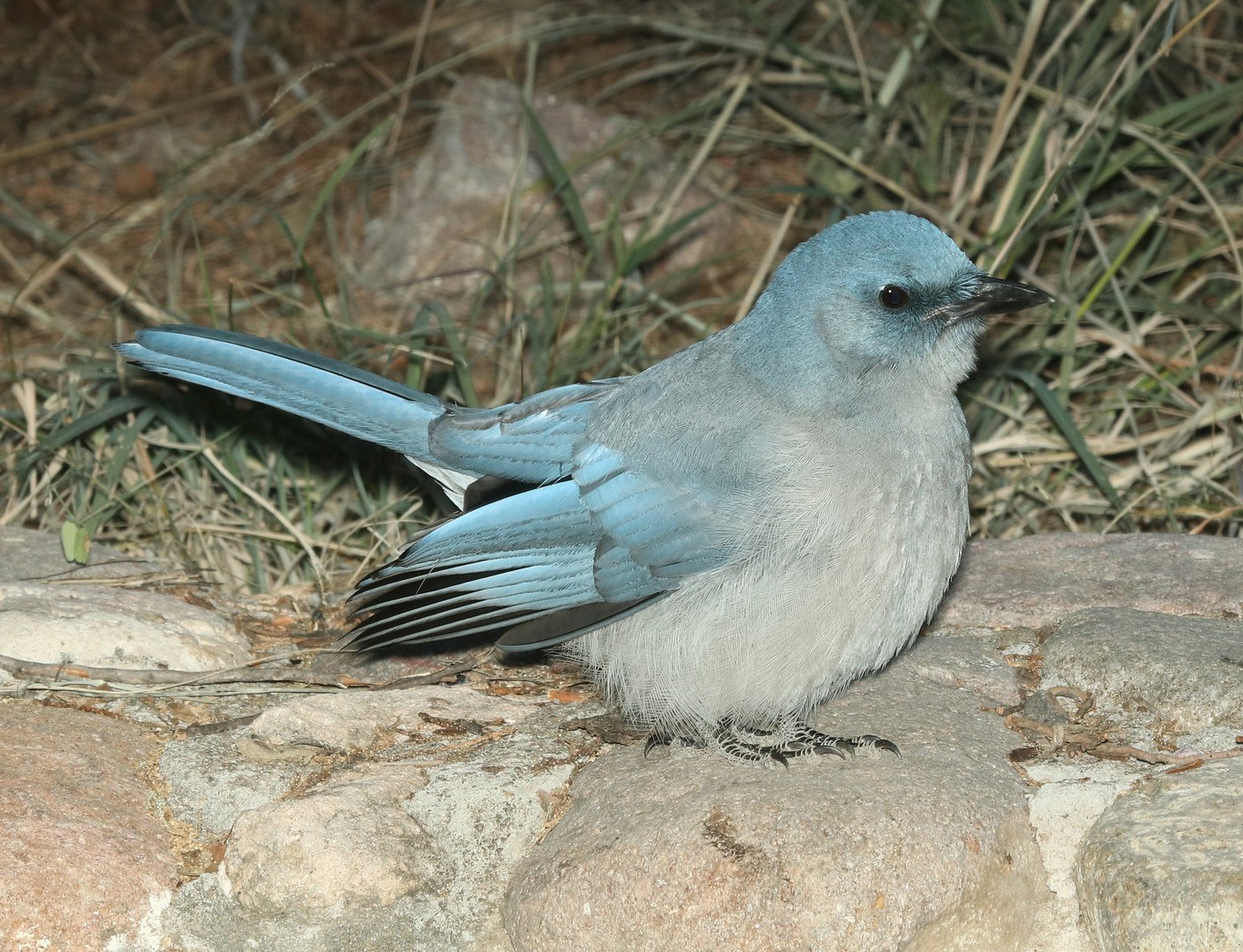
Key Field Marks
- Size & shape: A medium-large jay, about 29–31 cm (11.5–12 in) long, with a fairly long tail and no crest, distinguishing its silhouette from crested jays like Steller's Jay.
- Plumage: Overall dull blue on the head, wings, and tail, with a contrasting pale grey back and underparts and no bold pattern, streaking, or facial markings — an unusually "plain" look among jays.
- Bill: Stout, all-dark bill; juveniles show a pale/yellowish bill that darkens with age, a useful clue for aging birds within a family group.
- Behavior: Highly social, living in cooperative breeding groups/family flocks that forage, defend territory, and even help raise young together year-round — flocks of several to a dozen or more birds are typical.
- Voice-associated behavior: Frequently gives loud contact calls to keep the flock together while foraging through oak canopy and on the ground for acorns and insects.
Similar Species
- Steller's Jay (Cyanocitta stelleri): Has an obvious blackish crest and much darker, more uniformly blue-black plumage, easily separating it from the plain, crestless, pale-bellied Mexican Jay.
- Woodhouse's Scrub-Jay (Aphelocoma woodhouseii): Shows a distinct blue necklace/breast band and streaked throat, and a more contrasting white eyebrow/throat pattern, unlike Mexican Jay's uniformly plain grey underparts and lack of a necklace.
- California Scrub-Jay: Similar scrub-jay pattern with a blue necklace and white underparts, but occurs further west and shows more contrast than Mexican Jay's smooth, unmarked look.
Where & When to See It
- Range: Southeastern Arizona, southwestern New Mexico, western Texas (Trans-Pecos), and south through the highlands of Mexico.
- Habitat: Oak and pine-oak woodland in foothill and mid-elevation canyons, typically in the range of roughly 1,200–2,300 m (4,000–7,500 ft); a classic "sky island" and Madrean woodland specialist in the US.
- Season: Non-migratory resident year-round, with family groups holding stable territories across seasons.
Voice
- Gives a variety of loud, harsh, weezy calls, often a rising "wink" or "quink" note repeated by multiple flock members simultaneously, quite different from the sharper "shack" calls of scrub-jays.
Frequently asked questions
What is the easiest way to identify Mexican Jay?
Look for a plain, uncrested jay with dull blue upperparts, pale grey underparts, and no facial pattern, streaking, or necklace band, typically seen in noisy family flocks in oak canyons.
How is Mexican Jay different from Steller's Jay?
Steller's Jay has an obvious dark crest and darker, more uniform blue-black plumage, while Mexican Jay is crestless with a plainer, paler grey-bellied appearance.
Why does Mexican Jay live in flocks?
It is a cooperative breeder, living year-round in extended family groups that jointly defend territory, forage together, and often help raise young at shared nests.
Where in the US can Mexican Jay be found?
Southeastern Arizona, southwestern New Mexico, and the Trans-Pecos region of western Texas, in oak and pine-oak canyons of mountain 'sky islands.'