
Mexican Chickadee Identification Guide
A small, plain chickadee of high-elevation pine-oak forest, the only chickadee found in Mexico and, in the US, restricted to a handful of southeastern Arizona and southwestern New Mexico mountain ranges.
Read the full Mexican Chickadee encyclopedia entry →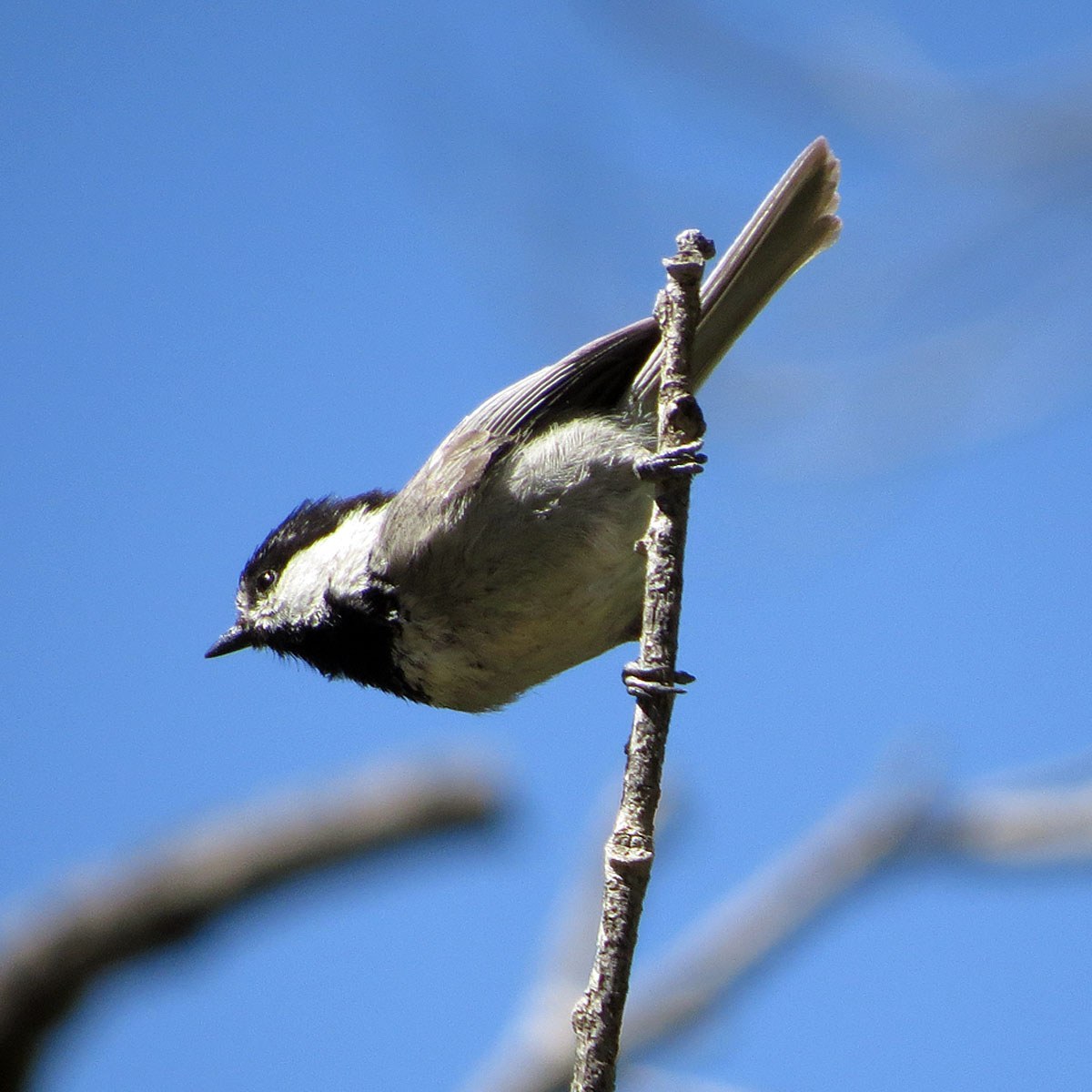
Key Field Marks
- Size & shape: A typical small chickadee, about 13 cm (5 in) long, with a round head, short neck, and a fairly long tail — overall shape similar to other North American chickadees.
- Head: Black cap and black bib (throat patch) separated by white cheeks, similar to the pattern of Black-capped and Mountain Chickadees, but the black bib is notably larger and extends further down onto the breast than in those species.
- Upperparts: Grey back, wings, and tail, lacking any strong contrasting edging.
- Underparts: Pale grey to whitish-grey below, generally lacking the buffy or warm tones some other chickadees show on the flanks.
- Bill: Small, thin, black chickadee bill.
- Behavior: Highly active, acrobatic forager typical of chickadees, often in small flocks moving through conifer and pine-oak canopy, frequently joining mixed-species foraging flocks with nuthatches, kinglets, and warblers.
Similar Species
- Mountain Chickadee (Poecile gambeli): Has a white supercilium (eyebrow stripe) above the eye, which Mexican Chickadee lacks entirely; ranges overlap only marginally at the northern edge of Mexican Chickadee's US range.
- Black-capped Chickadee (Poecile atricapillus): Smaller black bib restricted to the throat (not extending as far onto the breast), and occurs at lower elevations/more northerly latitudes than Mexican Chickadee's high sky-island range.
- Within its very limited US range, Mexican Chickadee is essentially unmistakable once the larger black bib and lack of eyebrow stripe are noted, since no other chickadee normally occurs alongside it there.
Where & When to See It
- US range: Extremely limited — found only in a few "sky island" mountain ranges of far southeastern Arizona (notably the Chiricahua Mountains) and adjacent southwestern New Mexico (Animas Mountains); considered a highly sought after specialty by US birders for this reason.
- Mexico range: More widespread in high mountains of the Sierra Madre Occidental and Sierra Madre Oriental south to about Oaxaca.
- Habitat: High-elevation coniferous and pine-oak forest, typically above roughly 2,300 m (7,500 ft), including spruce-fir, mixed conifer, and pine-oak associations.
- Season: Non-migratory resident year-round within its restricted mountain range habitat.
Voice
- Song is a simple, buzzy whistled phrase, generally lower and huskier than the classic "fee-bee" whistle of Black-capped Chickadee.
- Call is a harsh, buzzy "chick-a-dee-dee" typical of the genus, but often described as raspier or huskier than calls of more familiar US chickadee species.
Frequently asked questions
Where in the United States can I find Mexican Chickadee?
Only in a small number of high-elevation 'sky island' mountain ranges in far southeastern Arizona (especially the Chiricahua Mountains) and adjacent southwestern New Mexico — nowhere else in the US.
How do I tell Mexican Chickadee from Mountain Chickadee?
Mexican Chickadee lacks the white eyebrow stripe that Mountain Chickadee shows above the eye, and has a larger black throat bib that extends further onto the breast.
What habitat does Mexican Chickadee prefer?
High-elevation pine-oak and mixed conifer forest, generally above about 2,300 meters (7,500 feet).
Does Mexican Chickadee migrate?
No, it is a non-migratory, year-round resident within its restricted mountain habitat.