
Merlin Identification Guide
A small, compact, fast-flying falcon of open country, recognized by its bold direct flight, dark moustache that is faint or absent, and habit of low, dashing pursuit of small birds.
Read the full Merlin encyclopedia entry →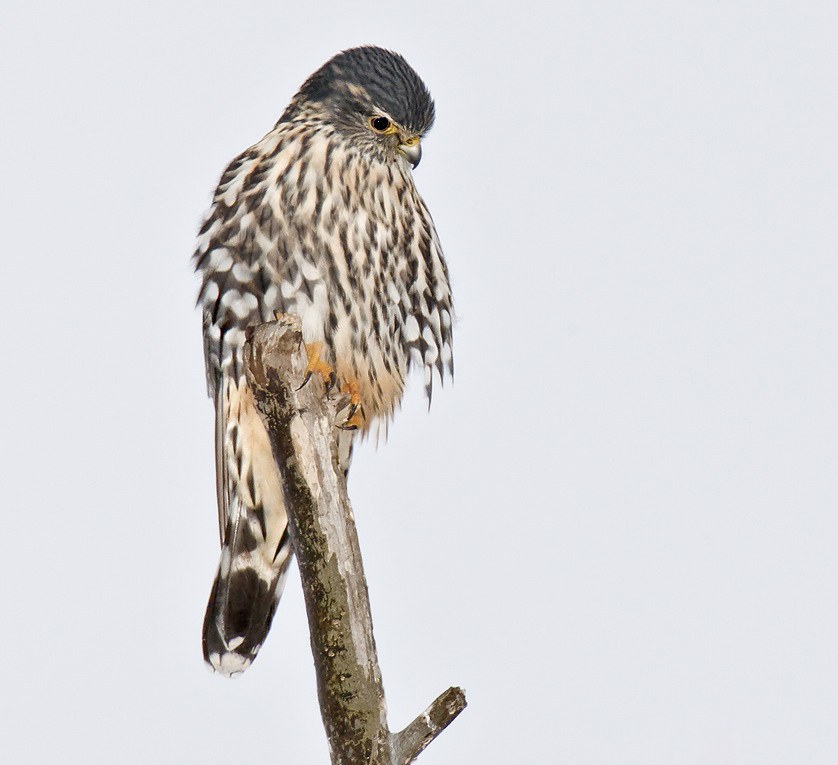
Key Field Marks
- Size & shape: A small falcon, about 24–33 cm (9.5–13 in) long, noticeably bulkier and broader-winged than a kestrel but smaller than a Peregrine; pointed wings and a moderately long tail typical of falcons.
- Male: Blue-grey upperparts (in most North American and European populations) with rufous-streaked underparts and a narrow, often faint or barely-there facial moustache mark, unlike the bold moustache of most other falcons.
- Female/immature: Brown above (rather than blue-grey) with heavily streaked buffy underparts; larger than males, as in most falcons.
- Tail: Shows dark tail bands; male's tail often has a broad dark subterminal band and blue-grey base, female/immature tail is brown with paler bands.
- Flight: Extremely fast, low, and dashing — flies with quick, choppy wingbeats often just above ground or hedge level in pursuit of small birds, rarely soaring for long like a Peregrine or Red-tailed Hawk.
- Behavior: Often perches on exposed posts, wires, or low trees scanning open ground; direct, purposeful, level flight rather than the hovering behavior typical of American Kestrel.
Similar Species
- American Kestrel (Falco sparverius): Smaller and more colorful with rufous back and tail and bold facial pattern (two dark moustache stripes); frequently hovers, which Merlin rarely does.
- Peregrine Falcon (Falco peregrinus): Much larger and bulkier with a bold black hood/moustache and typically hunts from high soaring flight or high-speed stoops, unlike Merlin's low-level dashing pursuit.
- Sharp-shinned Hawk (Accipiter striatus): Similar small dashing raptor silhouette but has rounded (not pointed) wings and a flap-flap-glide flight style versus the falcon's stiffer, more continuous wingbeats.
Where & When to See It
- Breeding range: Boreal forest, forest edge, and open taiga across northern North America, northern Europe, and northern Asia.
- Winter/non-breeding range: Much of temperate North America, Europe, and Asia; frequently found in open country, coastal marshes, agricultural fields, grasslands, and increasingly in cities and suburbs, where it hunts small birds around parks and feeders.
- Season: Northern breeders are migratory, moving south for winter (roughly September–April in much of the temperate zone); the species is increasingly noted as a winter/urban resident in many mid-latitude cities, where it preys on House Sparrows and other small birds.
Voice
- Generally quiet away from the nest; when vocal, gives a rapid, sharp, chattering "ki-ki-ki-ki" series, higher and more excited-sounding than a kestrel's similar call, typically heard near the nest site or when agitated.
Frequently asked questions
How do I tell a Merlin from an American Kestrel?
Merlin is bulkier, darker, and lacks the kestrel's rufous back/tail and bold double facial moustache; Merlin also rarely hovers, while American Kestrel hovers frequently while hunting.
What habitat is best for finding a Merlin in winter?
Open country such as agricultural fields, coastal marshes, grasslands, and increasingly urban and suburban areas where small flocking birds like House Sparrows and shorebirds provide prey.
Does Merlin hover like a kestrel?
No. Merlin typically hunts with fast, low, direct pursuit flight rather than hovering, which is a hallmark behavior of American Kestrel instead.
Is the Merlin's facial pattern useful for identification?
Yes, in a comparative sense: Merlin shows only a faint or narrow moustache mark, much less bold than the strong dark moustache typical of Peregrine Falcon or American Kestrel, helping separate it from those species.