
Mealy Parrot Identification Guide
One of the largest Amazon parrots, a bulky green bird of Central and South American lowland forest with a pale powdery bloom on the nape and a variable red-and-blue speculum flashed in flight.
Read the full Mealy Parrot encyclopedia entry →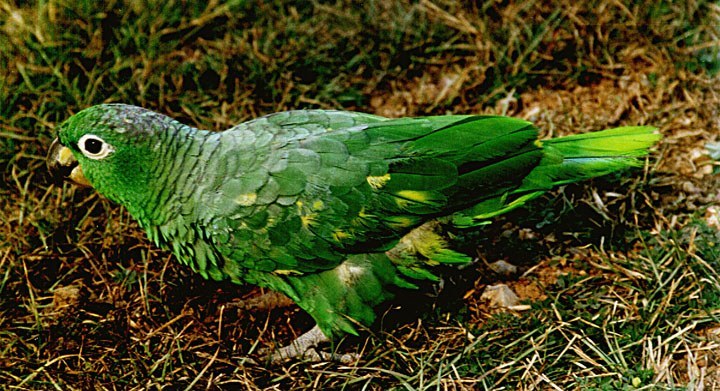
Key Field Marks
- Size & shape: A large, heavy-bodied Amazon parrot, roughly 38–41 cm (15–16 in) long — among the biggest members of the genus Amazona — with a short square tail and a proportionally large head and bill typical of Amazons.
- Plumage: Overall rich green body plumage; the crown and nape often show a pale, powdery grey-white "mealy" bloom (a dusty appearance from feather powder-down) that gives the species its name, though this can be subtle or absent on some individuals.
- Face: Plain green face with little bare skin visible; a thin blue tinge is sometimes present on the crown in some subspecies.
- Wings/speculum: Shows a red patch (sometimes with blue) in the wing speculum, visible mainly in flight or when the wing is spread; outer tail sometimes shows a thin yellow tip.
- Bill: Large, pale horn-grey to yellowish-grey bill, thick and strongly hooked.
- Behavior: Typically seen in pairs or small flocks flying above the forest canopy with strong, direct flight and shallow, stiff wingbeats, giving loud squawking calls; forages quietly and can be surprisingly hard to spot while perched in dense canopy foliage.
Similar Species
- Yellow-crowned Amazon (Amazona ochrocephala) and other yellow-headed Amazons: Show obvious yellow on the crown/nape, which Mealy Parrot lacks (aside from the pale powdery bloom, which is grey-white, not yellow).
- Farinosa vs. Southern Mealy Amazon: Some taxonomies split Mealy Parrot into two species (Northern Mealy Amazon A. guatemalae and Southern Mealy Amazon A. farinosa); ranges are essentially replaced from Mexico/Central America (northern) to South America (southern), so location alone often clarifies which form is present.
- Other large green Amazons (e.g., Blue-cheeked, Scaly-naped): Best separated by head pattern and range; Mealy Parrot's comparatively plain green head with a dusty grey bloom on the nape, larger overall size, and its typical high, direct overhead flight are useful combined clues.
Where & When to See It
- Range: From southern Mexico through Central America and into South America (Colombia, Venezuela, the Guianas, and the Amazon Basin south to Bolivia and Brazil).
- Habitat: Humid lowland and foothill tropical forest, both terra firme and várzea (seasonally flooded) forest, forest edge, and gallery forest; generally avoids very open or heavily deforested land.
- Season: Resident and non-migratory year-round throughout its range; most reliably observed at dawn and dusk when pairs and flocks commute noisily between roosting and feeding areas, or at clay licks in parts of the Amazon where parrots gather to eat mineral-rich soil.
Voice
- Loud, deep, resonant squawks and screeches given in flight, generally lower-pitched and more guttural than many smaller Amazon species.
- Pairs often call back and forth in flight, helping to locate flocks moving above the canopy before they come into view.
Frequently asked questions
Why is it called the Mealy Parrot?
It refers to the pale, powdery grey-white bloom (like a dusting of flour or 'meal') often visible on the crown and nape, produced by powder-down feathers.
How can I tell Mealy Parrot from other large green Amazon parrots?
Look for its plain green head lacking yellow, the dusty pale bloom on the nape, its notably large size, and its typically high, direct flight above the forest canopy. Voice and range are also useful supporting clues.
Where does the Mealy Parrot live?
Humid lowland tropical forest from southern Mexico through Central America and across much of the Amazon Basin in South America.
Is Mealy Parrot the same as Southern Mealy Amazon?
Some classifications split the species into Northern Mealy Amazon (Mexico/Central America) and Southern Mealy Amazon (South America); both are commonly referred to under the umbrella name Mealy Parrot.