
Masked Trogon Identification Guide
A medium-sized Andean trogon with a black face and throat, iridescent green upperparts, and a rosy-red (male) or pinkish-orange (female) belly, found in humid montane forest of the Andes.
Read the full Masked Trogon encyclopedia entry →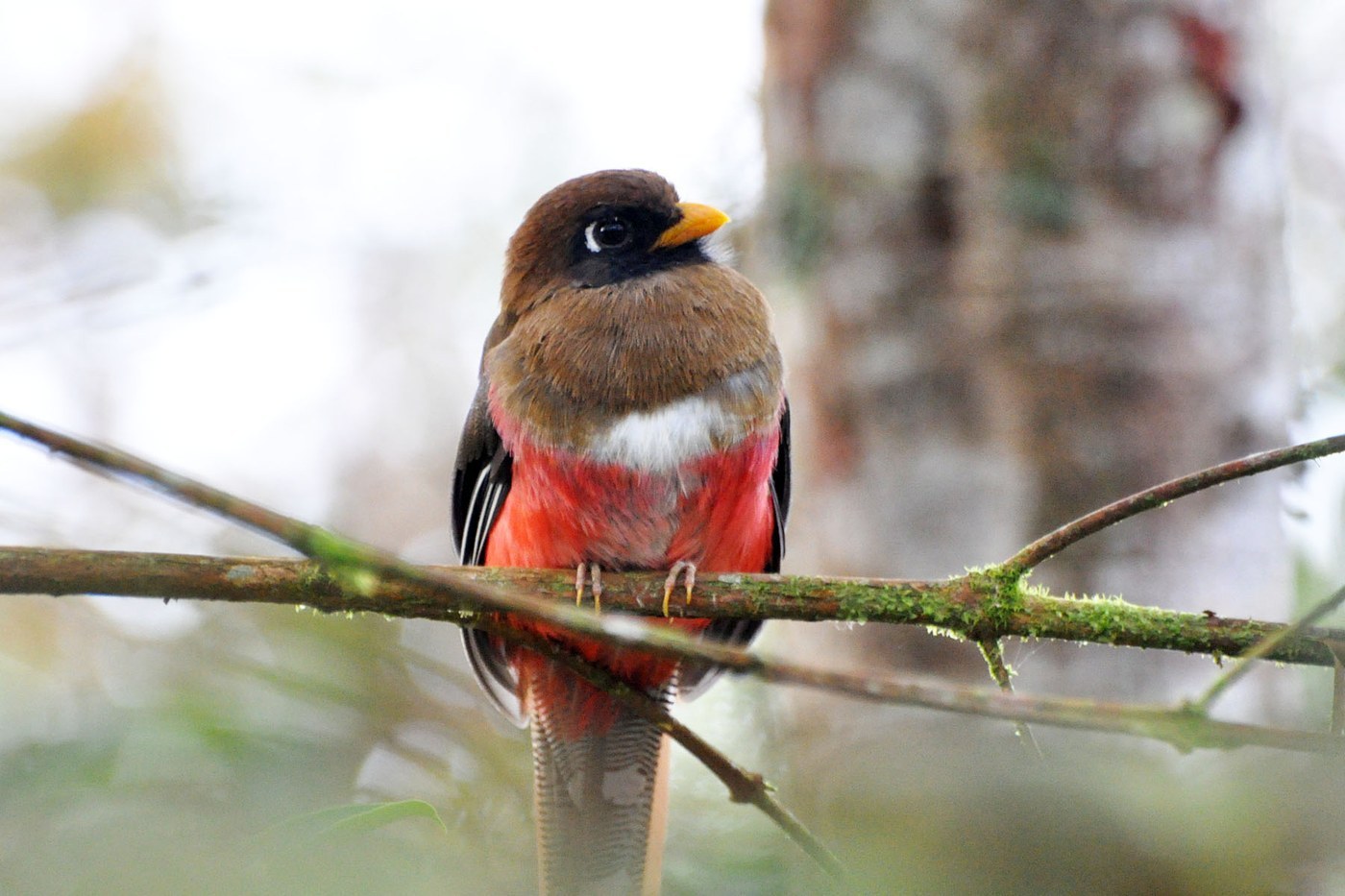
Key Field Marks
- Size & shape: A medium trogon about 23–25 cm (9–10 in) long with the classic trogon profile: stocky body, short neck, large head, and a long, square-tipped tail held mostly still while perched upright.
- Male: Glossy, iridescent green head, throat, and upperparts with a black face/mask around the eye and lores; breast is green grading to a sharp white band, below which the belly is bright rosy red.
- Female: Duller grey-brown head and upperparts (no black mask, replaced by grey face), white breast band, and a pinkish-orange to salmon belly — much less vivid red than the male.
- Bill: Short, stout, slightly hooked bill — yellowish in males, often duskier in females.
- Tail pattern: Undertail shows fine black-and-white barring, visible when the bird flicks or fans its tail; a useful mark separating trogon species when perched with tail toward the viewer.
- Posture/behavior: Sits motionless upright on mid-story perches for long periods, sallying out to snatch insects or fruit before returning to the same perch — a classic "trogon" foraging style that makes them easy to overlook despite bright colors.
Similar Species
- Collared Trogon (Trogon collaris): Very similar red-bellied male pattern, but Collared Trogon has a narrower white breast band and finer tail barring; ranges overlap in the Andes, so voice and elevation help confirm.
- White-tailed Trogon (Trogon chionurus) and other lowland trogons: Occur at lower elevations (foothills/lowlands) rather than Masked Trogon's mid-to-high montane forest, and show mostly white (not barred) outer tail feathers from below.
- Female Masked Trogons can be confused with female Collared Trogons; underside tail barring pattern and calls are the most reliable separators.
Where & When to See It
- Range: Andes from Venezuela and Colombia south through Ecuador, Peru, and Bolivia to northwestern Argentina.
- Habitat: Humid montane (cloud) forest and forest edge, typically 1,200–3,000 m (roughly 4,000–10,000 ft) elevation, favoring the mid-story and canopy of primary and mature secondary forest.
- Season: Resident and non-migratory throughout its range; can be found year-round at appropriate elevations, though it is often quiet and easy to miss outside the breeding season.
Voice
- Song is a series of soft, mellow, hollow-sounding notes, often a repeated "cow cow cow" or "cu-cu-cu-cu" on one pitch, slower and more subdued than many lowland trogons.
- Often the voice — not the plumage — is what first reveals a perched bird sitting motionless in dense foliage.
Frequently asked questions
How can I tell a male from a female Masked Trogon?
Males have a black face mask, glossy green upperparts, and a bright rosy-red belly. Females lack the black mask (showing grey-brown on the face and upperparts instead) and have a duller pinkish-orange belly.
At what elevation should I look for Masked Trogon?
It favors humid Andean cloud forest roughly between 1,200 and 3,000 meters (about 4,000–10,000 feet), so it is a mid-to-high elevation specialist rather than a lowland bird.
What is the easiest way to distinguish Masked Trogon from Collared Trogon?
Both have red-bellied males with a white breast band, but Masked Trogon's breast band is broader and its call is a slower, more subdued series of hollow notes; checking elevation and voice together is the most reliable approach.
Why are trogons hard to spot despite bright colors?
They perch motionless and upright in shaded mid-story foliage for long stretches, often facing away, so their brightest colors (the belly) can be hidden from view until they turn or fly.