
Masked Lovebird Identification Guide
A small, chunky African parrot with a black face, yellow collar and neck, and bright red bill, most often seen in the wild as an introduced population in East Africa or as feral flocks around Phoenix, Arizona.
Read the full Masked Lovebird encyclopedia entry →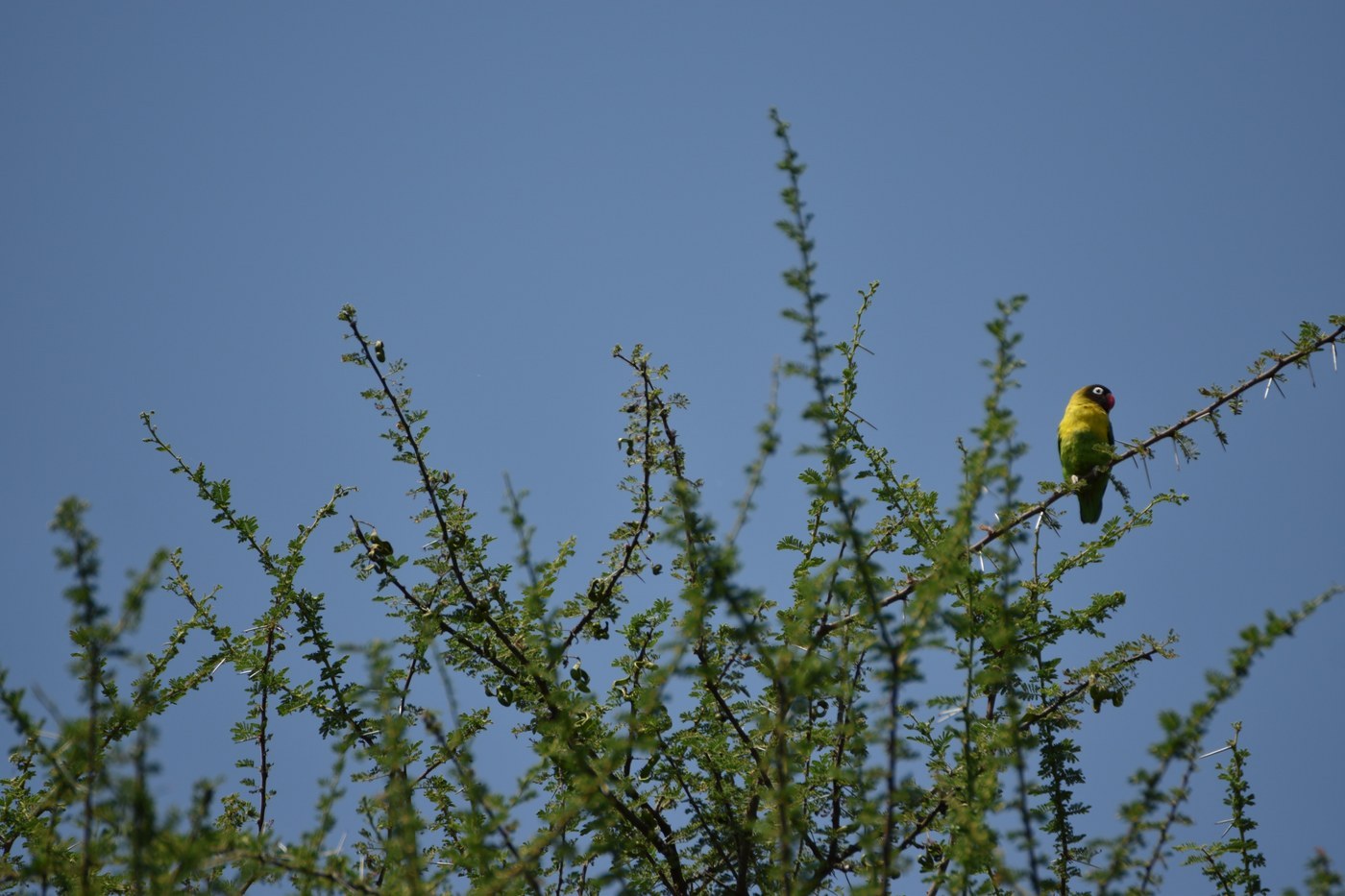
Key Field Marks
- Size & shape: A tiny, stocky parrot about 14–15 cm (5.5 in) long, with a short square tail and a large head relative to its body — typical of the genus Agapornis ("lovebirds").
- Head: Blackish-brown "mask" covering the face, forehead, and throat, sharply set off from a bright yellow collar around the hind-neck and upper breast.
- Body: Body plumage is mostly bright grass-green; underparts are yellow-green.
- Bill: Stubby, deep red bill — bright and waxy-looking, contrasting with the dark face.
- Legs/feet: Grey legs and feet, used to grip branches and food readily (zygodactyl toes, two forward/two back).
- Eyes: Dark eye set in the black mask, often with a thin white eye-ring visible at close range.
- Flight: Fast, direct, whirring wingbeats; usually travels in tight, fast-moving flocks giving sharp chattering calls.
Similar Species
- Fischer's Lovebird (Agapornis fischeri): Very similar shape and size, but has an orange-red face grading into yellow on the nape rather than a solid black mask, and often shows a green (not yellow) collar band. Hybrids between the two species occur where feral populations overlap, so some birds show intermediate head patterns.
- Yellow-collared Lovebird is simply an alternate name sometimes used for this same species (Masked Lovebird), not a different bird.
- Black-cheeked Lovebird (Agapornis nigrigenis): Similar dark face but the face patch is more restricted to the cheeks/throat and the body is more olive; ranges do not naturally overlap with Masked Lovebird.
Where & When to See It
- Native range: North-central Tanzania, in dry acacia savanna and woodland near water.
- Introduced/feral range: Well-established feral colonies in the Phoenix, Arizona metro area (Sonoran Desert suburbs), and small feral populations have been reported in Nairobi, Kenya and a few other cities where escaped cage birds established.
- Habitat: Open woodland, scrub, and increasingly parks, golf courses, and suburban yards with mature trees and bird feeders, especially where ornamental fruiting trees provide food and cavities for nesting.
- Season: Non-migratory; present year-round wherever established. In Phoenix, flocks are conspicuous at feeders and palm trees throughout the year.
Voice
- Loud, harsh, high-pitched chattering and screeching notes given constantly in flight and while perched in flocks — a shrill "screech-screech-screech" typical of small parrots.
- Contact calls keep flock members together as they move rapidly between feeding trees.
Frequently asked questions
Is the Masked Lovebird native to the United States?
No. It is native to Tanzania in East Africa. The well-known Phoenix, Arizona population descends from escaped or released pet birds and is now a self-sustaining feral population.
How do I tell a Masked Lovebird from a Fischer's Lovebird?
Masked Lovebird has a solid blackish face and a yellow collar; Fischer's Lovebird has an orange-red face that blends into yellow on the nape, without the sharp black mask. Hybrids can blur these marks in feral flocks.
What color is a Masked Lovebird's bill?
Bright red, which stands out strongly against the black face mask.
Do Masked Lovebirds migrate?
No, they are non-migratory and remain in the same area year-round, both in their native Tanzanian range and in introduced populations.