
Masked Lapwing Identification Guide
A large, loud Australasian plover with bright yellow facial wattles and sharp yellow wing spurs, famous for its aggressive nest defense.
Read the full Masked Lapwing encyclopedia entry →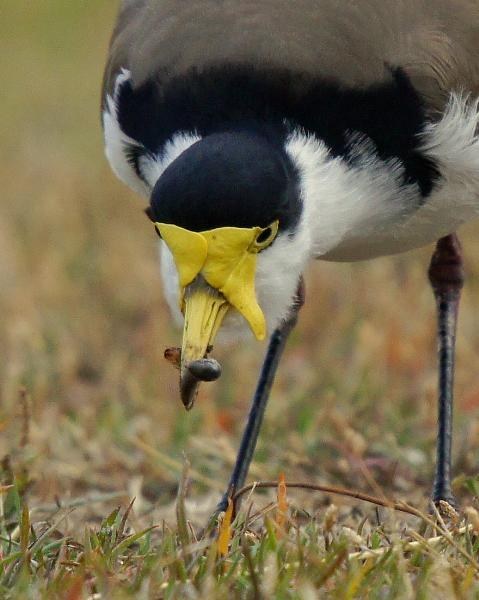
Key Field Marks
- Size & shape: A large plover, 30-37 cm, with long dull pinkish-red legs and a fairly upright stance.
- Head: Mostly white with a black cap; large, bright yellow fleshy wattles hang from the face in front of and below the eyes — the species' most distinctive feature.
- Body: Brownish-grey to olive-brown back and wings, black flight feathers, and white underparts.
- Wing spurs: Sharp yellow spurs at the bend of the wing (carpal spurs), used in aggressive displays and visible on a close view of a raised or spread wing.
- Subspecies variation: The northern subspecies (Vanellus miles miles) has an extensive black hood covering the crown and much of the neck with larger wattles, while the southern subspecies (V. m. novaehollandiae) shows black restricted mainly to the crown with smaller wattles — these forms were formerly treated as separate species (Masked Plover and Spur-winged Plover).
Separating It From Similar Species
- Within its range, the combination of large yellow facial wattles and yellow wing spurs makes it essentially unmistakable among plovers.
- Confusion is mainly between the two subspecies/forms rather than with other species; extent of black on the head and wattle size are the main clues to which form is being seen.
Where & When to See One
- Habitat: Open grassland, pasture, playing fields, parks, golf courses, and wetland margins — highly adaptable and often found in urban and semi-urban settings, though usually near some water.
- Range: Widespread across Australia and New Guinea; self-introduced and now well established in New Zealand, where it is also a fairly recent colonist.
- Season: Resident, with local movements tied to breeding and food availability.
Voice
- A loud, penetrating, rattling kek-kek-kek-kek alarm call, frequently given in flight and especially noticeable at night when the species is unusually vocal for a shorebird; used prominently when defending nests or chicks, often accompanied by aggressive dive-bombing of intruders using the wing spurs.
Frequently asked questions
What are the yellow lumps on a Masked Lapwing's face?
They are fleshy facial wattles, a distinctive feature of the species used in social signaling and unique among Australasian plovers.
Why do Masked Lapwings dive-bomb people?
They are famous for aggressively defending nests and chicks on the ground, swooping at perceived threats and sometimes striking with the sharp yellow spurs on their wings.
What is the difference between the two Masked Lapwing forms?
The northern form has a more extensive black hood covering the crown and neck with larger wattles, while the southern form shows black limited mainly to the crown with smaller wattles; these were once considered separate species.
Is the Masked Lapwing native to New Zealand?
No, it self-introduced from Australia relatively recently and has since become well established and common in New Zealand.