
Marbled Godwit Identification Guide
A large, warm cinnamon-brown shorebird with a long, slightly upturned bicolored bill, common on North American coastal mudflats in winter.
Read the full Marbled Godwit encyclopedia entry →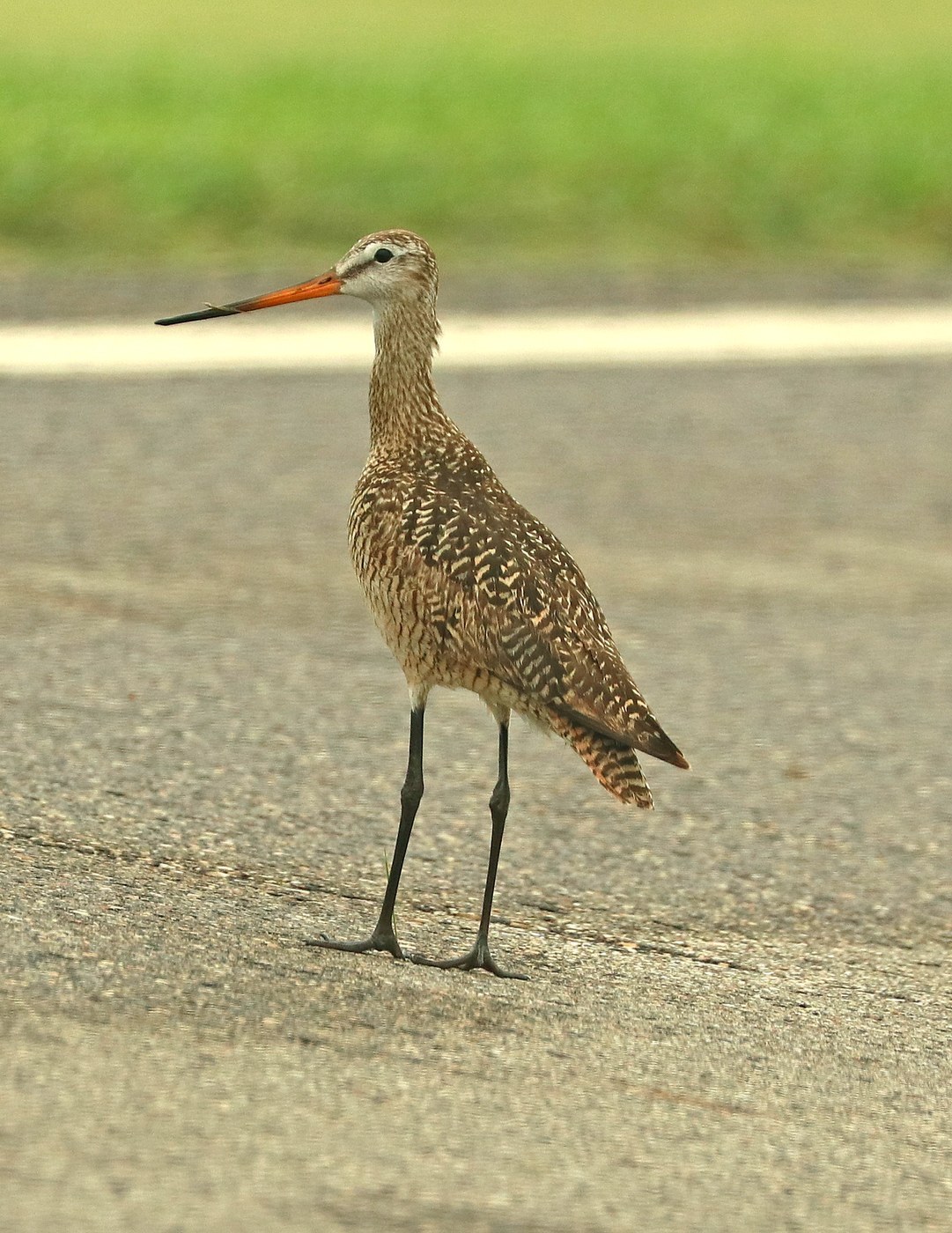
Key Field Marks
- Size & shape: A large shorebird, 42-48 cm, with a long neck, long blue-grey legs, and a long, slightly upturned bill that is bicolored — pink or orange at the base shading to black at the tip.
- Plumage: Warm cinnamon-buff overall, densely mottled and barred with dark brown, giving a rich 'marbled' appearance year-round (breeding and nonbreeding plumages are similar, unlike many shorebirds).
- In flight: Shows warm cinnamon underwings and wing linings, a useful mark at a distance or in flight silhouette.
Separating It From Similar Species
- Hudsonian Godwit is smaller and darker, with a black tail and white uppertail base, a white wing stripe visible in flight, chestnut underparts in breeding plumage, and a blackish (not cinnamon) underwing.
- Long-billed Curlew has a strongly down-curved bill rather than an upturned one and lacks the sharp bicolored bill pattern.
- Willet is shorter-billed with a straight bill and shows a bold black-and-white wing pattern in flight, quite different from the godwit's plain cinnamon wings.
- The combination of large size, upturned bicolored bill, and uniformly warm cinnamon-brown body is diagnostic for Marbled Godwit.
Where & When to See One
- Breeding habitat: Native mixed-grass prairie near shallow wetlands and ponds in the northern Great Plains.
- Range: Breeds in Montana, the Dakotas, and adjacent southern Saskatchewan, with a small disjunct population near James Bay; winters along both US coasts south through Mexico and into Central America, favoring tidal mudflats, sandy beaches, and estuaries.
- Season: Present on breeding grounds spring through summer; widespread on wintering coastal habitats from fall through spring, with many nonbreeders remaining year-round in some winter areas.
Voice
- A loud, far-carrying, strident call often rendered as ka-DIK, ka-DIK or a barking god-WIT-like cry, frequently given in flight and useful for locating birds before they are seen.
Frequently asked questions
How do you tell a Marbled Godwit from a Long-billed Curlew?
The Marbled Godwit's bill is straight to slightly upturned and bicolored (pink/orange base, black tip), while the Long-billed Curlew has a strongly down-curved, uniformly dark bill.
What is the easiest way to separate Marbled Godwit from Hudsonian Godwit?
Marbled Godwit is larger, warmer cinnamon-brown overall with cinnamon underwings, while Hudsonian Godwit is smaller and darker with a black tail, white uppertail base, and blackish underwing.
Where does the Marbled Godwit breed?
It breeds primarily in native prairie grassland of the northern Great Plains, including Montana, North and South Dakota, and southern Saskatchewan.
What habitat is best for finding wintering Marbled Godwits?
Coastal tidal mudflats, sandy beaches, and estuaries along the Pacific and Atlantic/Gulf coasts of the US, Mexico, and Central America.