
Maned Duck Identification Guide
Also called the Australian Wood Duck, this goose-like grazer has a dark maned head, grey vermiculated body, and an upright, terrestrial posture unlike typical ducks.
Read the full Maned Duck encyclopedia entry →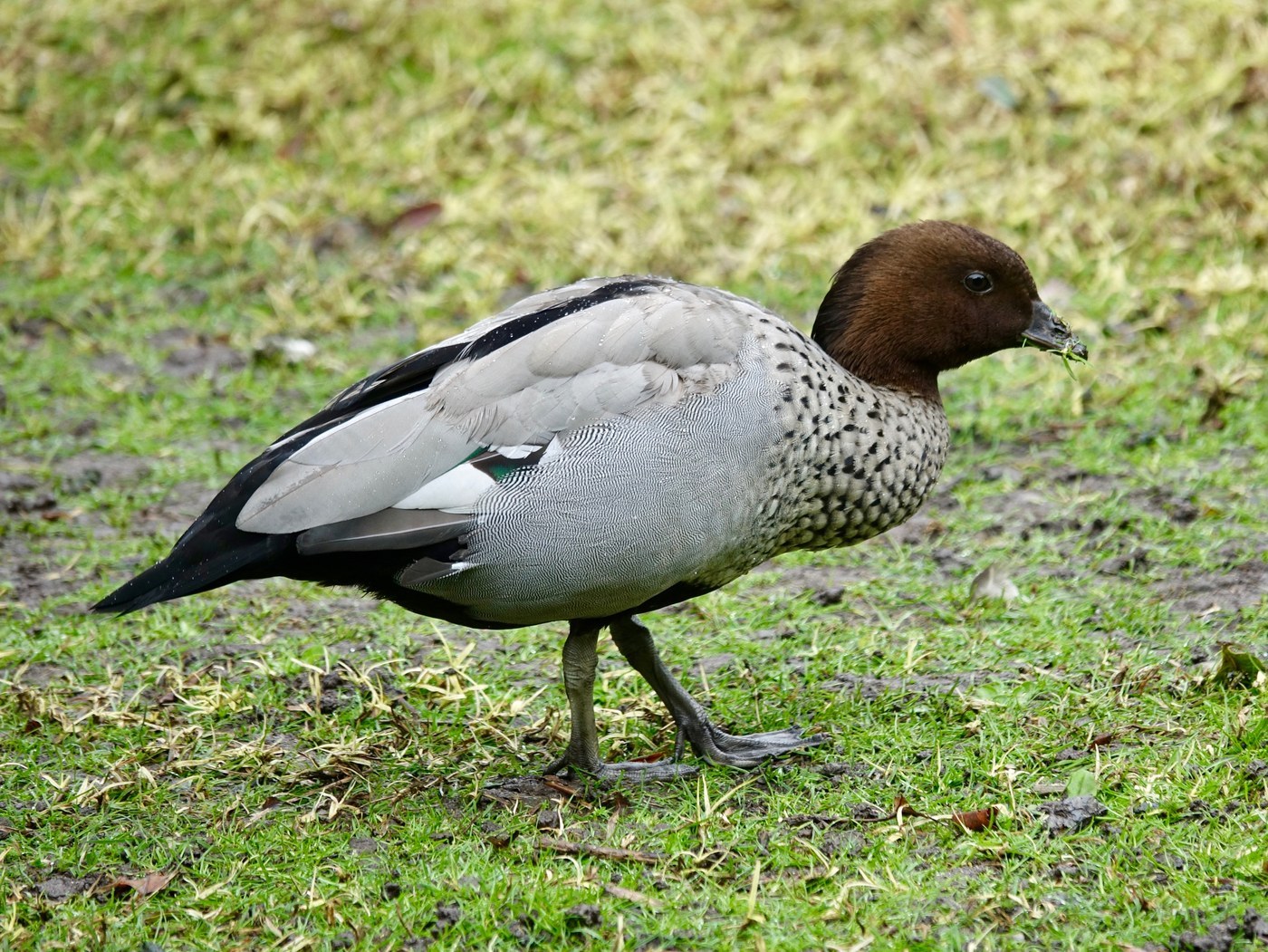
Key Field Marks
- Size & shape: Medium-large, 44-50 cm, with a small bill, long neck, and long legs, giving it an upright, goose-like posture rather than a typical low-slung duck profile.
- Head: Dark brown to blackish-brown with a short, shaggy 'mane' of longer feathers on the nape, most pronounced in males.
- Body: Grey overall with fine vermiculations (fine wavy barring) on the flanks and back; the breast is mottled dark brown to blackish, especially in males.
- Sexes: Males have a more uniformly dark, unmarked head; females show two pale stripes on the face — one above and one below the eye — plus a pale eyebrow, which is the most reliable way to sex birds in the field.
- Bill: Small, dark, and rather stubby compared to most ducks.
Separating It From Similar Species
- Its grazing, goose-like habit on open grass is the single best clue — few Australian waterfowl feed this way on dry land, often far from any water.
- The combination of a dark maned head, grey vermiculated body, and small dark bill separates it from Australian Wood Duck's superficially similar relatives such as the Pacific Black Duck (which has a bold facial stripe pattern and a broader, duck-like bill) or Australian Shelduck (much larger, with bold white wing patches and chestnut breast band).
- In flight, Maned Ducks show plain dark wings without bold white patches, unlike shelducks.
Where & When to See One
- Habitat: Grasslands, pastures, parklands, golf courses, and open areas near wetlands, dams, or slow rivers — it spends much of its time grazing on land like a goose.
- Range: Widespread and common across mainland Australia, including urban parks and farmland, but scarce in the driest desert interior.
- Season: Resident, though nomadic in response to rainfall and food availability; can form large post-breeding flocks on open pasture.
Voice
- A soft, nasal, mooing or drawn-out honking call, more goose-like than duck-like, frequently given in flight and useful for picking the species out overhead before it is seen well.
Frequently asked questions
Why is the Maned Duck sometimes mistaken for a goose?
It has an upright stance, long neck and legs, small bill, and spends much of its time grazing on grass away from water — all goose-like traits that distinguish it from typical dabbling ducks.
How do you tell male and female Maned Ducks apart?
Males have a darker, more uniformly colored head, while females show two pale stripes on the face (above and below the eye) plus a pale eyebrow.
Is the Maned Duck the same bird as the Australian Wood Duck?
Yes, 'Maned Duck' and 'Australian Wood Duck' both refer to Chenonetta jubata, the same species.
Does the Maned Duck need to live near water?
Not constantly — it grazes extensively on dry grassland and pasture and may be found well away from wetlands, though it still needs water nearby for breeding and rearing young.