
Mandarin Duck Identification Guide
A small, ornate perching duck best known for the drake's outlandish orange 'sail' feathers, purple breast, and painted face.
Read the full Mandarin Duck encyclopedia entry →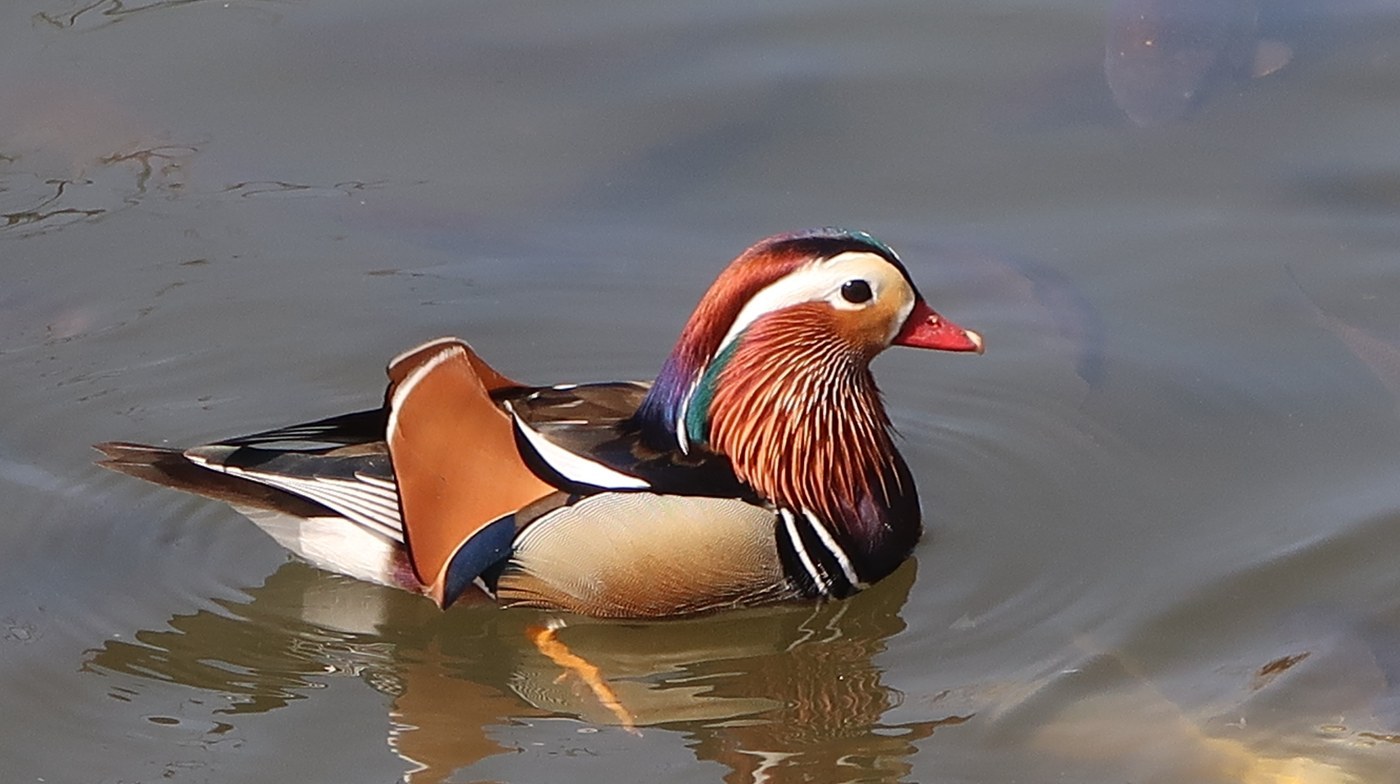
Key Field Marks
- Size & shape: A small, compact duck, 41-49 cm long, with a fairly large head, short neck, and a habit of perching on branches over water.
- Male (drake): Unmistakable in breeding plumage — orange fan-shaped 'sail' feathers raised on the back, a bristling orange-and-white mane, purple-chestnut breast with two white vertical bars, a pale orange face crossed by a broad white crescent behind the eye, and a red bill with a pale nail.
- Female (hen): Much more subdued — grey-brown overall with a narrow white 'spectacle' (eye-ring plus a thin trailing eye-stripe), finely pale-spotted flanks, a small whitish throat patch, and a grey bill with a pale tip.
- Eclipse male: From late summer into autumn, males molt into a female-like eclipse plumage but retain the red (not grey) bill, which is the fastest way to sex a dull-looking bird at that time of year.
Separating It From Similar Species
- Female Wood Duck is the classic confusion species where the two overlap (e.g., feral populations in North America and the UK). Wood Duck females show a bolder, more rounded white eye-ring/spectacle that is broader overall, while the Mandarin's is narrower and more teardrop-shaped with a thinner rearward extension.
- Mandarin females also tend to show a paler, greyer bill with a whitish (not dark) nail, and softer, more diffusely edged pale spotting on the flanks compared to Wood Duck's crisper spotting.
- Drakes are not confusable with anything else once the sail feathers and painted face are seen; in flight, both sexes show a dark body with a pale belly and a small white trailing bar on the secondaries.
Where & When to See One
- Native range: East Asia — China, Korea, Japan, and the Russian Far East, where it breeds along wooded rivers, ponds, and lakes and winters farther south in China and Japan.
- Introduced/feral populations: Long established and self-sustaining in the United Kingdom and parts of continental Europe; scattered feral or escaped individuals and small populations occur in North America (most famously isolated birds turning up on urban park ponds).
- Habitat: Prefers still or slow-moving water bordered by trees, since it nests in tree cavities and readily perches on branches — a good clue when separating it from most dabbling ducks.
- Season: Largely resident where naturalized; wild East Asian birds show some migratory movement south in winter.
Voice
- Males give a short, rising, whistled hwick or hue-ick, often in flight.
- Females give a sharp, scolding kett-kett-kett, similar in tone to a female Wood Duck's alarm call.
Frequently asked questions
How can I tell a female Mandarin Duck from a female Wood Duck?
Look at the white eye-ring: Mandarin females have a narrower, teardrop-shaped spectacle with a thin trailing stripe, while Wood Duck females show a bolder, rounder white eye patch. Bill color also helps — Mandarin hens have a paler, greyer bill with a whitish nail.
Why does the male Mandarin Duck look so much plainer in late summer?
Like most ducks, drakes molt into a duller 'eclipse' plumage after breeding that resembles the female. The red bill (versus the female's grey bill) remains the quickest way to sex an eclipse-plumage bird.
Is the Mandarin Duck native to Europe or North America?
No. It is native to East Asia. Populations in the UK, parts of Europe, and isolated sightings in North America stem from escaped or released captive birds that have become naturalized or remain as individual feral records.
What kind of nest site does a Mandarin Duck use?
It nests in tree cavities, sometimes well above the ground and away from water, then leads the ducklings on foot to the nearest pond or stream shortly after hatching.