
Malleefowl Identification Guide
A secretive, chicken-sized Australian megapode famous for building enormous mound nests that use decomposing vegetation as an incubator.
Read the full Malleefowl encyclopedia entry →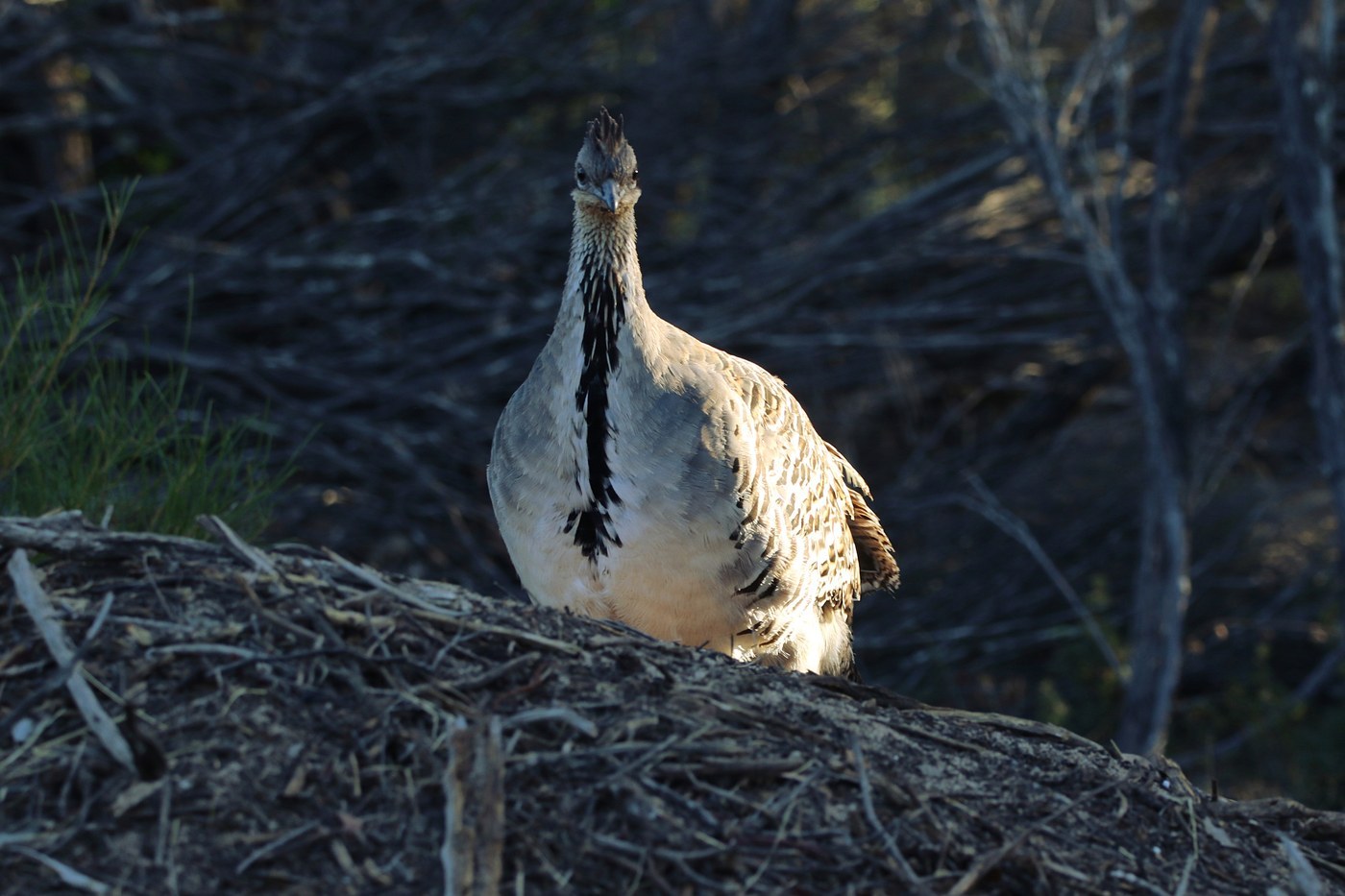
Key Field Marks
- Size & shape: A ground-dwelling bird about the size of a large domestic fowl (55–60 cm), with a plump body, small head, and strong legs and feet adapted for digging and scratching.
- Plumage: Intricately patterned gray, black, brown, and white in a scalloped, barred pattern across the back and wings, providing excellent camouflage against leaf litter and mallee scrub; underparts paler grayish-buff.
- Head & crest: Small head with a short, dark crest that can be raised slightly; pale grayish face and throat.
- Legs & feet: Strong, large, grayish legs and feet built for digging and raking soil and litter, used to build and maintain its mound nest.
Behavior
Best known for its extraordinary nesting strategy: males build and maintain a massive mound of sand, soil, and decomposing leaf litter, sometimes several meters across and over a meter high, in which eggs are incubated entirely by the heat generated from decomposition and solar warming rather than by a parent sitting on them. The male tends the mound almost daily for months, opening and closing it to regulate internal temperature with astonishing precision, using its bill and tongue to sense heat. Chicks hatch fully independent, digging their own way out of the mound and receiving no parental care whatsoever. Generally shy, solitary, and quiet, spending most of its time on the ground scratching for seeds, fruit, and invertebrates in leaf litter.
Separating It From Similar Species
- Australian Brushturkey (rainforest/wet forest species, limited range overlap): Has a bare red head and yellow-to-purple wattle, all-dark body plumage, and a fanned black tail, very different from Malleefowl's scalloped camouflage pattern and fully feathered head.
- Domestic fowl (feral chickens): Occasionally present in similar semi-arid habitat edges, but lack Malleefowl's precise scalloped gray-brown-black barring and its distinctive crouched, wary ground behavior.
- No other Australian bird shares the Malleefowl's combination of camouflaged scalloped plumage, ground-dwelling habits, and mound-building behavior, making confirmed sightings (or an active mound) essentially diagnostic.
Where & When to See It
Found in semi-arid mallee eucalypt scrub and adjacent woodland across parts of southern Australia, including regions of Western Australia, South Australia, Victoria, and New South Wales, though its range has contracted significantly and it is considered vulnerable/threatened. Resident year-round, but extremely shy and easily overlooked; birds are most detectable by locating an active mound (males visit and work on mounds especially during the cooler months building up through the breeding season, roughly September to February) rather than by chance encounters with the bird itself.
Voice
Generally quiet; when vocal, gives a low, booming or grunting call, along with soft clucking notes, but Malleefowl are far more often detected by signs of mound activity than by voice.
Frequently asked questions
Why is the Malleefowl famous among Australian birds?
It builds an enormous mound nest of soil and decomposing leaf litter and uses the heat generated by decomposition (rather than body heat) to incubate its eggs, one of the most remarkable nesting strategies of any bird.
Do Malleefowl parents care for their chicks?
No. Chicks hatch fully independent, dig their own way out of the mound, and receive no parental care or feeding whatsoever.
How can you find a Malleefowl in the wild?
Because the birds themselves are shy and cryptically camouflaged, they are most often detected by locating an active mound, which males tend and regulate almost daily, especially during the breeding season.
What habitat does the Malleefowl live in?
Semi-arid mallee eucalypt scrub and adjacent woodland across parts of southern Australia, including Western Australia, South Australia, Victoria, and New South Wales.
Is the Malleefowl closely related to chickens?
Not closely — it belongs to the megapode family, a distinct lineage of ground-dwelling birds known for mound-building incubation, only distantly related to true fowl.