Malachite Kingfisher Identification Guide
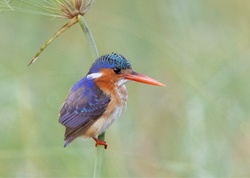
A tiny, jewel-like African kingfisher with an iridescent blue back, orange underparts, and a blue-black barred crest.
Read the full Malachite Kingfisher encyclopedia entry →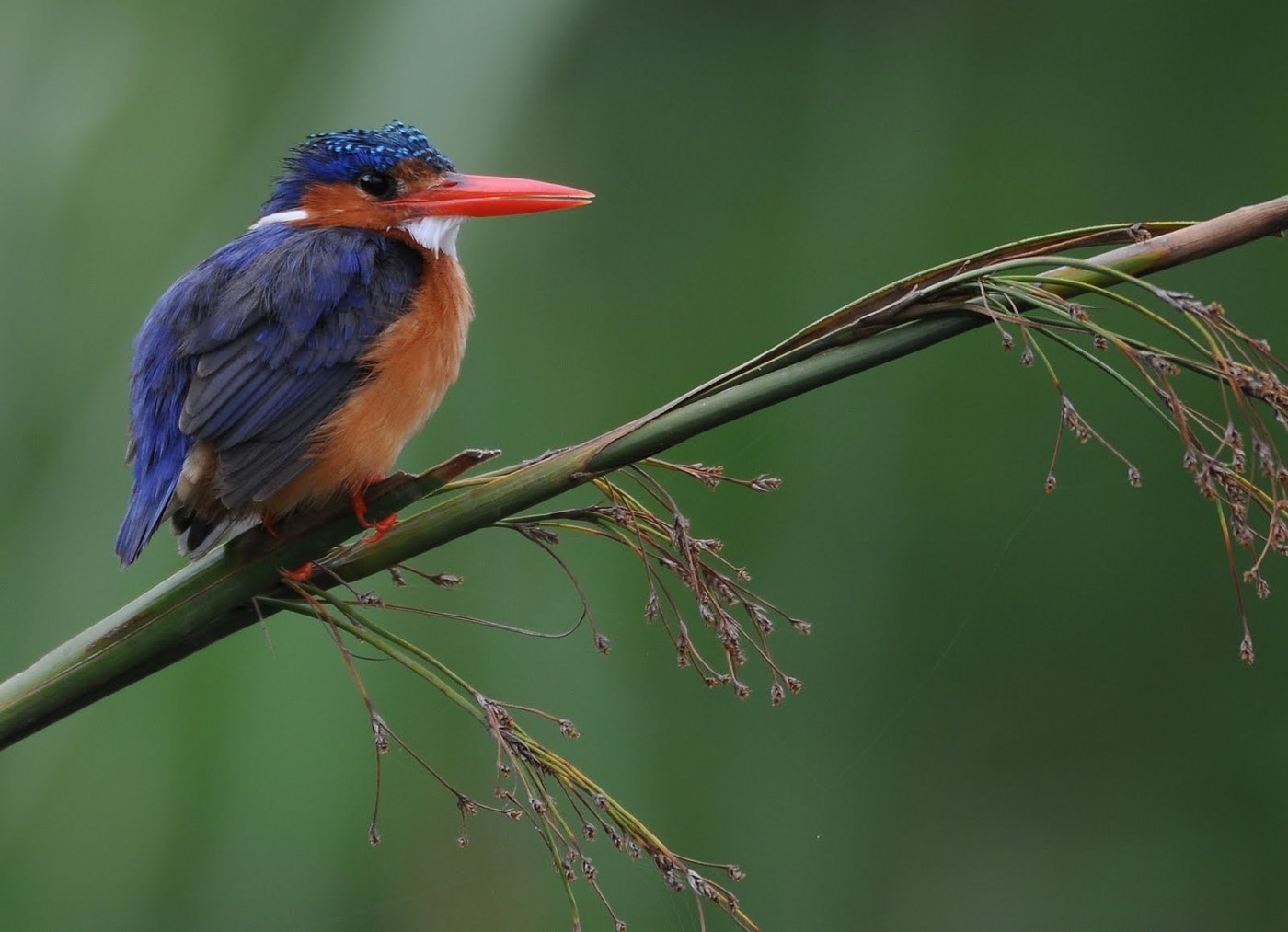
Key Field Marks
- Size & shape: Very small, around 13 cm, with the compact, large-headed, short-tailed shape typical of kingfishers, and a proportionally long, dagger-like bill.
- Upperparts: Brilliant iridescent blue to violet-blue back, rump, and wings that flash vividly in sunlight.
- Underparts: Rich rufous-orange throat, breast, and belly.
- Crest: A distinctive black crest barred with iridescent blue, often raised when the bird is alert or excited, giving a spiky-headed look.
- Bill & legs: Long, straight, bright red-orange bill in adults (black in juveniles); bright red-orange legs and feet.
- Cheek patch: White patch on the side of the neck/throat area contrasting with the orange underparts.
Behavior
Typically perches low over still or slow-moving water — on reeds, low branches, or exposed roots — watching intently for small fish, tadpoles, and aquatic insects before plunge-diving. Solitary and territorial outside the breeding season, often flushing low and fast over the water with a shrill call when disturbed. Nests in a burrow excavated into a earthen bank near water.
Separating It From Similar Species
- African Pygmy Kingfisher: Similar tiny size and orange underparts, but lacks a crest, shows a mauve/purple wash on the crown and ear coverts, and is typically found away from water in woodland and savanna rather than closely tied to wetlands.
- Common Kingfisher (Eurasian species, limited range overlap in parts of Africa in winter): Similar blue-and-orange pattern but lacks the shaggy crest of Malachite Kingfisher and has a shorter, stockier overall shape; Common Kingfisher is a nonbreeding visitor rather than a resident in most of Africa.
- Half-collared Kingfisher: Larger, more uniformly blue above without the barred crest, and lacks the strongly rufous underparts.
Where & When to See It
Widespread resident across sub-Saharan Africa, found along the reedy edges of rivers, lakes, ponds, marshes, and even coastal lagoons, wherever there is still or slow-flowing fresh or brackish water with perches nearby. Present year-round throughout its range, with some local seasonal movements tied to water levels; a classic, easily seen species at wetland reserves across the continent.
Voice
Gives a sharp, high-pitched "peep" or "tsee" call, often uttered in a short, piping series as the bird flies low and fast along a watercourse, frequently the first clue to its presence as a blue-orange blur skimming the water.
Frequently asked questions
How do you tell Malachite Kingfisher from African Pygmy Kingfisher?
Malachite Kingfisher has a shaggy black-and-blue barred crest and stays close to water, while African Pygmy Kingfisher lacks a crest, shows a mauve wash on the head, and is often found well away from water.
What does a Malachite Kingfisher eat?
Mainly small fish, tadpoles, and aquatic insects, caught by plunge-diving from a low perch over still or slow-moving water.
Where does the Malachite Kingfisher nest?
In a burrow it excavates into an earthen bank near water, typical of many kingfisher species.
What color is the Malachite Kingfisher's bill?
Bright red-orange in adults; juveniles have a duller, blackish bill that brightens as they mature.
Is the Malachite Kingfisher found only near water?
Yes, it is closely tied to still or slow-flowing freshwater and brackish habitats such as reedy river edges, lakes, ponds, and marshes across sub-Saharan Africa.
Malachite Kingfisher identified by the community
Recent Malachite Kingfisher sightings identified with Bird Identifier.