
Maguari Stork Identification Guide
A large white South American stork with black flight feathers and tail, red legs, and a pale bill, found in open wetlands and grasslands.
Read the full Maguari Stork encyclopedia entry →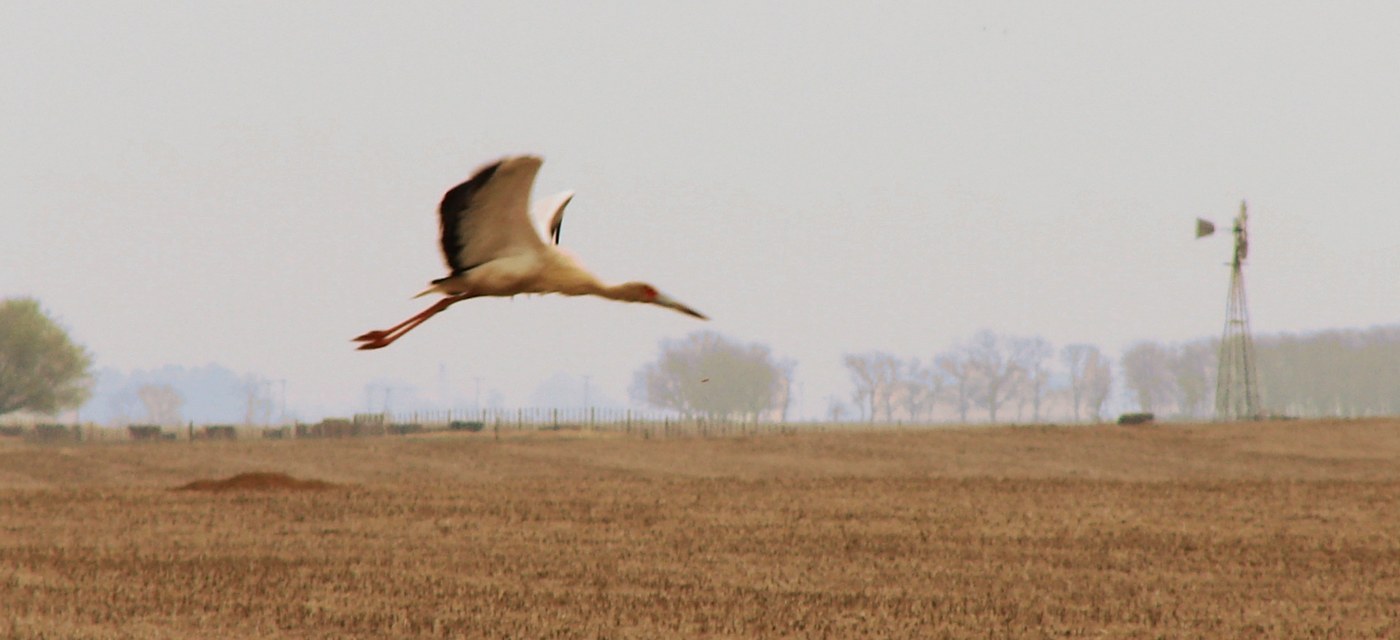
Key Field Marks
- Size & shape: A very large wading bird, standing about 90–100 cm tall, with a long neck, long legs, and a heavy, straight bill typical of storks.
- Plumage: Predominantly white body with contrasting glossy black flight feathers and a black tail, visible as a dark trailing edge and rear when the bird is standing with wings folded.
- Head: Fully white-feathered head and neck (not bare-skinned), with a small patch of bare reddish skin around the eye.
- Bill & legs: Pale bluish-gray to horn-colored bill; long, bright red-pink legs, conspicuous both standing and in flight.
- In flight: Neck extended straight out (not tucked in an S like herons), legs trailing well beyond the tail, with black flight feathers strongly contrasting against the white body and wing coverts.
Behavior
Forages by walking slowly through shallow water and wet grassland, picking and probing for fish, amphibians, large insects, and other small prey. Often seen alone, in pairs, or in loose small groups, sometimes alongside other large waders. Builds a large stick nest, typically in isolated trees or shrubs near wetlands, and soars well on thermals like other storks, often in small kettles.
Separating It From Similar Species
- Wood Stork (overlapping range in parts of South America): Has a bare, dark grayish-black, unfeathered head and upper neck, versus the fully white-feathered head of Maguari Stork; Wood Stork's bill is heavier and more strongly downcurved.
- White Stork (Old World species, no natural range overlap): Similar white-body/black-flight-feather pattern, but has an all-red bill (versus Maguari's pale bluish bill) and lacks the bare red eye-patch.
- Jabiru (same range, much larger): Enormous all-white body with a bare black head and neck and a massive black bill, plus a red inflatable neck patch — much bigger and structurally very different from Maguari Stork.
Where & When to See It
Resident and locally nomadic across the wetlands, marshes, flooded grasslands, and llanos/pampas of South America, from Colombia and Venezuela south through the Amazon basin and the Pantanal to Argentina. Found year-round in suitable wetland habitat, with local movements tracking water levels and seasonal flooding rather than long-distance migration. The Pantanal and Llanos regions are especially reliable strongholds.
Voice
Like most storks, adults are largely voiceless apart from loud bill-clattering displays at the nest, used in greeting and courtship between mates; may also give occasional low grunts or hisses.
Frequently asked questions
How do you tell a Maguari Stork from a Wood Stork?
Maguari Stork has a fully white-feathered head with just a small bare red patch around the eye, while Wood Stork has an entirely bare, dark grayish-black head and neck.
How is Maguari Stork different from the Old World White Stork?
Maguari Stork has a pale bluish-gray bill and a bare red eye-patch, while White Stork has an all-red bill and a fully feathered head with no bare skin; the two species also don't naturally overlap in range.
What habitat does the Maguari Stork prefer?
Open wetlands, marshes, and flooded grasslands such as the Pantanal and Llanos of South America, where it wades in shallow water to forage.
Does the Maguari Stork migrate?
It is largely resident, though it makes local nomadic movements tracking seasonal flooding and water levels rather than undertaking long-distance migration.
What color are a Maguari Stork's legs?
Bright red-pink, a conspicuous field mark both when the bird is standing and in flight, when the legs trail well beyond the black tail.