
Magpie Tanager Identification Guide
A large, long-tailed South American tanager with a striking black-and-white pattern reminiscent of a true magpie.
Read the full Magpie Tanager encyclopedia entry →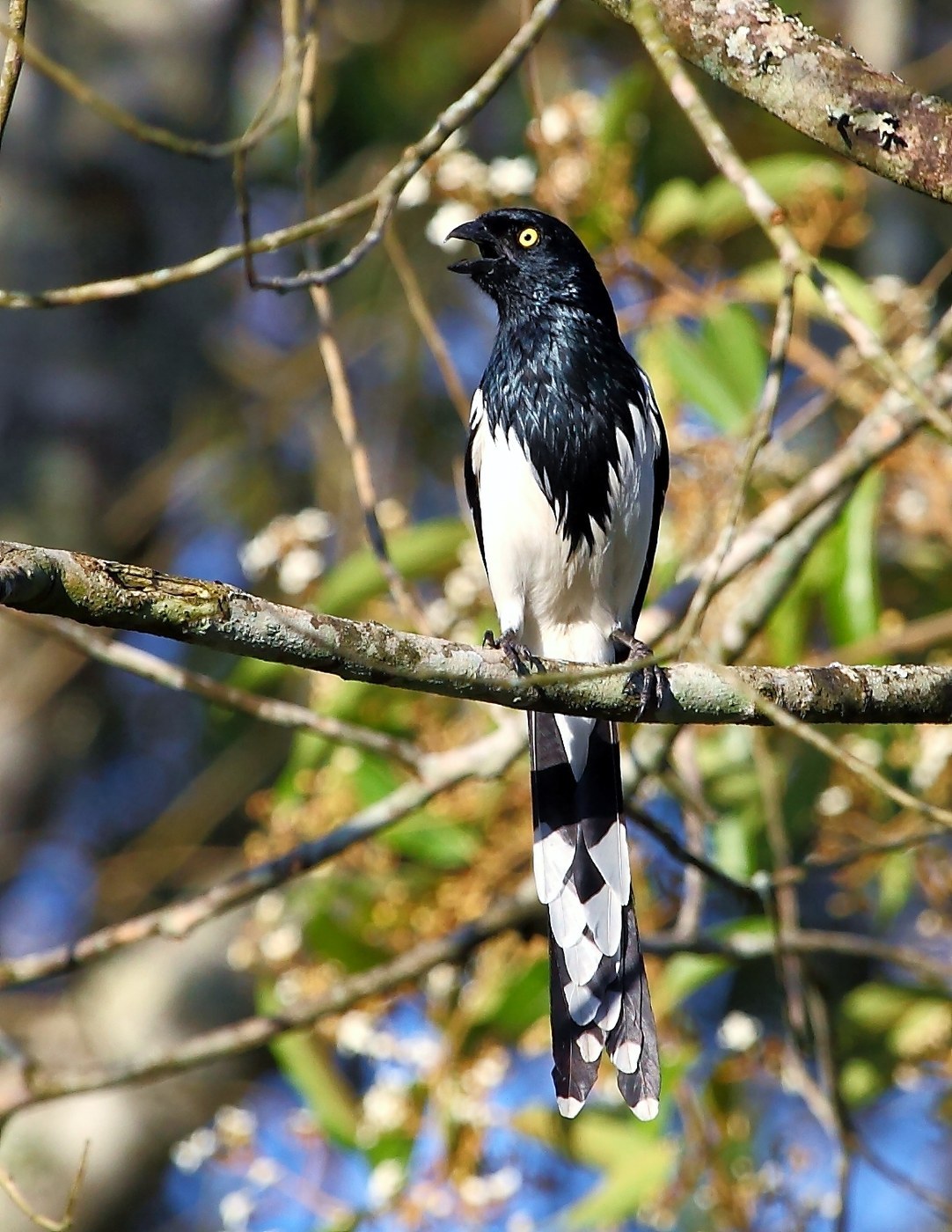
Key Field Marks
- Size & shape: One of the largest tanagers, roughly 28 cm long, with a notably long, graduated black tail and an upright, alert posture.
- Plumage: Bold black-and-white pattern — black head, back, wings, and tail contrasting with a white throat, breast, belly, and prominent white patches on the wings and tail corners.
- Bill: Stout, blackish, slightly hooked at the tip compared to many smaller tanagers.
- In flight: White wing patches and white-tipped outer tail feathers flash conspicuously.
Behavior
Usually encountered in pairs or small family groups, often associating loosely with mixed-species flocks at forest edges. Forages actively at low to mid-levels in dense second growth, forest borders, and riverine thickets, gleaning insects and taking fruit; noticeably more active and vocal than many forest-interior tanagers, frequently flicking its long tail.
Separating It From Similar Species
- Black-and-white Tanager (more restricted range, drier habitats): Smaller, with less white in the wing and a shorter tail, and lacks the Magpie Tanager's obviously long, magpie-like tail proportions.
- White-shouldered Tanager: Much smaller with a compact shape and limited white confined to the shoulder, entirely different silhouette from the long-tailed Magpie Tanager.
- Swallow-tanager: Different shape with a shorter tail and turquoise/green tones in males, not a black-and-white pattern.
The combination of large size, very long black tail, and bold pied pattern makes the Magpie Tanager essentially unmistakable within its range once seen well.
Where & When to See It
Resident across much of tropical South America east of the Andes, including the Amazon basin, the Guianas, and parts of the Atlantic Forest region of southeastern Brazil, Paraguay, and northern Argentina. Favors forest edges, secondary growth, riverine woodland, and scrubby clearings rather than deep undisturbed forest interior. Present year-round with no significant migratory movements; most easily found by listening for its noisy foraging groups moving through edge habitat.
Voice
Gives a variety of harsh, scratchy chattering notes and squeaky calls while foraging in groups, generally noisier and less musical than typical tanager song, helping to locate active groups moving through edge vegetation.
Frequently asked questions
What makes the Magpie Tanager easy to identify?
Its combination of large size, very long black tail, and bold black-and-white plumage with white wing and tail patches is distinctive and essentially unmatched among other tanagers in its range.
What habitat does the Magpie Tanager prefer?
Forest edges, secondary growth, riverine woodland, and scrubby clearings, rather than deep, undisturbed forest interior.
Is the Magpie Tanager related to true magpies?
No, it's a tanager (family Thraupidae) that simply resembles magpies in its bold black-and-white pattern and long tail; it is not related to crow-family magpies.
Does the Magpie Tanager travel in flocks?
It's typically seen in pairs or small family groups, often loosely associating with mixed-species foraging flocks at forest edges.
Where in South America is the Magpie Tanager found?
Across much of tropical South America east of the Andes, including the Amazon basin, the Guianas, and the Atlantic Forest region of southeastern Brazil, Paraguay, and northern Argentina.