
Magnolia Warbler Identification Guide
A brightly patterned boreal-forest warbler with a bold black necklace on yellow underparts and a broad white tail band visible from below.
Read the full Magnolia Warbler encyclopedia entry →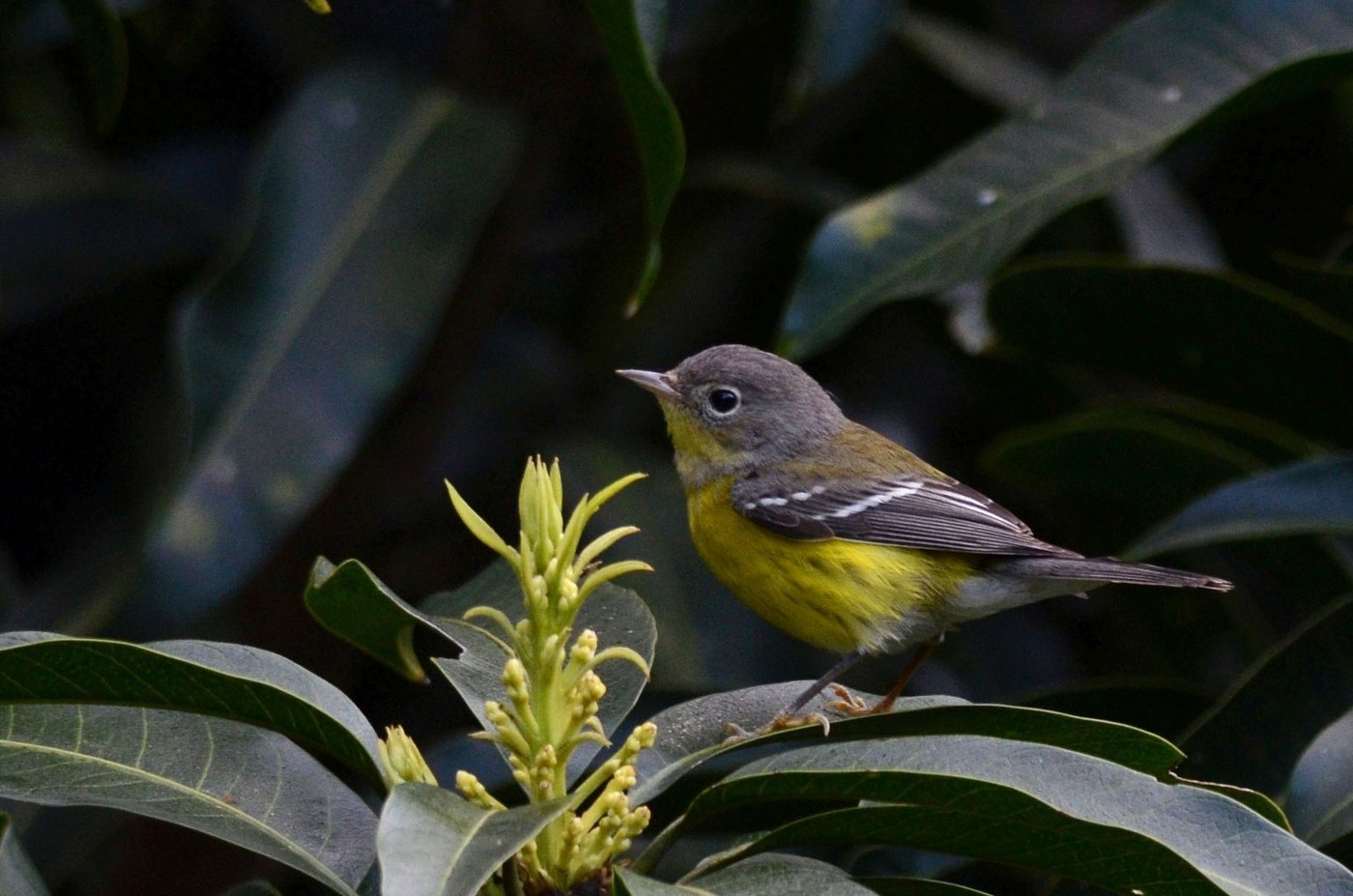
Key Field Marks
- Size & shape: A small, active warbler (about 12 cm) that often forages with tail cocked and spread, flashing its distinctive tail pattern.
- Breeding male: Gray crown, black face mask, bold white eyebrow and eye-arc, black back, and heavy black streaking forming a "necklace" across a bright yellow breast and belly; yellow rump.
- Female/nonbreeding/immature: Much duller version of the same pattern — grayer head, a thin pale eye-ring, faint gray necklace instead of bold black streaking, but always retaining the yellow rump and diagnostic tail pattern.
- Tail pattern (best mark for all plumages): Viewed from below, a broad white band crosses the middle of the tail, with black at the base and a black terminal band — unlike any other regularly occurring warbler.
Behavior
Forages actively in the lower and middle levels of coniferous and mixed forest, often flicking its tail open to flash the white band, a habit useful for picking it out among foliage. Gleans insects from needles and leaves and occasionally hawks for flying insects.
Separating It From Similar Species
- Yellow-rumped Warbler: Also has a yellow rump, but lacks the bold black necklace streaking and has a very different tail pattern (dark tail with small white corners, not a broad white band).
- Canada Warbler: Also shows a necklace of streaking on a yellow breast, but has no wing bars, a complete white eye-ring, blue-gray (not black-and-white) upperparts, and a plain tail without the white band.
- Prairie Warbler: Yellow underparts with dark streaking on the sides, but streaking is more restricted to the flanks, olive back with rufous streaks, and a different tail-bobbing habit; lacks the gray hood and white tail band.
Where & When to See It
Breeds across the boreal forest of Canada and the northeastern U.S., favoring young, dense conifers such as spruce and fir, especially at forest edges and regenerating stands. Migrates through the eastern and central U.S. in spring (April–May) and fall (August–October), when it can appear in almost any woodland or park with cover. Winters mainly in Mexico, Central America, and the Caribbean.
Voice
The song is a bright, whistled "weeta weeta weeteeo," with the phrase often repeated; the call note is a distinctive, nasal "tsik" or "chip," and flight calls are thin, buzzy notes given by migrating birds overhead at night.
Frequently asked questions
What is the easiest way to identify a Magnolia Warbler?
Look for the broad white band across the middle of the tail, visible from below, combined with a black necklace of streaking on bright yellow underparts and a yellow rump — a combination unique among North American warblers.
How do female Magnolia Warblers differ from males?
Females and immatures are much duller, with a grayer head, thinner eye-ring instead of a bold eyebrow, and faint gray streaking instead of a bold black necklace, but they still show the diagnostic white tail band and yellow rump.
Where do Magnolia Warblers breed?
In dense young conifer forest across the boreal zone of Canada and the northeastern United States, particularly spruce and fir at forest edges and regenerating stands.
How is Magnolia Warbler different from Canada Warbler, which also has a necklace?
Magnolia Warbler has black-and-white upperparts, wing bars, and a broad white tail band, while Canada Warbler has plain blue-gray upperparts, no wing bars, a complete white eye-ring, and a plain tail.
When is the best time to see Magnolia Warblers away from the breeding grounds?
During spring migration (April–May) and fall migration (August–October) across the eastern and central United States, when they pass through a wide variety of wooded habitats.