
Magnificent Frigatebird Identification Guide
A huge, long-winged tropical seabird with a deeply forked tail, best known for the male's brilliant red inflatable throat pouch.
Read the full Magnificent Frigatebird encyclopedia entry →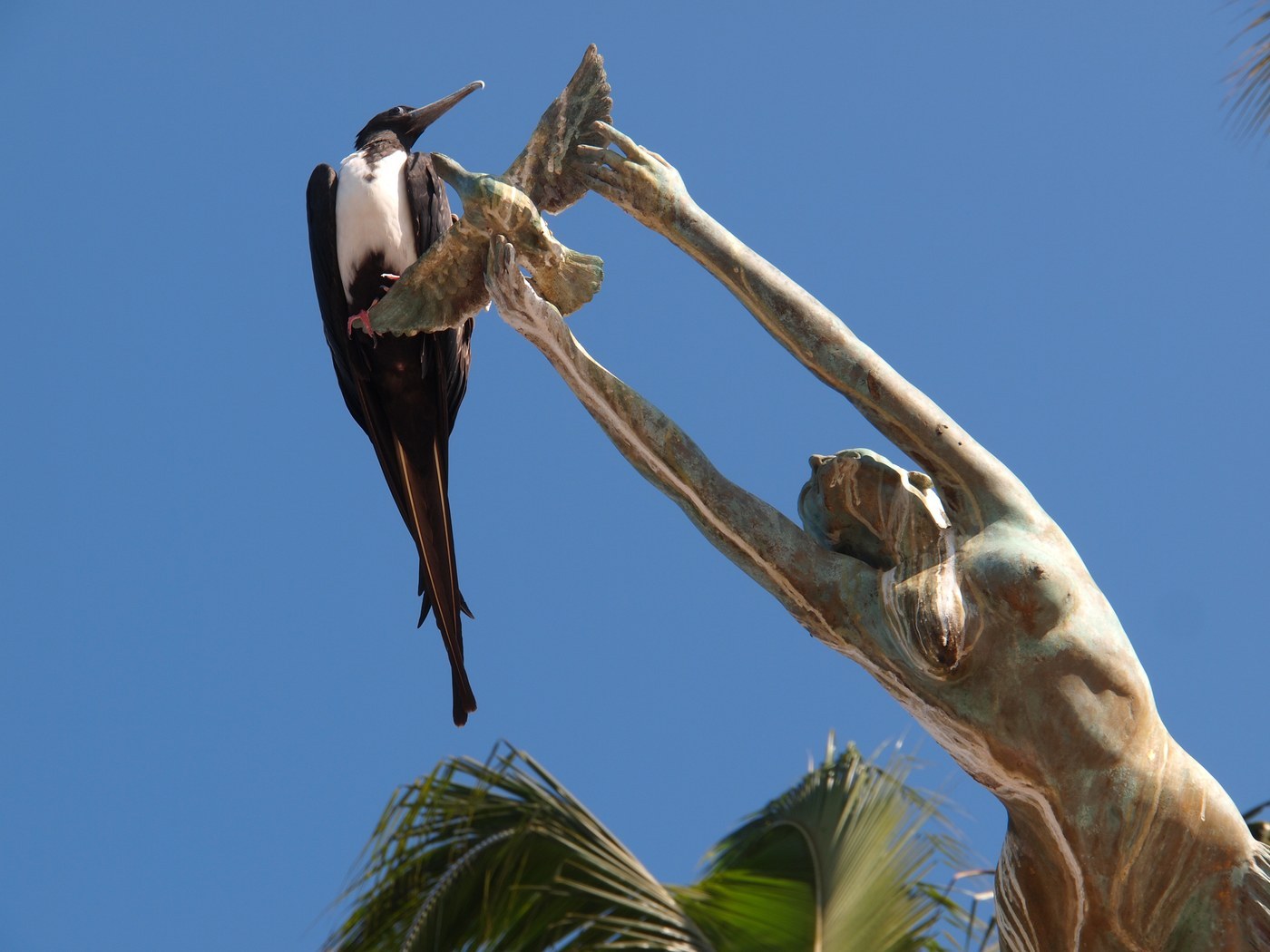
Key Field Marks
- Size & shape: A very large seabird with a wingspan over 2 meters, long angular wings bent at the wrist, and a long, deeply forked tail often held closed in a point while soaring.
- Male plumage: All-black body with a glossy greenish sheen and a bright red gular (throat) pouch that can be inflated into a huge balloon during courtship display.
- Female plumage: Black overall with a contrasting white breast and shoulder patch, and a pale grayish band on the upper wing.
- Immatures: Show a white or rusty head and underparts that gradually darken with age over several years to adult plumage.
- Flight: Extremely buoyant, effortless soaring with minimal flapping; silhouette resembles a giant "M" or bent bow shape in flight.
Behavior
Almost never lands on water because its plumage is not waterproof and its legs are weak; instead it snatches fish and squid from the surface in flight or steals food from other seabirds (kleptoparasitism), chasing boobies, terns, and pelicans until they drop or regurgitate their catch. Roosts communally in coastal trees and mangroves, and males display at colonies by inflating their red throat pouches while making a drumming sound with their bills.
Separating It From Similar Species
- Great Frigatebird (mainly Pacific/Indian Ocean, rare vagrant elsewhere): Adult males show a slightly purplish rather than greenish gloss and lack the pale upperwing band on females; females have a red eye-ring versus the blue-gray eye-ring of Magnificent. Range is the primary clue, as Magnificent is the default frigatebird of the Atlantic and eastern Pacific coasts of the Americas.
- Turkey Vulture (superficially similar soaring silhouette at a distance): Has a shorter, less deeply forked (fan-shaped) tail, holds wings in a shallow V (dihedral) while teetering, and lacks the sharply bent-wing frigatebird shape.
Where & When to See It
Common along tropical and subtropical coasts of the Americas, from Florida and the Gulf Coast, throughout the Caribbean, and along both coasts of Mexico and Central America, south to Ecuador and Brazil. Present year-round in core range; wanders widely and can turn up well inland after storms or hurricanes. Best looked for soaring over harbors, beaches, and fishing boats, or roosting in coastal mangroves.
Voice
Largely silent away from breeding colonies. At nesting colonies, males produce a loud, rattling drum-roll by vibrating their bill against the inflated red pouch, and both sexes give harsh, guttural rattles and croaks during courtship and territorial interactions.
Frequently asked questions
What is the red pouch on a male Magnificent Frigatebird?
It's an inflatable gular (throat) pouch that males blow up into a bright red balloon during courtship display to attract females at breeding colonies.
How can you tell male and female Magnificent Frigatebirds apart?
Males are all black with a red throat pouch; females are black with a white breast and shoulder patch and lack the red pouch.
Why do Magnificent Frigatebirds steal food from other birds?
Their plumage isn't waterproof and their legs are weak, so landing on water is risky; chasing other seabirds until they drop their catch (kleptoparasitism) is an efficient alternative feeding strategy.
How do you separate Magnificent Frigatebird from Great Frigatebird?
Range is the main clue since Magnificent is the expected species along Atlantic and eastern Pacific American coasts; up close, female Great Frigatebirds have a red rather than blue-gray eye-ring and lack the pale upperwing band.
Can Magnificent Frigatebirds swim?
They rarely land on water at all, since their feathers lack waterproofing oils and their weak legs make takeoff from the surface difficult; they feed almost entirely on the wing.