
MacGillivray's Warbler Identification Guide
A skulking western warbler with a slate-gray hood, broken white eye-arcs, and an olive back that hides in dense low brush.
Read the full MacGillivray's Warbler encyclopedia entry →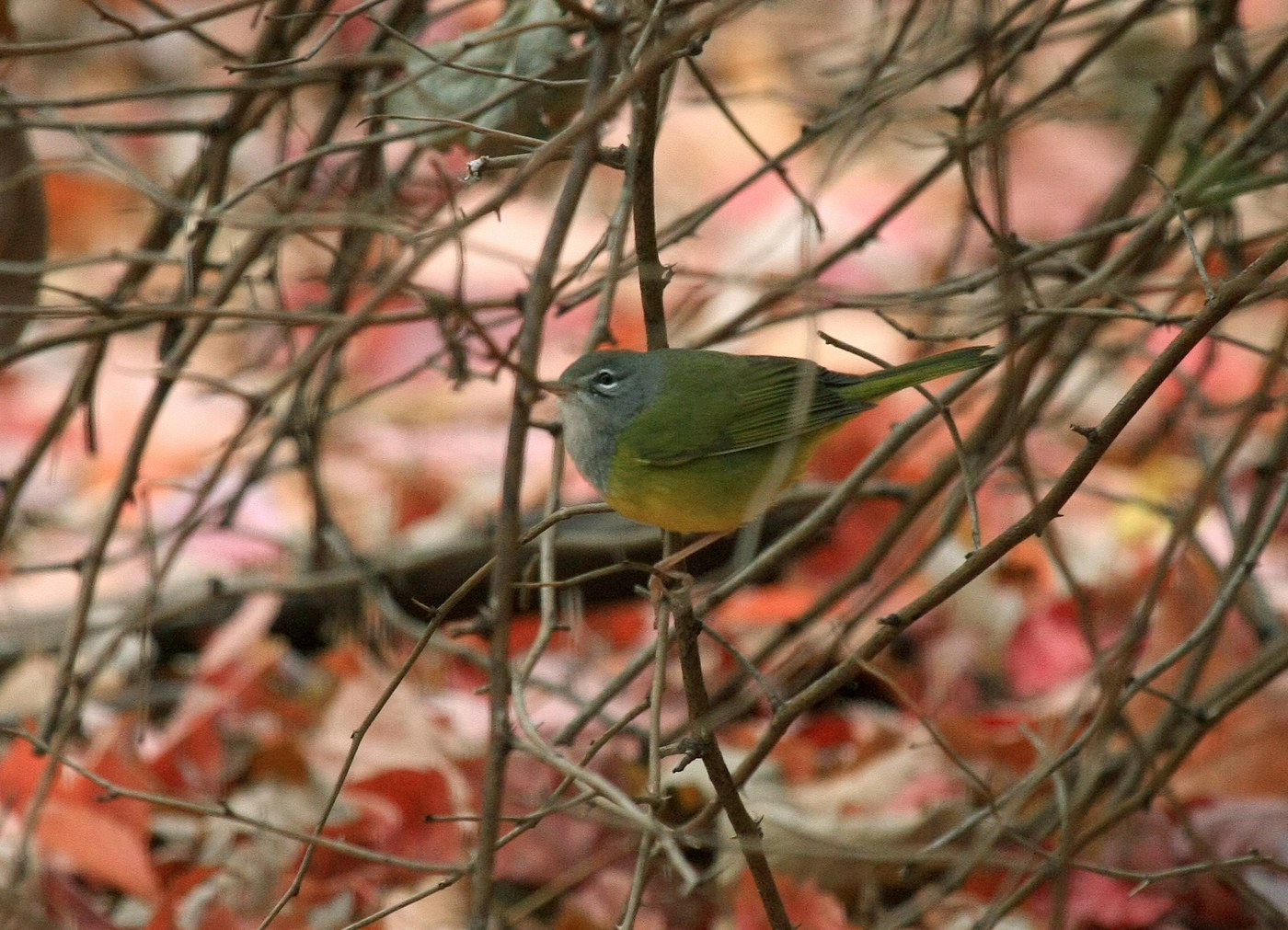
Key Field Marks
- Size & shape: A small, chunky warbler (about 13 cm) with a fairly long tail that it often flicks and pumps while foraging low in vegetation.
- Head & hood: Adult males show a solid slate-gray hood over the head, throat, and upper breast; females and immatures have a paler, more diffuse gray-brown hood.
- Eye-arcs: The single best mark is a pair of broken white crescents above and below the eye ("eye-arcs") — never a complete ring.
- Body: Olive-green back and wings, bright yellow belly and undertail; no wing bars.
- Bill & legs: Fairly thick, pinkish-based bill; pale pinkish legs.
Behavior
Skulks and forages low, often near or on the ground, in tangles of blackberry, ceanothus, willow, and other dense understory shrubs, usually staying hidden and hopping through cover rather than flying in the open. Frequently flicks its tail sideways or pumps it downward, a helpful habit for picking it out in thick brush.
Separating It From Similar Species
- Mourning Warbler (largely allopatric, breeding farther east): Lacks eye-arcs entirely, or shows at most a thin, faint lower arc; hood often looks more blended into the yellow underparts with less contrast. Ranges barely overlap in the northern Rockies/Canada, where caution is needed.
- Connecticut Warbler: Larger, longer-winged, with a bold complete white eye-ring (not broken arcs), and it walks rather than hops; also a much shyer, more terrestrial forager of different habitat (bogs, aspen groves).
- Common Yellowthroat: Males have a black facial mask edged in white/gray, not a gray hood with eye-arcs; females lack any hood.
Where & When to See It
Breeds in dense understory of montane and coastal forests across western North America, from southeast Alaska and British Columbia south through the Pacific Northwest, the Rockies, and into the mountains of the southwestern U.S. and Mexico. A long-distance migrant, it winters from Mexico south to Panama and northern South America. Look for it in shrubby regrowth, riparian thickets, and brushy clearcuts from May through August; migrants pass through lowland thickets and hedgerows in spring and fall.
Voice
The song is a loud, rolling series of paired notes, often rendered as "sweeter-sweeter-sweeter-sweet," with the last note sometimes dropping in pitch. The call is a sharp, dry "tsik" or "plick," similar to but slightly different from the calls of Mourning and Common Yellowthroat, often the first clue to a bird's presence in dense cover before it is ever seen.
Frequently asked questions
What is the single best mark to separate MacGillivray's Warbler from Mourning Warbler?
Broken white eye-arcs above and below the eye. MacGillivray's shows them clearly; Mourning Warbler lacks them or shows only a faint lower crescent.
Does MacGillivray's Warbler have a complete white eye-ring like Connecticut Warbler?
No. Its eye-arcs are broken into two separate crescents, not a full ring, and it is smaller and hops rather than walks like Connecticut Warbler.
Where is the best place to look for MacGillivray's Warbler?
Dense low shrub tangles and brushy regrowth in western mountains and coastal forests, from southeast Alaska south through the Rockies and Pacific states, generally staying low and hidden.
How can I tell a female MacGillivray's Warbler from a male?
Females and immatures show a paler, less sharply defined gray hood than the solid slate-gray hood of adult males, but both sexes retain the diagnostic broken white eye-arcs.
What does MacGillivray's Warbler sound like?
A loud, rolling, paired-note song often described as 'sweeter-sweeter-sweeter-sweet,' and a sharp, dry 'tsik' call note.