
Macaroni Penguin Identification Guide
A sub-Antarctic crested penguin with bushy orange-yellow head plumes meeting at the forehead, breeding in vast colonies on remote southern islands.
Read the full Macaroni Penguin encyclopedia entry →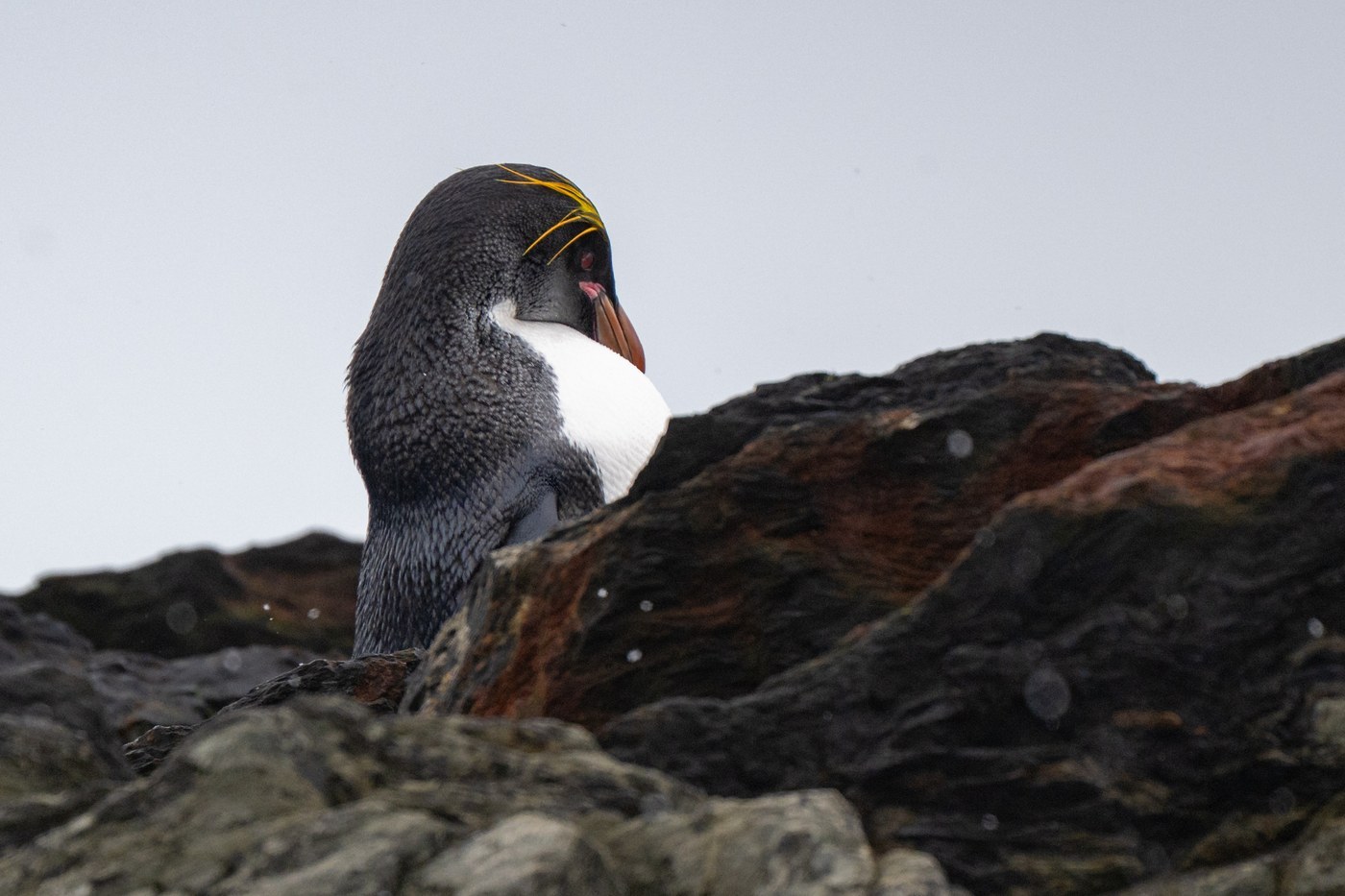
Key Field Marks
- Size & shape: A medium-large, stocky penguin with a bull-necked build, a heavy orange-brown bill, and pinkish-flesh feet.
- Crest: The signature field mark — drooping, bushy orange-yellow plumes that arise from the center of the forehead and sweep back over the head, meeting (or nearly meeting) above the base of the bill, unlike the separated eyebrow-style plumes of rockhopper penguins.
- Face & upperparts: Black head, chin, throat, and upperparts contrast sharply with clean white underparts.
- Eyes: Reddish-brown to red.
- Behavior: Highly colonial, nesting in enormous, dense colonies on rocky slopes and cliffs of sub-Antarctic islands, often numbering in the hundreds of thousands of pairs at major sites.
Separating from Similar Crested Penguins
- Royal Penguin: Very similar and sometimes treated as the same species or a close subspecies; Royal Penguin shows a whitish to pale gray face rather than the Macaroni's solid black face, and breeds essentially only on Macquarie Island, so range and face color together resolve the identification.
- Rockhopper Penguins (Southern/Northern/Eastern): Noticeably smaller, with thinner yellow eyebrow-stripe plumes that project outward to the sides rather than meeting at the forehead, brighter red eyes, and a smaller bill; rockhoppers also have a more actively hopping gait among rocks.
- Erect-crested Penguin: Similar crest concept but plumes are more erect/bristly rather than drooping, and range does not overlap (New Zealand subantarctic islands).
Where & When to See It
Breeds in immense colonies on rocky, often steep coastal slopes of sub-Antarctic islands, including South Georgia, the Falkland Islands, Kerguelen, Crozet, and other Southern Ocean island groups — among the most numerous penguin species in the world by total population despite ongoing declines at some colonies. Birds are present at colonies mainly during the austral spring and summer breeding season, dispersing to forage at sea (sometimes far offshore) during the nonbreeding months.
Voice
Loud, harsh, braying and trumpeting calls are given constantly at breeding colonies, used in mate recognition and territorial disputes amid the dense, noisy crowds of nesting birds.
Frequently asked questions
What is the key field mark of a Macaroni Penguin?
Bushy, drooping orange-yellow crest plumes that arise from the center of the forehead and meet above the bill, combined with a solid black face.
How do you tell a Macaroni Penguin from a Rockhopper Penguin?
Macaroni Penguin is larger with thicker crest plumes that meet at the forehead, while Rockhopper Penguins are smaller with thinner eyebrow-like plumes that project outward to the sides rather than meeting.
What is the difference between Macaroni and Royal Penguin?
Royal Penguin has a whitish to pale gray face, while Macaroni Penguin has a solid black face; Royal Penguin also breeds almost exclusively on Macquarie Island, making range a useful clue.
Where do Macaroni Penguins breed?
In enormous colonies on rocky slopes of sub-Antarctic islands such as South Georgia, the Falkland Islands, Kerguelen, and Crozet, mainly during the austral spring and summer.