
Lucifer Hummingbird Identification Guide
A small desert hummingbird of the U.S.-Mexico borderlands, identified by its strongly decurved bill and, in males, an elongated iridescent purple gorget.
Read the full Lucifer Hummingbird encyclopedia entry →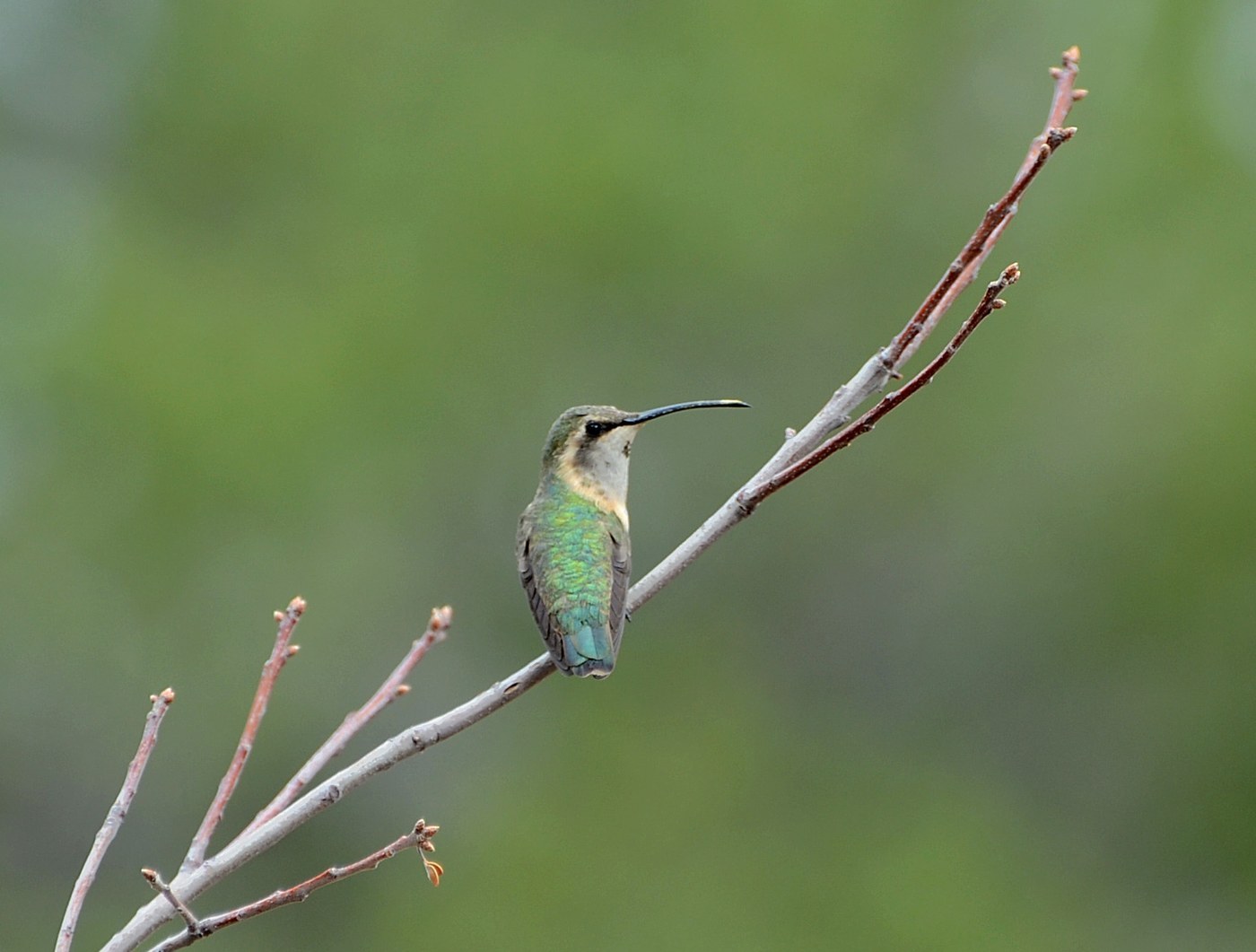
Key Field Marks
- Size & shape: A small hummingbird with a distinctly forked tail and a notably decurved (downward-curved) bill — a feature not shared by most other regularly occurring U.S. hummingbirds, making bill shape one of the quickest clues to this species.
- Male: Brilliant iridescent purple-magenta gorget that flares out and elongates at the sides into pointed extensions, green crown and back, whitish underparts, and a deeply forked, mostly dark tail.
- Female: Lacks the gorget; buffy underparts, green upperparts, decurved bill like the male, and a rounded (not forked) tail edged with rufous and white tips.
- Behavior: Feeds heavily at agave and other tubular desert flowers, for which the curved bill is well suited; males perform steep aerial display dives near territories.
Separating from Similar Species
- Black-chinned Hummingbird: Has a straight bill and different gorget color/shape (black shading to violet at the base rather than an elongated magenta gorget); overlaps in range but the decurved bill of Lucifer is diagnostic.
- Beautiful Hummingbird (mainly Mexico): Similar decurved-bill group but differs in gorget color and range; rarely an identification issue within the U.S.
- Costa's Hummingbird: Has a straight bill and a violet (not magenta) gorget that sweeps back in points from the face rather than flaring at the throat sides. The strongly decurved bill, unique among regularly occurring U.S. hummingbirds, is the fastest way to rule in Lucifer Hummingbird.
Where & When to See It
A localized summer breeder in desert scrub, agave-covered slopes, and rocky canyons of the U.S.-Mexico borderlands, most notably in the Big Bend region of far west Texas and in southeastern Arizona, with the core of its range extending into the Mexican highlands. It is present in the U.S. mainly from spring through late summer/early fall before withdrawing south for winter.
Voice
Gives high, thin chip notes; males produce a buzzy sound with their wings during steep display dives near territorial perches.
Frequently asked questions
What is the fastest way to identify a Lucifer Hummingbird?
Look for a strongly decurved bill — a feature not shared by most other U.S. hummingbirds — combined, in males, with an elongated magenta gorget and deeply forked tail.
Where in the U.S. can Lucifer Hummingbird be found?
It is a localized summer breeder in desert and canyon habitat, primarily in the Big Bend area of far west Texas and in southeastern Arizona.
How do you tell a female Lucifer Hummingbird from other female hummingbirds?
Her decurved bill combined with buffy underparts and a rounded, rufous-edged tail help separate her from straighter-billed species like Black-chinned Hummingbird.
What habitat does Lucifer Hummingbird prefer?
Arid desert scrub and rocky canyon slopes, especially areas with flowering agave, which its curved bill is well adapted to feed from.