
Long-tailed Sylph Identification Guide
An Andean cloud-forest hummingbird whose male sports an extravagantly long, deeply forked, glittering blue-green tail.
Read the full Long-tailed Sylph encyclopedia entry →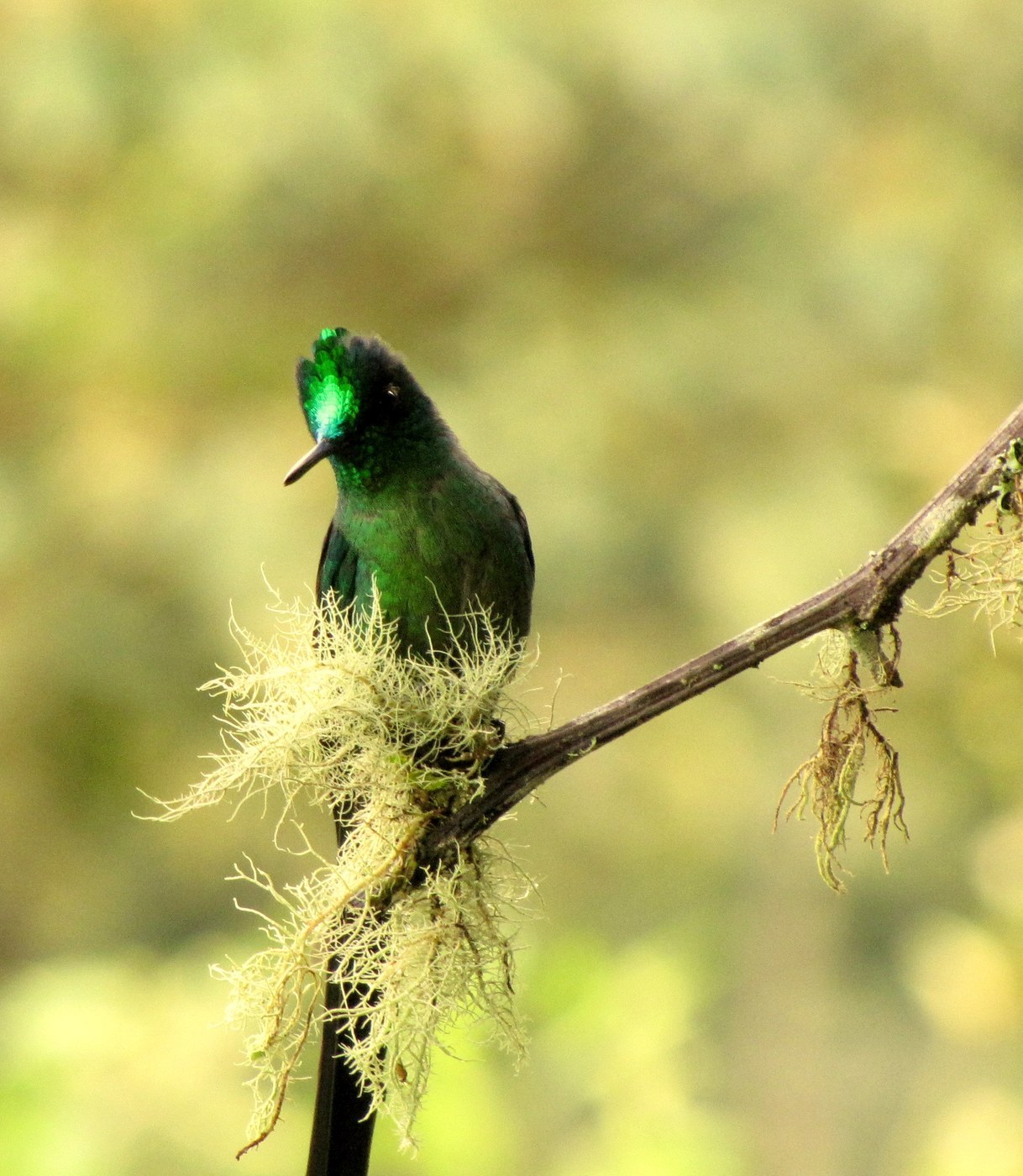
Key Field Marks
- Size & shape: A medium hummingbird whose male is dominated by an extraordinarily long, deeply forked tail that can be two to three times the length of the body — one of the most dramatic tails of any hummingbird.
- Male plumage: Glittering green body with a shining blue-violet crown, and the signature elongated, iridescent blue-green tail streamers.
- Female plumage: Much shorter, notched (not deeply forked) tail; green above, buffy below with green spangling across the throat.
- Behavior: Feeds at flowering shrubs and trees along forest edges and clearings, often perching between feeding bouts (unlike some hummingbirds that hover constantly), which allows better views of the tail.
Separating from Similar Species
- Violet-tailed Sylph: Very similar in shape, but its tail is violet-blue rather than blue-green, and it replaces Long-tailed Sylph on the Pacific slope of the Andes in Colombia and Ecuador, while Long-tailed Sylph occupies the eastern Andean slopes from Venezuela south to Bolivia — range is often the quickest way to separate the two.
- Other long-tailed hummingbirds (e.g., trainbearers): Trainbearers have thinner, less deeply forked tails and different head coloring; sylphs show a more triangular, deeply cleft fork.
- Female/immature sylphs are harder to identify to species and are best distinguished by range and, if seen well, subtle throat spangling and tail shape.
Where & When to See It
Found in humid montane and cloud forest edges and adjacent shrubby clearings on the eastern slope of the Andes, roughly from Venezuela and Colombia south through Ecuador and Peru to Bolivia, typically between about 1,500 and 2,800 meters elevation. It is a year-round resident within this elevational band, though some local elevational movement can occur following flowering.
Voice
Gives high-pitched twittering and chattering notes typical of hummingbirds, along with soft chase calls during territorial disputes at flowering shrubs.
Frequently asked questions
What is the most obvious field mark of a male Long-tailed Sylph?
An extremely long, deeply forked, glittering blue-green tail that can be several times the length of the body.
How do you tell Long-tailed Sylph from Violet-tailed Sylph?
Tail color and range are the best clues: Long-tailed Sylph has a blue-green tail and occurs on the eastern Andean slope, while Violet-tailed Sylph has a violet-blue tail and occurs on the Pacific slope of Colombia and Ecuador.
Do female Long-tailed Sylphs have the long tail too?
No, females have a much shorter, simply notched tail and lack the male's dramatic elongated streamers.
At what elevation is Long-tailed Sylph typically found?
Roughly 1,500 to 2,800 meters, in humid montane and cloud forest edge habitat along the eastern slope of the Andes.