
Long-eared Owl Identification Guide
A slender, secretive woodland owl with tall, close-set ear tufts and rich rufous facial disc, best located by its communal winter roosts.
Read the full Long-eared Owl encyclopedia entry →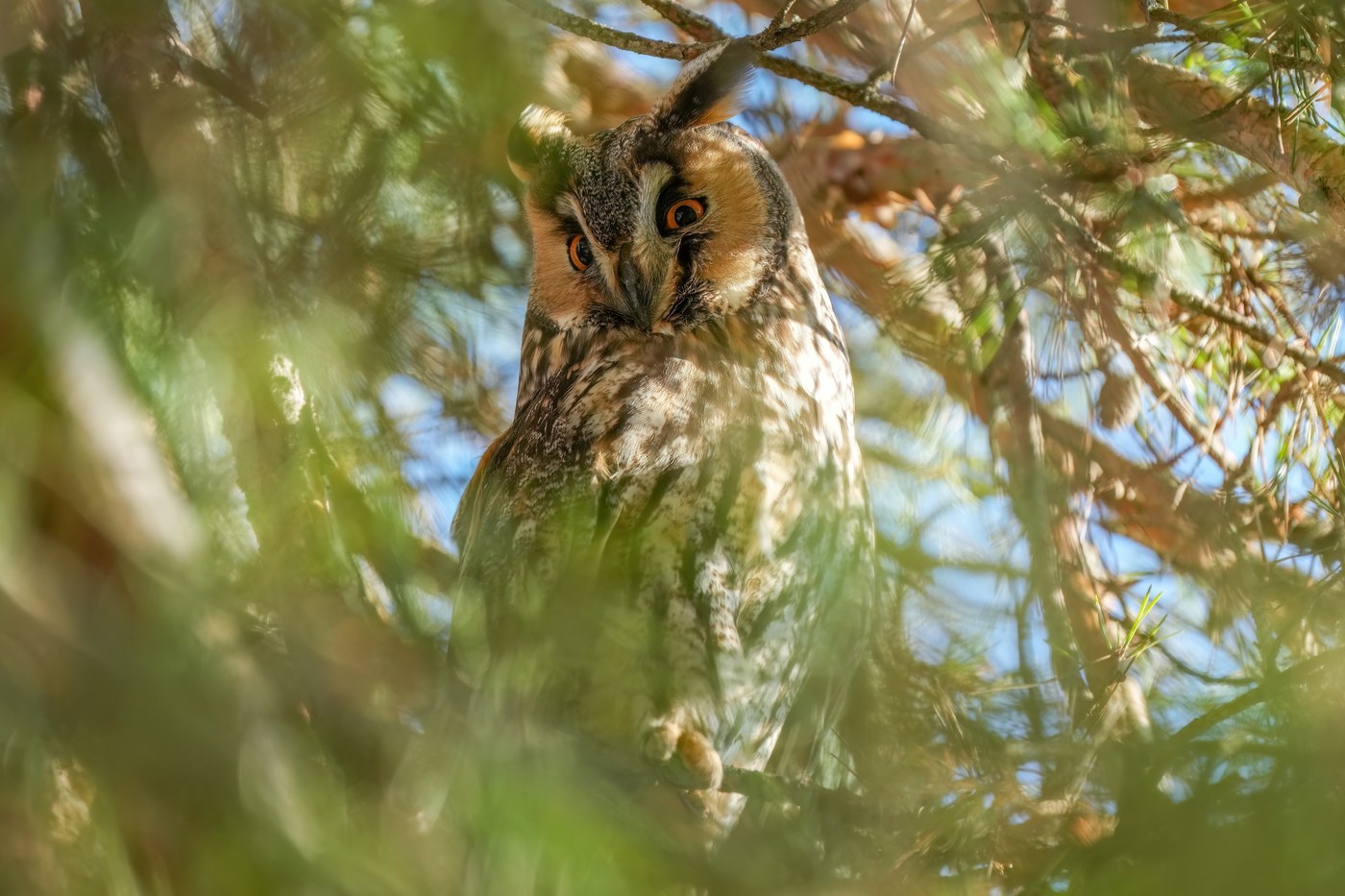
Key Field Marks
- Size & shape: A medium-sized owl, slimmer and less bulky than a Great Horned Owl, with a notably narrow, upright posture when roosting.
- Ear tufts: Long, held close together and vertically over the center of the head — a key difference from the widely-spaced tufts of Great Horned Owl.
- Face: Rich orange-rufous facial disc rimmed with black, and bright orange-yellow eyes.
- Plumage: Intricately streaked and vermiculated brown, buff, and gray overall, providing excellent camouflage against tree bark when the bird stretches upright and thin.
- Behavior: Highly nocturnal and secretive; roosts by day pressed close to a tree trunk in dense cover, often communally with other Long-eared Owls in winter.
Separating from Similar Owls
- Great Horned Owl: Much larger and bulkier, with widely-spaced ear tufts and a white throat patch; Long-eared Owl is noticeably slimmer with tufts set close together.
- Short-eared Owl: Has very short, often invisible ear tufts, paler overall coloring, dark "wrist" patches visible in flight, and is regularly active at dusk/dawn (crepuscular) hunting low over open fields with buoyant, floppy flight — quite unlike the Long-eared Owl's strict nocturnal habits and preference for roosting in dense woodland cover.
- Screech-owls: Much smaller, stockier, with shorter ear tufts and different vocalizations.
Where & When to See It
Breeds in dense conifer or mixed woodland patches, often adjacent to open hunting habitat, across much of Canada, the northern and western United States, and Eurasia. In winter, many birds move south into communal roosts within thick shelterbelts, conifer groves, and riparian thickets, sometimes with a dozen or more birds roosting together. Because it is so secretive, most sightings come from patient searching of likely winter roost sites rather than chance encounters.
Voice
Mostly silent outside the breeding season. On territory, males give a low, breathy hoo repeated at intervals of a few seconds; both sexes also give barking, catlike, and wing-clap sounds during display flights.
Frequently asked questions
How can I tell a Long-eared Owl from a Great Horned Owl?
Long-eared Owl is noticeably slimmer with ear tufts held close together near the center of the head, while Great Horned Owl is bulkier with widely-spaced tufts and a white throat patch.
What is the difference between Long-eared and Short-eared Owls?
Short-eared Owl has very short or invisible ear tufts, paler plumage, and hunts actively over open fields at dusk with floppy flight, while Long-eared Owl has tall, obvious ear tufts and stays hidden in dense woodland roosts during the day, emerging only after dark.
Where is the best place to find a Long-eared Owl?
Search dense conifer groves, shelterbelts, or thick riparian cover, especially communal winter roost sites, since the species is highly secretive and roosts pressed against tree trunks by day.
What sound does a Long-eared Owl make?
A low, breathy hoo repeated steadily by territorial males; the species is largely silent outside the breeding season.