
Long-billed Thrasher Identification Guide
A South Texas thorn-scrub specialist with rich rufous plumage, bold streaking, and a long curved bill, closely related to the Brown Thrasher.
Read the full Long-billed Thrasher encyclopedia entry →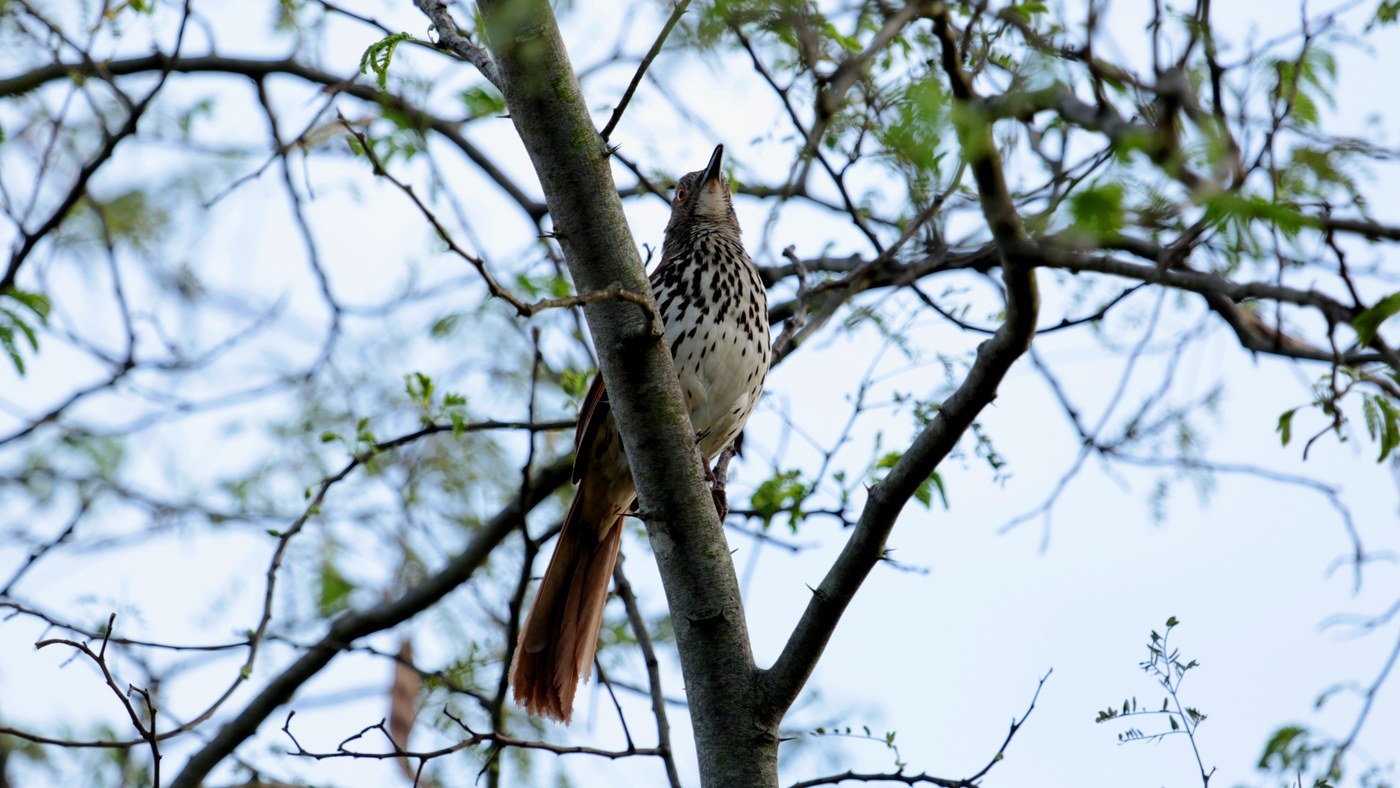
Key Field Marks
- Size & shape: A slender, long-tailed songbird about the size of a large thrush, with a strongly downcurved, blackish bill that is proportionately longer than that of most other thrashers.
- Plumage: Rich rufous-brown upperparts and tail, with a contrastingly grayer face and crown. Underparts are whitish to pale gray with bold, heavy blackish streaking from the throat to the flanks.
- Eye: Bright orange to yellow-orange, standing out against the gray face.
- Behavior: Skulking and secretive, spends much of its time low in dense brush or on the ground tossing leaf litter aside while foraging; often detected by voice before it is seen.
Separating from Brown Thrasher
The two are close relatives and were once considered the same species. Where ranges meet in southern Texas, look for:
- Head color: Long-billed shows a distinctly gray face and crown contrasting with the brown back; Brown Thrasher's head is uniformly rufous-brown like the back.
- Bill: Long-billed's bill is longer and more strongly curved.
- Overall tone: Long-billed is a richer, darker rufous above with bolder, blacker, more solidly-marked streaking below; Brown Thrasher is paler rufous with finer, more diffuse streaking.
- Range: Brown Thrasher is rare to absent in the Long-billed Thrasher's core range (the Rio Grande Valley and South Texas brushlands), so location alone is often decisive.
Where & When to See It
A non-migratory resident confined almost entirely to South Texas (and adjacent northeastern Mexico), where it inhabits dense thorn-scrub, mesquite brushlands, and riparian woodland edges. It can be found year-round and does not undertake long-distance migration, though local movements occur.
Voice
Song is a rich, musical series of phrased notes, often doubled or tripled, similar in cadence to other thrashers and mockingbirds but with fewer mimicked phrases and a slower, more deliberate delivery. The call is a sharp, whistled cheeoo or a harsh chek.
Frequently asked questions
How do you tell a Long-billed Thrasher from a Brown Thrasher?
Look for a gray face contrasting with a rufous back, a longer more strongly curved bill, and bolder, blacker streaking below. Brown Thrasher has a uniformly rufous head and paler, finer streaking, and rarely occurs in the Long-billed Thrasher's South Texas range.
Where is the best place to find a Long-billed Thrasher?
The Rio Grande Valley and South Texas brushlands are the core range; it is a year-round resident there and essentially absent elsewhere in the U.S.
Does the Long-billed Thrasher migrate?
No, it is largely non-migratory and stays on territory in dense thorn-scrub habitat throughout the year.
What does a Long-billed Thrasher sound like?
A rich, musical song of doubled or tripled phrases, plus a sharp whistled cheeoo call and a harsher chek note.