
Long-billed Dowitcher Identification Guide
A chunky, long-billed shorebird best told from the nearly identical Short-billed Dowitcher by voice, habitat, and fine plumage details.
Read the full Long-billed Dowitcher encyclopedia entry →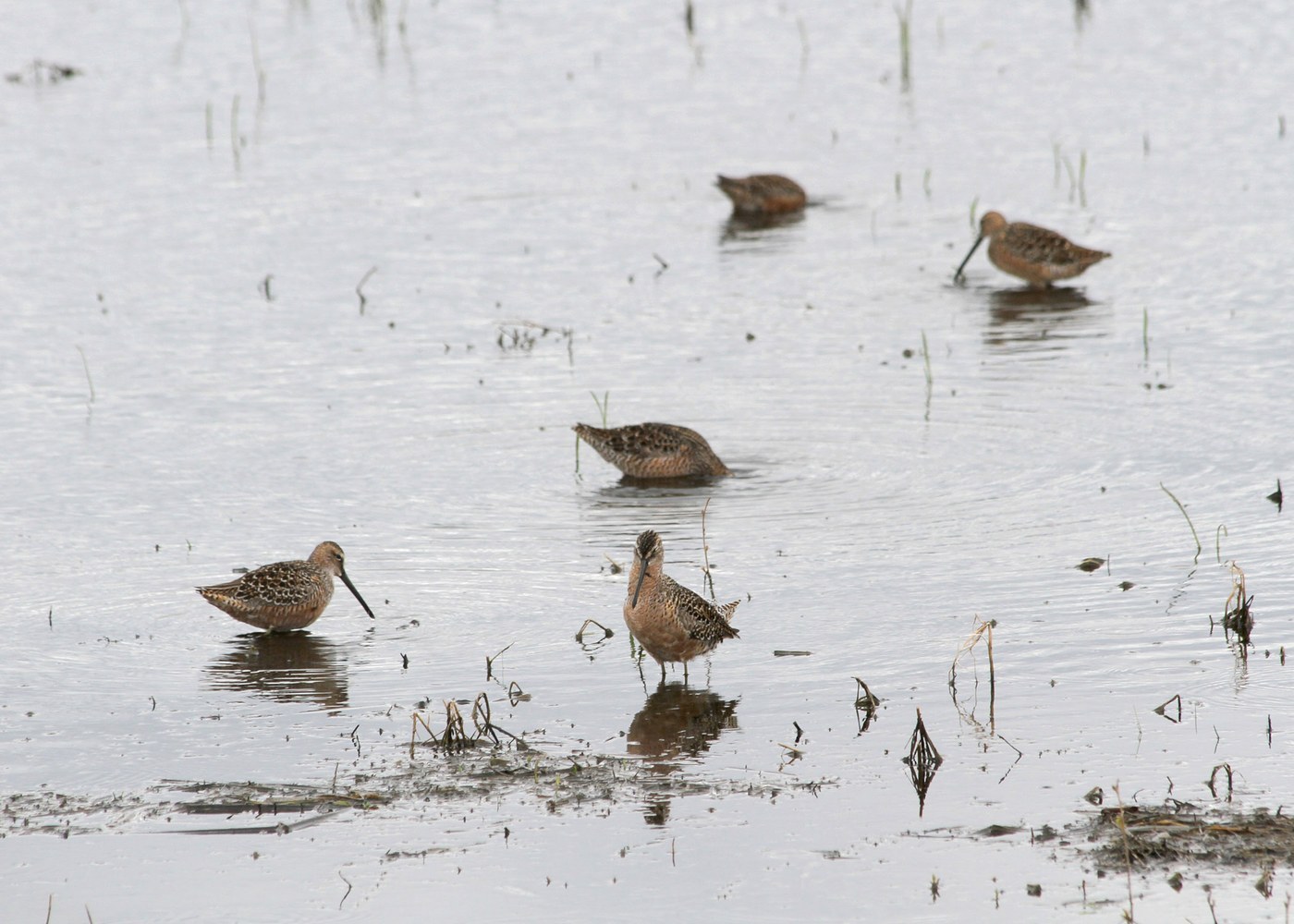
Key Field Marks
- Size & shape: A plump, football-shaped shorebird with short legs and a very long, straight bill used to probe mud "sewing-machine" style, plunging up and down rapidly.
- Bill: Long and straight, noticeably longer in females than males; longer on average than Short-billed Dowitcher's, but bill length overlaps too much between the species to be a reliable field mark on its own.
- Breeding plumage: Rich reddish-orange underparts extending onto the belly and undertail coverts, with dense dark barring along the flanks that often continues across the belly. Back feathers are dark with rufous-buff fringes.
- Nonbreeding plumage: Plain gray overall — gray breast, white belly, and a gray-brown back with faint scaling — much less distinctive than breeding birds.
- In flight: White wedge up the back and a barred tail (dark bars wider than the white bars, giving a darker overall tail impression than Short-billed).
Separating from Short-billed Dowitcher
This is one of the classic hard shorebird ID pairs. Useful clues, in order of reliability:
- Voice is the most reliable feature: Long-billed gives a sharp, single or repeated keek note; Short-billed gives a mellow, tri-syllabic tu-tu-tu.
- Habitat/salinity: Long-billed strongly prefers freshwater and brackish wetlands (flooded fields, mudflats along rivers and ponds); Short-billed favors coastal saltwater habitats, tidal mudflats, and estuaries. This is a strong probabilistic clue, especially inland.
- Breeding-plumage barring: Long-billed shows barring extending across the belly with little or no white showing; Short-billed shows more spotting on the breast fading to a whiter belly, especially in the eastern subspecies.
- Tail pattern: Long-billed's tail bars are black and wider than the white bars (looks darker); Short-billed's are more evenly black-and-white or white-dominant.
- Structure: Long-billed tends to look slightly more attenuated with proportionately longer bill, but this is subtle and not diagnostic alone.
Where & When to See It
Breeds on wet Arctic tundra in Alaska and far northern Canada, and in eastern Siberia. During migration and winter it is found across the interior United States on freshwater impoundments, flooded agricultural fields, and pond edges, as well as on the coasts. It winters from the southern United States through Mexico and Central America, generally in more inland/freshwater sites than Short-billed Dowitcher, which winters more coastally.
Voice
The single, sharp keek or peep note, often given in flight or when flushed, is the best confirming clue and differs clearly from the mellow triple note of Short-billed Dowitcher.
Frequently asked questions
What is the single best way to tell a Long-billed from a Short-billed Dowitcher?
Voice. Long-billed gives a sharp single-note keek, while Short-billed gives a mellow three-note tu-tu-tu. Plumage and bill length overlap too much to be reliable alone.
Does bill length reliably separate the two dowitcher species?
No. Despite the name, bill lengths overlap significantly, especially between long-billed females and short-billed males, so bill length alone is not diagnostic.
Is habitat useful for identifying dowitchers?
Yes, as a strong clue: Long-billed Dowitchers favor freshwater and brackish wetlands, while Short-billed Dowitchers favor coastal saltwater mudflats, though there is some overlap during migration.
Where does the Long-billed Dowitcher breed?
It breeds on wet tundra in Alaska, far northern Canada, and eastern Siberia, and winters mainly in the southern U.S., Mexico, and Central America.