
Long-billed Curlew Identification Guide
North America's largest shorebird, unmistakable thanks to its extremely long, decurved bill and warm cinnamon-buff plumage.
Read the full Long-billed Curlew encyclopedia entry →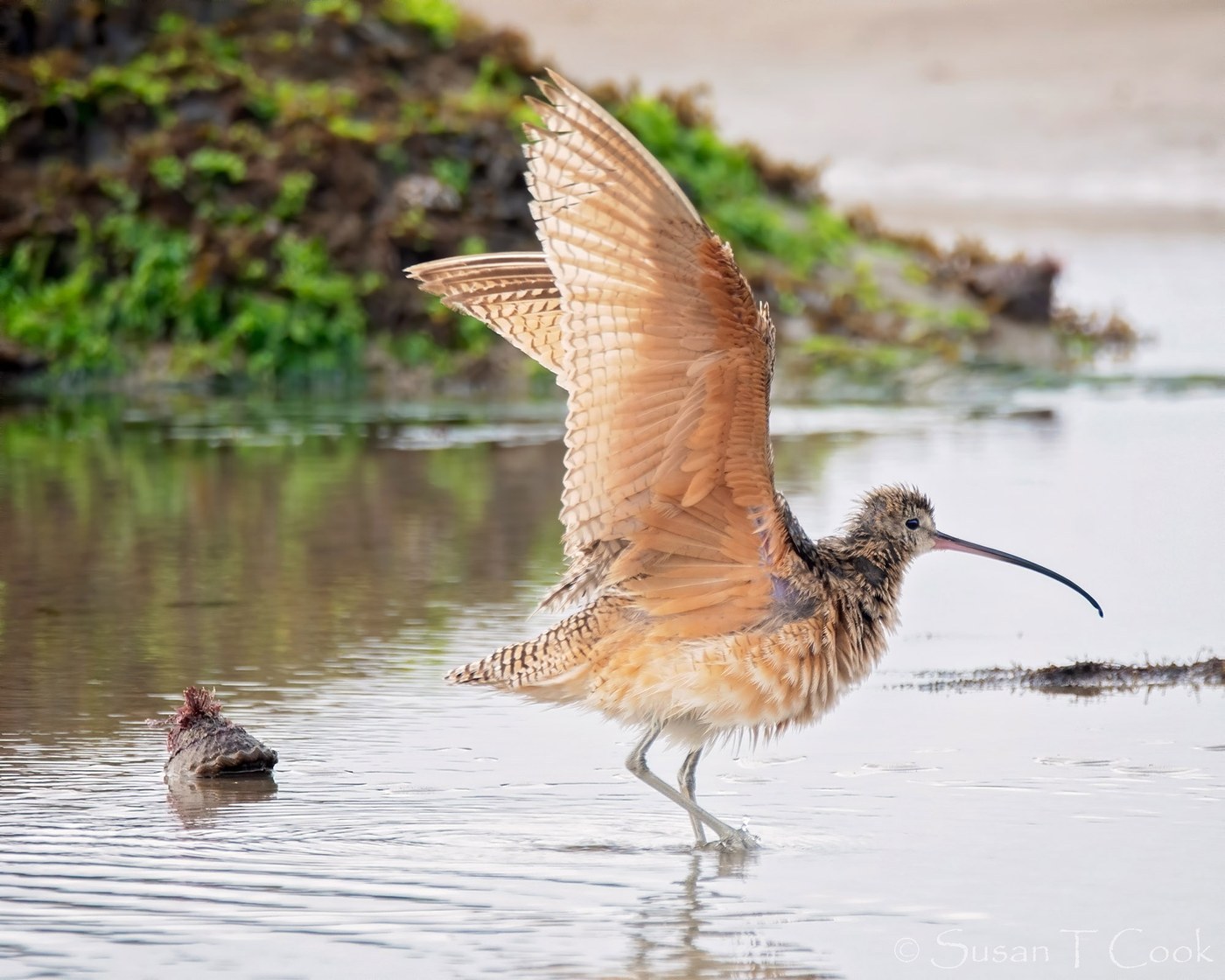
Key Field Marks
- Size & shape: The largest North American shorebird, 50–65 cm long, with a heavy body, long bluish-grey legs, and a spectacularly long, evenly decurved bill (females have noticeably longer bills than males, sometimes exceeding 20 cm).
- Plumage: Warm cinnamon-buff overall, with darker brown streaking and barring on the back and wings; the crown lacks strong stripes, unlike some relatives.
- In flight: Bright cinnamon underwings are a striking and diagnostic feature, contrasting with the duller upperparts.
- Behavior: Probes deeply into mud or soil with its long bill for invertebrates; on breeding grounds also forages on drier upland areas, picking insects from the surface.
Separating It From Similar Species
- Whimbrel: Smaller with a shorter, more sharply kinked (rather than smoothly decurved) bill and a bold striped crown pattern that Long-billed Curlew lacks.
- Marbled Godwit: Bill is long but slightly upturned rather than downcurved, and overall plumage is less richly cinnamon, especially on the underwing.
- Eurasian/Far Eastern Curlew (rare vagrants): Larger overall size and different underwing color (whiter or greyer rather than cinnamon) help distinguish these from Long-billed Curlew, though such species do not normally overlap in range.
Where & When to See It
- Habitat: Breeds in shortgrass and mixed-grass prairies, grazed grasslands, and semi-arid plains of the interior western United States and southern Canada; winters on coastal mudflats, estuaries, beaches, and agricultural fields.
- Range: Breeding range spans the Great Plains and Intermountain West of North America; winters along the Pacific, Gulf, and southern Atlantic coasts of the U.S. and into Mexico and Central America.
- Season: Present on breeding grounds in spring and summer; migrates to coastal and lowland wintering areas by autumn, with some individuals wintering as far as Central America.
Voice
- A loud, rolling, rising "cur-lee" call that gives curlews their name, along with a variety of whistled and bubbling notes, especially during display flights on the breeding grounds.
Frequently asked questions
What is the single best field mark for the Long-billed Curlew?
Its extremely long, evenly decurved bill combined with cinnamon-colored underwings visible in flight make it essentially unmistakable among North American shorebirds.
How does the Long-billed Curlew differ from the Whimbrel?
Long-billed Curlew is larger with a much longer, smoothly curved bill and a plain crown, while Whimbrel is smaller with a shorter, more angled bill and bold dark crown stripes.
Do male and female Long-billed Curlews look different?
They look similar in plumage, but females typically have significantly longer bills than males, an unusual degree of sexual dimorphism in bill length.
Where does the Long-billed Curlew breed?
It breeds in shortgrass and mixed-grass prairie and other open grassland habitats across the interior western United States and southern Canada, away from water.