
Long-billed Corella Identification Guide
A white Australian cockatoo with an elongated bill and extensive crimson markings on the face and breast, used for digging up roots and bulbs.
Read the full Long-billed Corella encyclopedia entry →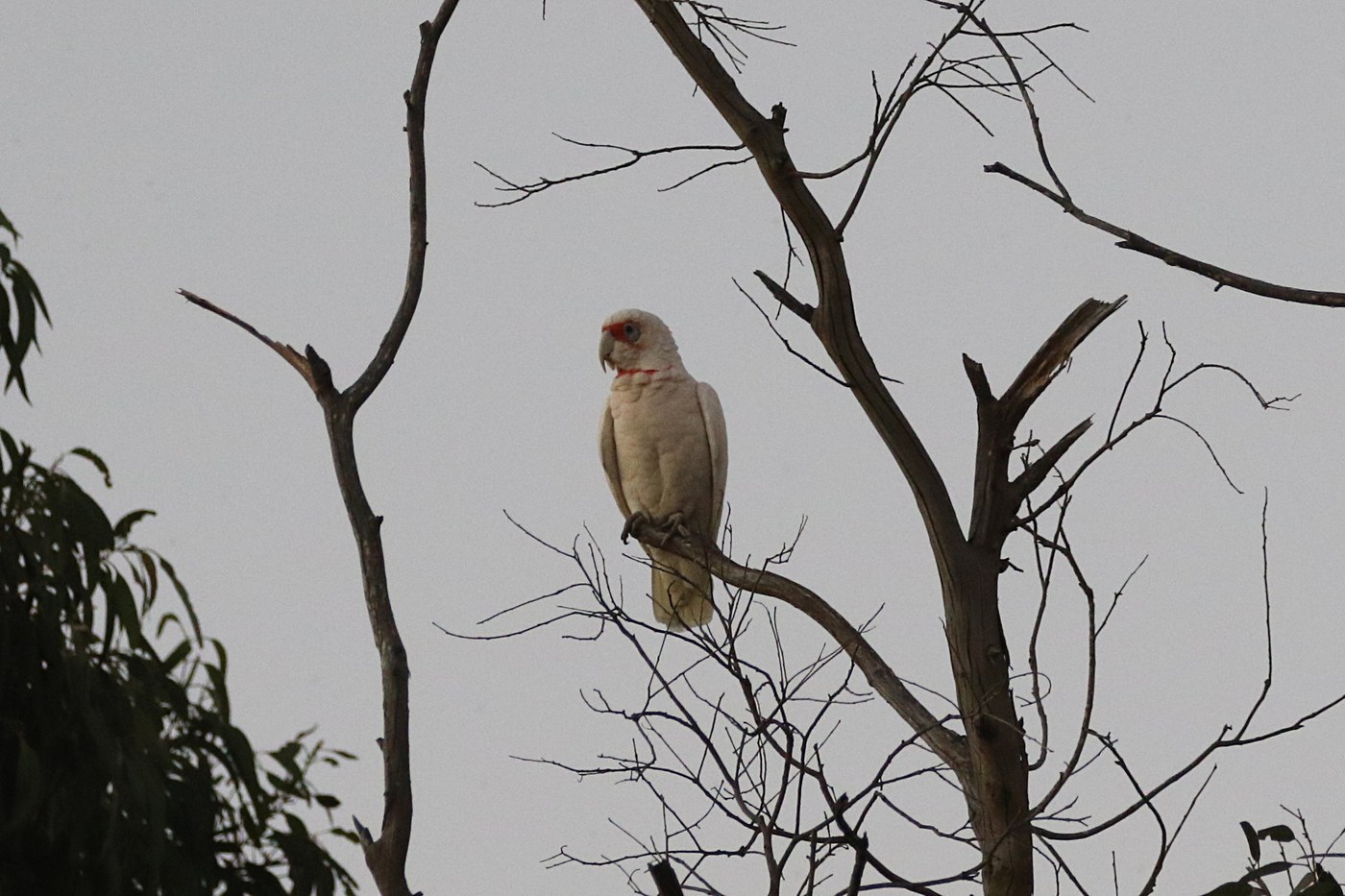
Key Field Marks
- Size & shape: Medium-sized cockatoo, about 38–41 cm, with a distinctly long, slender, curved upper mandible — much longer than in related corellas — adapted for digging in soil.
- Plumage: Predominantly white with a short, low crest rarely raised.
- Face & breast: Extensive crimson-red patch across the forehead and lores, plus a red-pink band or splash across the throat and upper breast — far more extensive than in the Little Corella.
- Eye-ring: Pale bluish bare skin around the eye.
- Legs: Dark grey.
- Behavior: Feeds heavily on the ground, using its long bill to dig up bulbs, corms, and roots — a distinctive behavior linked to its bill shape.
Separating It From Similar Species
- Little Corella: Shorter, stubbier bill and only a small, subtle salmon-pink facial patch with no red breast band; Long-billed Corella's bill and red markings are both far more extensive.
- Galah: Has a solid pink breast and grey back/wings, quite different from the white body and localized red markings of the Long-billed Corella.
- Sulphur-crested Cockatoo: Larger, with a prominent yellow crest, lacking any red facial or breast markings.
Where & When to See It
- Habitat: Open grassy woodlands, pastures, farmland, and increasingly parks and playing fields where it digs for underground plant material.
- Range: Native to a relatively restricted area of southeastern Australia (parts of Victoria, southern New South Wales, and South Australia), but escaped/released birds have established feral populations well beyond this range, including in Western Australia and New Zealand.
- Season: Resident and gregarious year-round, often forming large flocks, sometimes mixing with Little Corellas or Galahs.
Voice
- A distinctive, quavering "wulik-wulik" or rolling "currup" call, along with harsh screeches typical of corellas.
Frequently asked questions
What is the clearest way to distinguish a Long-billed Corella from a Little Corella?
Look at the bill length and facial markings: Long-billed Corella has a noticeably long, curved bill and extensive red markings across the face and breast, while Little Corella has a short bill and only a small, subtle facial patch.
Why does the Long-billed Corella have such a long bill?
Its elongated bill is adapted for digging into soil to extract bulbs, corms, and roots, a major part of its diet.
Is the Long-billed Corella native to all of Australia?
No, its natural range is fairly restricted to parts of southeastern Australia, though feral populations from escaped aviary birds now occur in other regions, including Western Australia and New Zealand.
Do Long-billed Corellas flock with other cockatoo species?
Yes, they often mix with Little Corellas, Galahs, or Sulphur-crested Cockatoos in feeding and roosting flocks.