
Little Owl Identification Guide
A small, flat-headed owl often seen perched openly in daylight, easily known by its staring yellow eyes and white eyebrow markings.
Read the full Little Owl encyclopedia entry →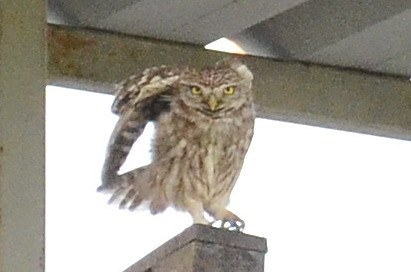
Key Field Marks
- Size & shape: Small and compact, about 21–23 cm, with a flattened, rounded head lacking ear tufts and a short tail.
- Face: Piercing bright yellow eyes set in a pale facial disc with bold whitish streaks above the eyes giving a fierce, frowning "eyebrow" expression.
- Plumage: Brown upperparts heavily spotted with white/cream; underparts pale with brown streaking.
- Posture & behavior: Often perches upright and exposed on fence posts, rocks, roofs, or bare branches in full daylight; bobs its head and bows up-and-down when alert or agitated.
- Flight: Low, fast, and deeply undulating (bounding), somewhat woodpecker-like, usually covering short distances between perches.
Separating It From Similar Species
- Burrowing Owl (Americas): Similar small size and daytime activity, but has longer legs suited to standing on the ground near burrows, and their ranges do not overlap (Little Owl is Old World).
- Pygmy Owl species: Lack the bold whitish eyebrow markings and have a more rounded head without the flat-topped look; also typically more arboreal and less prone to open, low perching.
- Scops/Screech Owls: Have ear tufts (even if small) and are strictly nocturnal, rarely seen perched in daylight, unlike the day-active Little Owl.
Where & When to See It
- Habitat: Open farmland, orchards, olive groves, pastures with old trees, stone walls, barns, or quarries providing nest and roost cavities.
- Range: Native across most of Europe, North Africa, and temperate Asia; successfully introduced to Britain in the 19th century and to New Zealand.
- Season: Resident and non-migratory throughout its range; most easily seen at dawn, dusk, or even midday when it often sits in the open.
Voice
- A plaintive, yelping "kiew" or "kwoo" call; also gives sharp barking and chattering alarm notes, and a rhythmic "goek-goek" territorial call at dusk.
Frequently asked questions
Is the Little Owl active during the day?
Yes, unlike most owls it is frequently active and visible in daylight, often seen perched openly on posts, walls, or bare branches.
How is the Little Owl different from the Burrowing Owl?
They look and behave similarly (small, day-active owls), but they occupy different continents — Little Owl in Eurasia/Africa, Burrowing Owl in the Americas — and Burrowing Owl has proportionately longer legs.
What is a good behavioral clue for identifying a Little Owl?
A distinctive up-and-down bobbing or bowing motion when alarmed or curious, combined with its habit of perching in the open during the day.
Where is the Little Owl found in Britain if it is not native there?
It was successfully introduced to England in the late 1800s and is now well established and resident across much of lowland England and Wales.