
Little Gull Identification Guide
The world's smallest gull, distinguished in breeding plumage by a black hood, dark rounded underwings, and buoyant tern-like flight.
Read the full Little Gull encyclopedia entry →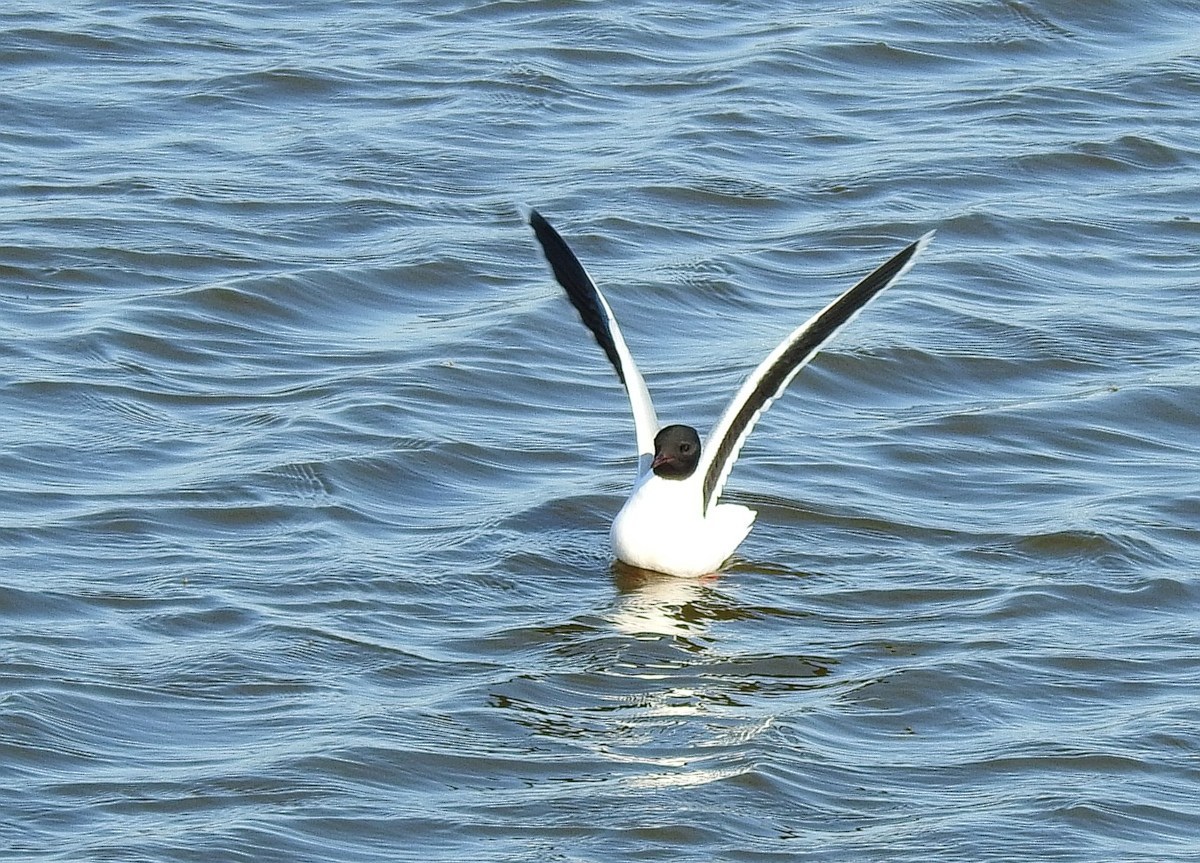
Key Field Marks
- Size & shape: Tiny for a gull, about 25–30 cm with a wingspan of only 61–78 cm; rounded wingtips and a small, delicate bill give it a distinctive silhouette.
- Breeding adult: Jet-black hood, blackish-grey (dusky) underwings that look almost solidly dark in flight, a faint pink flush on the breast, and dark red bill and legs.
- Non-breeding/winter adult: White head with a dark cap-like patch on the crown/nape and a small dark spot behind the eye; underwings remain dusky, a key mark at any season.
- Juvenile/first-winter: Shows a bold blackish "M" or zigzag pattern across the upperwings in flight, reminiscent of a juvenile Kittiwake but smaller and daintier.
- Flight: Light, buoyant, and tern-like, often dipping to pick insects or small fish directly from the water's surface.
Separating It From Similar Species
- Black-headed Gull: Noticeably larger with white leading-edge wing patches and white (not dark) underwings.
- Bonaparte's Gull (North America): Similar small size and black hood but has clean white underwings, unlike Little Gull's dark underwings.
- Ross's Gull: Has a wedge-shaped tail, more extensive pink flush, and a thin black neck ring in breeding plumage — a rarer, more northern species with different structure.
- Kittiwake (juvenile): Larger with a proportionately bigger bill and different flight action; the wing pattern is superficially similar to juvenile Little Gull but on a much bigger bird.
Where & When to See It
- Habitat: Breeds at freshwater marshes, wet meadows, and shallow lakes with emergent vegetation across Eurasia; winters mainly along temperate coasts and estuaries, sometimes far offshore.
- Range: Breeds discontinuously across northern and eastern Europe into western Siberia; winters in Western Europe, the Mediterranean, and Black Sea; a rare but regular visitor to North America, especially the Great Lakes and Atlantic coast.
- Season: Look for breeding-plumaged adults in spring/summer at inland marshes, and non-breeding birds along coasts in autumn and winter.
Voice
- A short, sharp "kek" or "kek-kek" call, softer and higher-pitched than larger gulls.
Frequently asked questions
What makes the Little Gull the easiest small gull to identify?
Its dark, dusky underwings at all ages/seasons combined with its very small size are diagnostic and separate it from similar small gulls like Bonaparte's and Black-headed Gull.
Is the Little Gull the smallest gull species in the world?
Yes, it is generally recognized as the smallest gull species worldwide.
How do I distinguish a winter Little Gull from a winter Black-headed Gull?
Little Gull is smaller with dark underwings and no white leading wing patch, while Black-headed Gull is larger with white underwings and a bold white wedge on the outer wing.
Where would I find a Little Gull in North America?
It is a rare but regular vagrant/winter visitor, most often reported around the Great Lakes and along the Atlantic coast, usually mixed in with flocks of Bonaparte's Gulls.