Little Corella Identification Guide
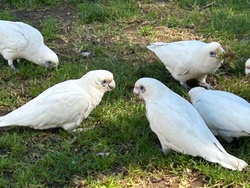
A small, stocky white Australian cockatoo told from similar corellas by its short bill and only a faint salmon-pink face patch.
Read the full Little Corella encyclopedia entry →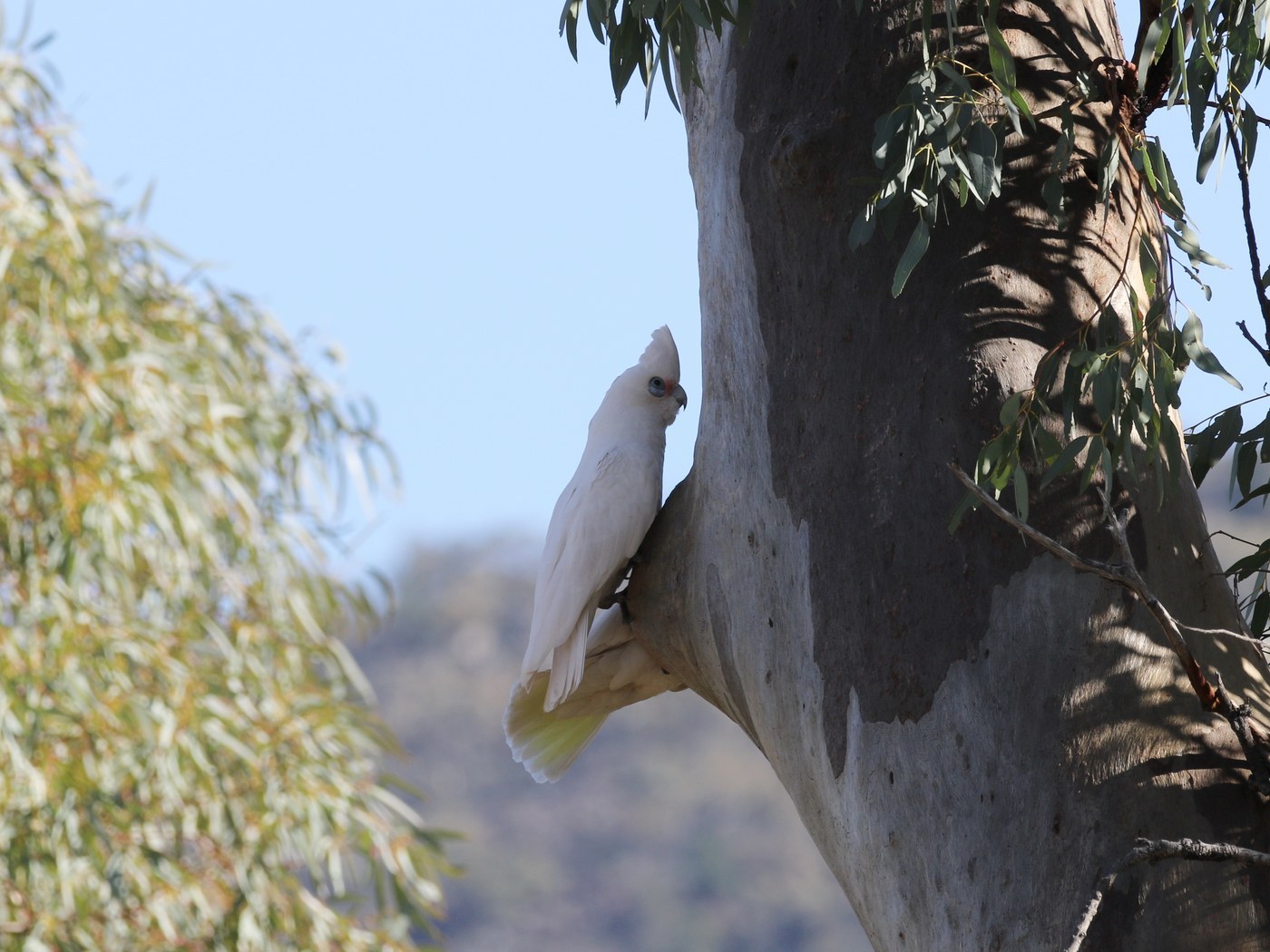
Key Field Marks
- Size & shape: About 35–39 cm, one of the smaller and stockier of the white cockatoos, with a short, deep-based white/pale bill and a rounded head that often shows little or no visible crest at rest.
- Plumage: Overall white with a very short, inconspicuous crest (raised only briefly when excited or landing).
- Face: A pale bluish bare skin ring around the eye and a small salmon-pink to reddish patch between the eye and the base of the bill (lores) — subtle and easy to miss at a distance.
- Underwing/undertail: Faint pale yellow wash visible in flight, most obvious against the white body.
- Legs/feet: Dark grey, used adeptly for grasping food while feeding on the ground.
Separating It From Similar Species
- Long-billed Corella: Has a noticeably longer, more slender bill and much more extensive red-pink coloring across the forehead and forming a band across the throat/upper breast. Little Corella shows only a small facial patch and a short bill.
- Sulphur-crested Cockatoo: Much larger (45–55 cm) with an obvious bright yellow crest raised often; Little Corella's crest is minimal and white.
- Galah: Has a contrasting pink breast and grey back — unmistakable once seen, unlike the all-white Little Corella.
- Corella flocks vs. cockatiel or other parrots: Size, flock behavior, and screeching calls quickly rule out smaller parrots.
Where & When to See It
- Habitat: Open woodlands, grasslands, farmland, floodplains, and increasingly city parks, ovals, and street trees.
- Range: Widespread across inland and northern Australia; range has expanded into many coastal cities in recent decades, sometimes considered locally invasive where it competes with native hollow-nesters.
- Season: Resident year-round; forms large, highly social, often noisy flocks, especially outside the breeding season, sometimes numbering in the hundreds or thousands at communal roosts.
- Behavior: Feeds on the ground on seeds, grain, and roots; famous for aerial acrobatics and synchronized flock wheeling flights at dusk.
Voice
- Loud, harsh, quavering shrieks and chattering "chill-chill" or "kee-arr" contact calls, typically given constantly in flight and at roosts — a good clue to locating a flock before you see it.
Frequently asked questions
What is the easiest way to tell a Little Corella from a Long-billed Corella?
Look at the bill and face: Little Corella has a short, stubby bill and only a tiny salmon patch near the eye, while Long-billed Corella has an obviously longer bill and much more red-pink across the face and throat.
Are Little Corellas native to Australian cities?
No — their traditional range is inland and northern Australia; large urban and coastal flocks in many cities result from range expansion and escaped/released birds over the last several decades.
Why do Little Corellas gather in such large, noisy flocks?
They are highly social and gregarious year-round, roosting and feeding communally, which offers safety in numbers and helps locate scattered food sources like seeds and waste grain.
Do Little Corellas have a crest like other cockatoos?
They have only a very small, inconspicuous crest that is rarely raised, unlike the prominent yellow crest of the Sulphur-crested Cockatoo.
Little Corella identified by the community
Recent Little Corella sightings identified with Bird Identifier.