
Little Bee-eater Identification Guide
Africa's smallest bee-eater, a tiny, brilliant green bird with a golden throat, black gorget, and rufous ear patch, often seen perched low near water hawking insects.
Read the full Little Bee-eater encyclopedia entry →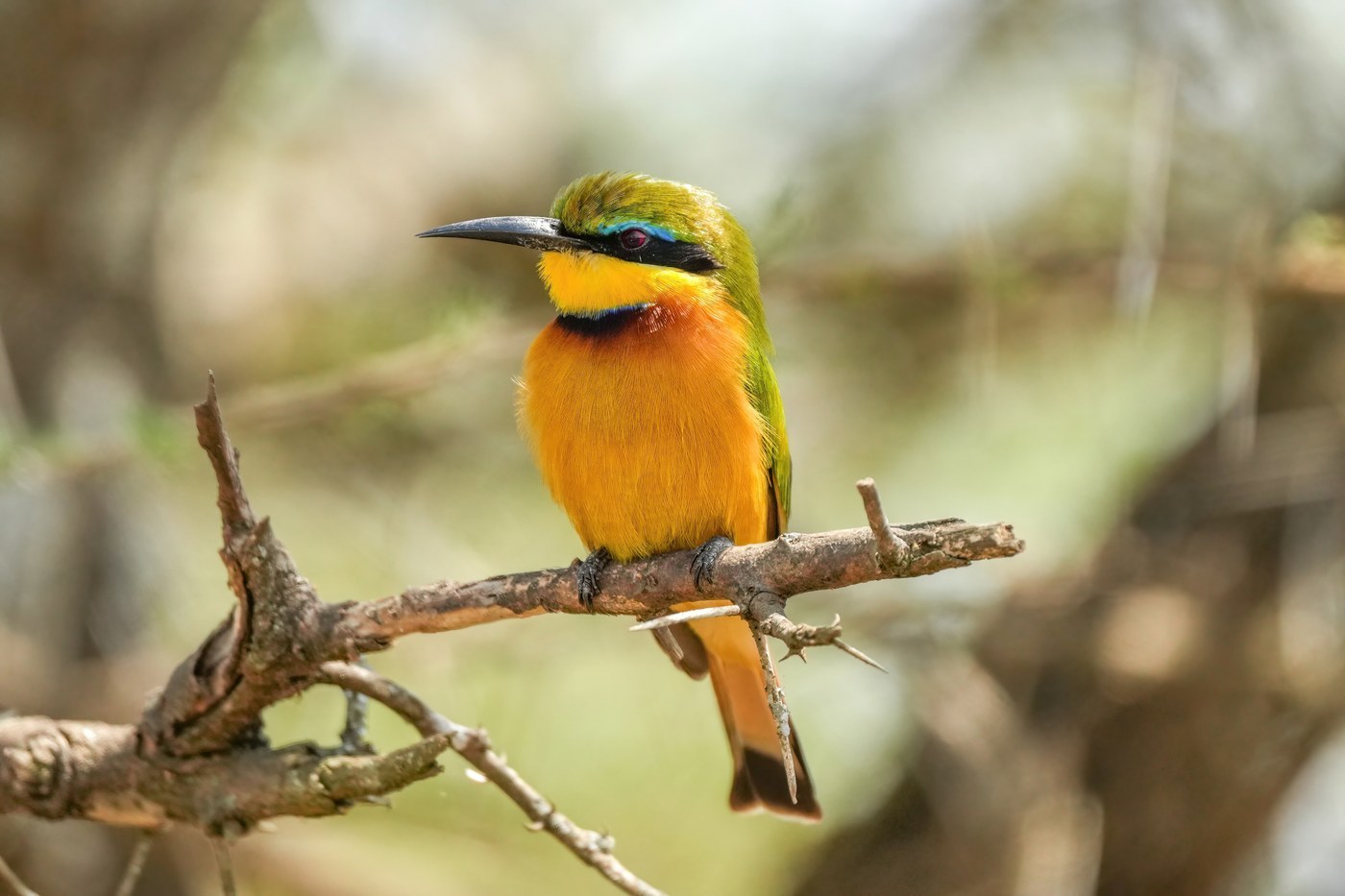
Key Field Marks
- Size and shape: Very small for a bee-eater, only about 6 inches long including a short, squared (not elongated) tail, with the slim body and slightly downcurved, pointed bill typical of the family.
- Plumage: Bright grass-green upperparts and crown, a golden-yellow throat bordered below by a narrow black gorget (breast band), and cinnamon-orange underparts and ear coverts.
- Face: A black eye-stripe bordered above by a thin blue line, contrasting with the yellow throat below.
- Tail: Unlike many larger bee-eaters, lacks long tail streamers — the tail is short and square-ended, a useful mark at a distance.
Separating from Similar Species
- Swallow-tailed Bee-eater: Similar coloring but has a distinctly forked, swallow-like tail rather than a square one.
- Blue-cheeked Bee-eater / European Bee-eater: Both are notably larger with elongated central tail streamers and more extensive blue tones, easily separated by size alone.
- White-fronted Bee-eater: Larger, with a white forehead and red throat patch, quite different head pattern.
- Little Bee-eater's diminutive size, square tail, and cinnamon underparts make it the easiest bee-eater in its range to identify at a glance.
Habitat and Range
Widespread across sub-Saharan Africa in open country: savanna, grassland, farmland edges, and areas near rivers, marshes, and waterholes with scattered low perches. Found from Senegal east to Ethiopia and south through East and Southern Africa, generally avoiding dense forest and very arid desert.
Season
Mostly resident, though some populations make local seasonal movements linked to rainfall patterns and insect abundance. It is a common, easily seen year-round resident across much of its range, including popular safari areas.
Behavior
Perches low, often just a meter or two above ground on shrubs, reeds, or fence wires, from which it sallies out to catch flying insects — especially bees and wasps, which it beats against the perch to remove the sting before swallowing. Usually seen singly, in pairs, or small family groups rather than the large colonies formed by some larger bee-eater species. Nests in burrows excavated in earthen banks or flat ground.
Voice
A soft, high-pitched "zip" or "tsee-tsee" contact call, quieter and less far-carrying than the calls of larger bee-eater species.
Frequently asked questions
How can I tell a Little Bee-eater from other African bee-eaters?
Its small size, square (not forked or streamer-tipped) tail, and cinnamon-orange underparts set it apart — most other African bee-eaters are larger with elongated tail feathers.
Where do Little Bee-eaters live?
Open savanna, grassland, and farmland across most of sub-Saharan Africa, typically near low perches and often close to water.
What do Little Bee-eaters eat?
Flying insects caught in the air from a low perch, especially bees and wasps, which they strike against the perch to remove the stinger before eating.
Do Little Bee-eaters migrate?
Most populations are resident year-round, though local movements occur in response to rainfall and insect availability.
Are Little Bee-eaters colonial nesters like some other bee-eaters?
Not typically — they usually nest as isolated pairs or small family groups in burrows dug into banks or level ground, rather than in the large colonies formed by species like the White-fronted Bee-eater.