
Lilac-crowned Amazon Identification Guide
A medium-sized, mostly green parrot from Mexico's Pacific slope with a maroon forehead, lilac-blue crown and nape, and a pale horn-colored bill.
Read the full Lilac-crowned Amazon encyclopedia entry →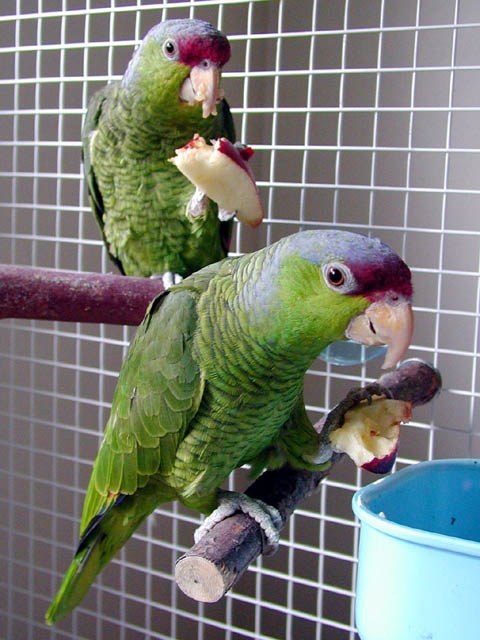
Key Field Marks
- Size and shape: A medium-sized amazon parrot around 12–13 inches long, with the stocky body, short square tail, and rounded wings typical of the genus.
- Plumage: Predominantly bright green body with darker feather edging giving a slightly scalloped look; the defining feature is a maroon-red forehead grading into a soft lilac-blue crown and nape.
- Bill: Pale horn-colored to yellowish bill, a useful mark since several similar amazons have dark or gray bills.
- Flight: Shows a red wing speculum patch in flight, typical of many amazon parrots, along with blue in the outer primaries; flight is direct with shallow, stiff wingbeats.
Separating from Similar Species
- Red-crowned Amazon (Green-cheeked Amazon): Has a red (not maroon-lilac) crown restricted mostly to the forehead, with more blue on the cheeks and a dark bill rather than pale horn-colored; ranges overlap only marginally in Mexico.
- White-fronted Amazon: Smaller with a white forehead and red patch around the eye, quite different head pattern.
- Yellow-headed and Yellow-crowned Amazons: Show yellow rather than lilac-blue on the crown/head, an easy distinction.
- The combination of maroon forehead fading into lilac-blue on the crown and nape, plus the pale bill, is diagnostic for Lilac-crowned Amazon within its native range.
Habitat and Range
Endemic to Mexico's Pacific slope, found in tropical deciduous and semi-deciduous forest, thorn forest, and forest edge from Sinaloa south to Oaxaca. Feral and naturalized populations also occur in parts of southern California (notably the Los Angeles basin) as a result of escaped or released cage birds.
Season
Generally non-migratory and resident throughout its range, though it may make local movements in response to fruiting seasons. Naturalized populations in California are also resident year-round.
Behavior
Forages in the canopy on fruits, seeds, nuts, blossoms, and occasionally cultivated crops, often in noisy pairs or small flocks that grow larger outside the breeding season. Nests in tree cavities. Highly social and vocal, especially at dawn and dusk when flocks fly between roosting and feeding areas.
Voice
Loud, harsh, and far-carrying squawks and screeches typical of amazon parrots, along with more varied chattering notes when perched. Flight calls are sharp, repeated squawks used to keep flock members in contact.
Frequently asked questions
How do you identify a Lilac-crowned Amazon?
Look for a green parrot with a maroon-red forehead blending into a lilac-blue crown and nape, and a pale, horn-colored (not dark) bill.
Where is the Lilac-crowned Amazon originally from?
It is native to tropical deciduous forest along Mexico's Pacific slope, from Sinaloa south to Oaxaca.
Why are there Lilac-crowned Amazons in California?
Naturalized, self-sustaining populations descended from escaped or released pet birds now breed in the Los Angeles basin and a few other southern California locations.
How is it different from the Red-crowned Amazon?
Red-crowned Amazon has a solid red crown restricted more to the forehead and more blue on the face, with a dark bill, while Lilac-crowned Amazon shows the maroon-to-lilac gradient on the crown and a pale bill.
Is the Lilac-crowned Amazon endangered?
Yes, it is considered Endangered in the wild due to habitat loss and capture for the illegal pet trade, even though naturalized feral populations persist in California.