
Lewis's Woodpecker Identification Guide
A large, uniquely plumaged western woodpecker with a dark greenish-black back, silvery gray collar, deep pink belly, and a habit of catching insects on the wing like a flycatcher.
Read the full Lewis's Woodpecker encyclopedia entry →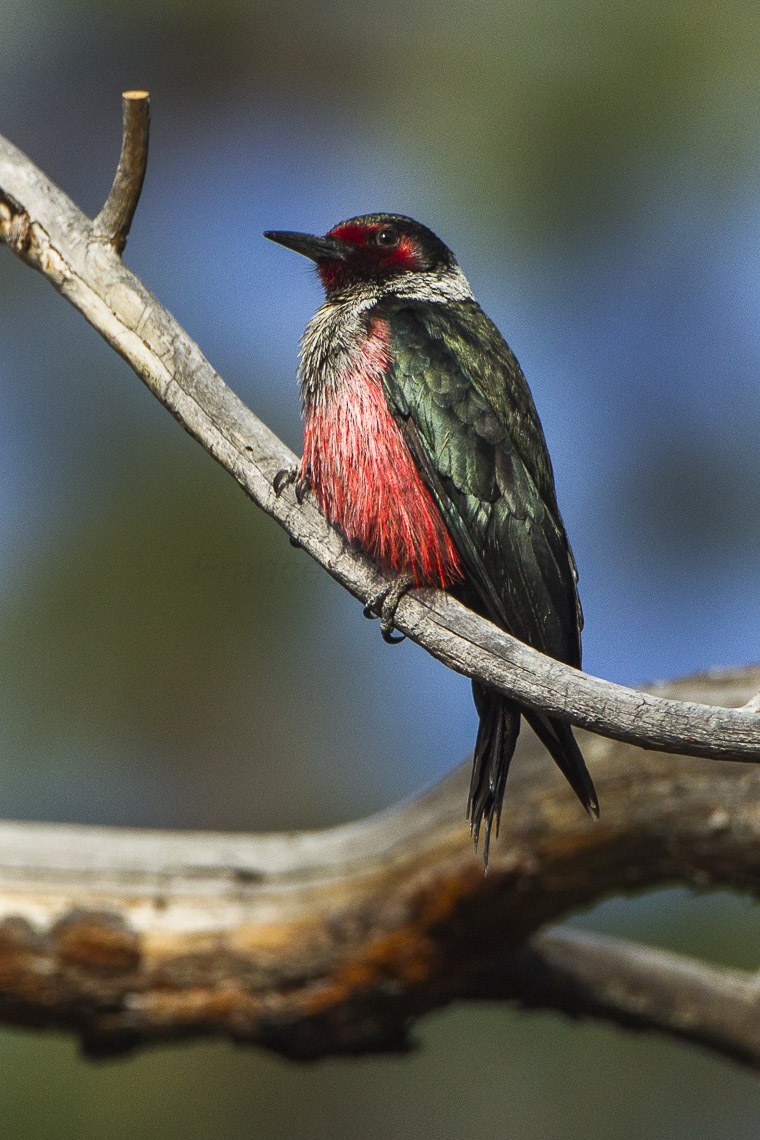
Key Field Marks
- Size and shape: A large woodpecker, about 10–11 inches long, with broad, rounded wings and a relatively long tail — proportions closer to a crow than a typical woodpecker in flight.
- Plumage: Distinctive and unlike any other North American woodpecker: glossy dark greenish-black upperparts and crown, a pale silvery-gray collar and breast band, and a deep rose-pink to raspberry-red belly and lower breast.
- Face: Dark, blackish-red face lacking the bold black-and-white facial pattern typical of most woodpeckers.
- Flight style: Flies with slow, steady, crow-like wingbeats rather than the bounding, undulating flight of most woodpeckers — often a key first clue at a distance.
Separating from Similar Species
- Red-headed Woodpecker: Shares some pink-red tones but has a fully red head and bold black-and-white body pattern with large white wing patches; Lewis's lacks white wing patches entirely and has a dark, not red, head.
- Acorn Woodpecker: Also found in oak woodlands and caches acorns, but has a clown-like black-and-white face with a red cap and pale eye, quite different from Lewis's uniformly dark head.
- In silhouette and flight, Lewis's crow-like, flap-and-glide flight and habit of sallying after insects from an exposed perch is unusual among woodpeckers and a strong identification clue on its own.
Habitat and Range
Associated with open ponderosa pine forest, burned pine and oak woodlands, riparian cottonwood groves, and oak savanna across the interior western United States and southern British Columbia. Breeds from southern British Columbia and Alberta south through the Rocky Mountain states to New Mexico and Arizona.
Season
Partially migratory and irruptive; many populations move south or to lower elevations in winter, concentrating in oak woodlands and areas with abundant acorn or nut crops. Wintering range extends into the southwestern U.S. and northern Mexico, though some birds remain year-round in favorable areas. Numbers and locations vary year to year depending on food (especially mast) availability.
Behavior
Forages very differently from most woodpeckers: rather than drilling into wood, it commonly perches on an exposed snag or wire and sallies out to catch flying insects in mid-air, flycatcher-style. In fall and winter it switches heavily to acorns and other nuts, which it caches in bark crevices for later use, behavior reminiscent of Acorn Woodpecker. Often perches upright and conspicuously rather than clinging to bark.
Voice
Generally quiet compared to other woodpeckers. Gives a harsh, low "churr" or "chuur" rattling call, and a sharper "chack" alarm note. Drumming is weak and infrequent compared to most woodpecker species.
Frequently asked questions
What makes Lewis's Woodpecker easy to identify?
Its unique color combination — dark greenish-black body, silvery-gray collar, and deep pink belly — plus its crow-like flight and flycatching behavior set it apart from every other North American woodpecker.
Does Lewis's Woodpecker act like other woodpeckers?
Not really. It rarely drills for insects, instead catching flying insects in the air from a perch and, in fall and winter, gathering and caching acorns and nuts.
Where is the best place to find Lewis's Woodpecker?
Open ponderosa pine forests, burned woodlands, and cottonwood riparian areas in the interior western U.S. and southern British Columbia during the breeding season; oak woodlands at lower elevations in winter.
Is Lewis's Woodpecker migratory?
It shows variable, irruptive movements — some populations migrate south or downslope for winter, especially when local nut and acorn crops are poor, while others stay resident where food is reliable.
How can you tell Lewis's Woodpecker from Red-headed Woodpecker?
Red-headed Woodpecker has a solid red head and bold white wing patches with black-and-white body plumage, while Lewis's has a dark head, no white wing patches, and a distinctive pink belly.