
Lewin's Honeyeater Identification Guide
A chunky, olive-green Australian honeyeater with a bold crescent-shaped yellow ear patch and a loud, machine-gun-like rattling call.
Read the full Lewin's Honeyeater encyclopedia entry →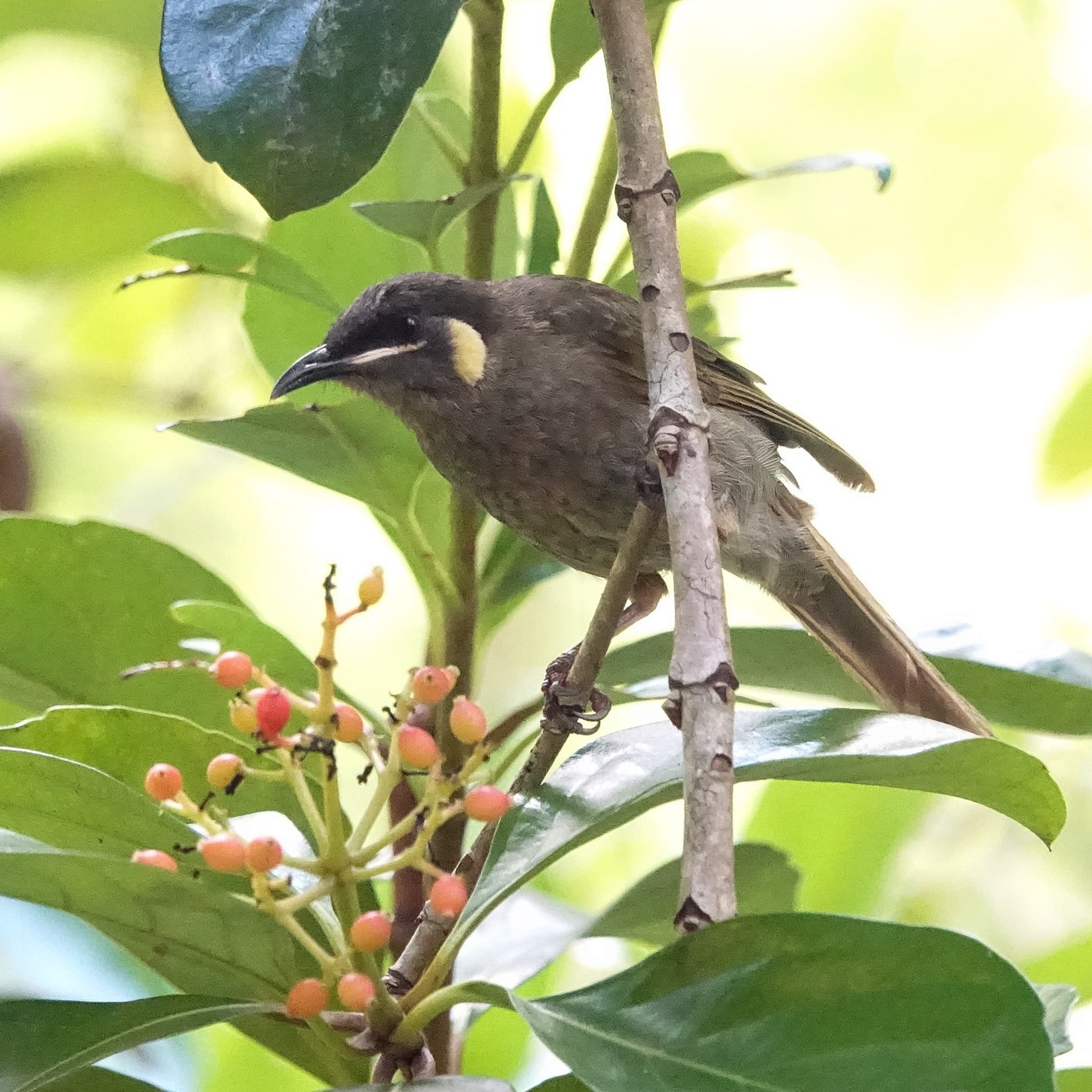
Key Field Marks
- Size and shape: A medium-large, robust honeyeater around 20–22 cm (8 in) long, with a fairly heavy build, short-ish tail, and slightly downcurved bill.
- Plumage: Overall olive-green above and paler olive-gray below, with fine pale streaking on the breast that can be hard to see at a distance.
- Head pattern: The signature mark is a bright yellow, crescent-shaped patch behind and below the eye extending onto the ear coverts, bordered by dusky-olive surrounding plumage. A small area of bare, pale grayish skin around the eye is also visible at close range.
- Bill: Blackish, moderately long and slightly downcurved, typical of nectar-feeding honeyeaters.
Separating from Similar Species
- Yellow-spotted Honeyeater (its close relative, found further north in Queensland): Very similar but has a yellow spot rather than a full crescent behind the eye, and the two species' ranges barely overlap, with Lewin's more common in southern and eastern coastal regions.
- White-eared Honeyeater: Has a bold white (not yellow) ear patch and black head, easily separated by color.
- Yellow-faced Honeyeater: Smaller and slimmer with a narrow yellow crescent that is less bold and more restricted, plus a black malar stripe that Lewin's lacks.
- Lewin's overall bulkier shape, uniformly olive body, and loud rattling call are the quickest confirmation.
Habitat and Range
Common in wet forests, rainforest edges, eucalypt woodland with dense understory, coastal scrub, and increasingly in leafy suburban gardens along the eastern coast of Australia, from far north Queensland south through New South Wales into eastern Victoria. Also occurs on Lord Howe Island as an endemic subspecies.
Season
Resident and non-migratory across its range; present year-round. Some local altitudinal or seasonal movements occur in response to flowering and fruiting, but there is no long-distance migration.
Behavior
Active and often noisy, foraging at all levels from understory to canopy for nectar, fruit, and insects gleaned from foliage and bark. Frequently seen alone or in pairs, sometimes joining mixed foraging flocks. Aggressively defends flowering or fruiting trees from other honeyeaters and small birds.
Voice
One of the most distinctive rainforest sounds in eastern Australia: a loud, rapid, chattering rattle often rendered as "gick-gick-gick-gick-gick," delivered in a fast machine-gun burst. Also gives sharp single "chip" contact calls.
Frequently asked questions
What is the easiest way to identify a Lewin's Honeyeater?
Look for a chunky olive-green bird with a bold yellow crescent-shaped patch on the ear coverts, and listen for its loud, rapid rattling call, often the first clue to its presence in dense forest.
How is Lewin's Honeyeater different from Yellow-spotted Honeyeater?
Lewin's has a full yellow crescent behind the eye rather than a small spot, and the two species have largely separate ranges, with Yellow-spotted found mainly in northern Queensland and Lewin's further south and along the coast.
Where do Lewin's Honeyeaters live?
They favor wet eucalypt forest, rainforest margins, coastal scrub, and suburban gardens with dense vegetation along Australia's eastern seaboard, plus Lord Howe Island.
What does a Lewin's Honeyeater eat?
A mix of nectar from flowering trees and shrubs, soft fruit, and insects gleaned from leaves and bark.
Are Lewin's Honeyeaters migratory?
No, they are largely sedentary residents, though they may shift locally to track flowering and fruiting food sources.