
Lesser Yellowlegs Identification Guide
A slim, dainty shorebird with bright yellow legs and a short, straight, needle-thin bill, best told from its larger cousin by size and voice.
Read the full Lesser Yellowlegs encyclopedia entry →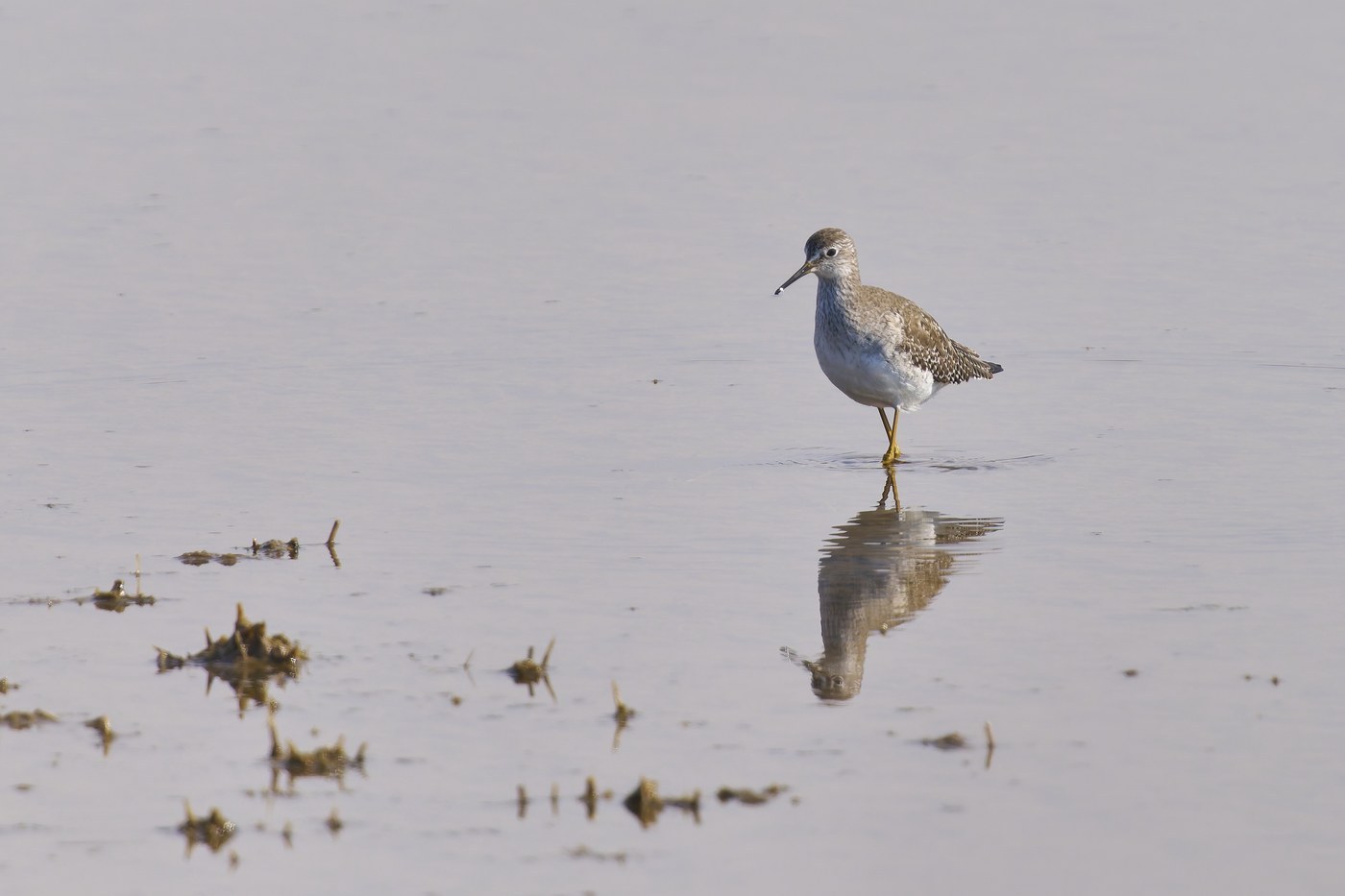
Key Field Marks
- Size and shape: A small, elegant sandpiper roughly 10–11 inches long, with a slender neck, small rounded head, and long bright-yellow legs.
- Bill: Short, thin, straight, and needle-like — about the same length as the head, and entirely dark. This is one of the best marks separating it from Greater Yellowlegs.
- Plumage: Gray-brown upperparts finely speckled with white and black in breeding plumage; paler, plainer gray-brown above and white below in non-breeding plumage. White rump and finely barred tail visible in flight.
- Legs: Long, slim, and bright yellow to orange-yellow, trailing noticeably beyond the tail tip in flight.
Separating from Similar Species
- Greater Yellowlegs: Larger (12–14 in) with a longer, slightly upturned, two-toned (paler base) bill that is distinctly longer than the head depth. Greater Yellowlegs also has a louder, more strident three- or four-note call versus the Lesser's softer one- or two-note call. Bill length compared to head size is the most reliable mark when size is hard to judge.
- Solitary Sandpiper: Similar size but has dark greenish legs (not yellow), a bolder white eye-ring, and dark central tail feathers with barred sides.
- Stilt Sandpiper: Stockier, with a slightly downcurved bill and greenish-yellow (duller) legs; feeds with a distinctive probing, sewing-machine motion.
Habitat and Range
Breeds in open boreal forest clearings, bogs, and muskeg across Alaska and northern Canada. During migration and winter, found in a wide variety of shallow wetlands: flooded fields, mudflats, marsh edges, sewage ponds, and coastal lagoons — often preferring shallower, more vegetated water than Greater Yellowlegs. Winters from the southern United States through Central America and much of South America.
Season
A long-distance migrant. Spring migration peaks April–May; birds arrive on breeding grounds by late May. Fall migration is protracted, starting as early as late June with failed breeders and continuing into October. Non-breeders may oversummer well south of the breeding range.
Behavior
Forages by walking briskly through shallow water, picking and probing at the surface and just below it for insects, small crustaceans, and other invertebrates; less prone to the sweeping bill motion of Greater Yellowlegs. Often feeds in loose flocks and bobs its head when alarmed. Flight is light and buoyant.
Voice
Gives a soft, mellow "tu" or "tu-tu" — one or two notes, lower-pitched and less piercing than the ringing three- to four-note "tew-tew-tew" of Greater Yellowlegs. Voice is often the quickest way to separate the two species at a distance.
Frequently asked questions
How do I tell Lesser Yellowlegs from Greater Yellowlegs?
Focus on bill length and shape: Lesser has a short, straight, all-dark bill about equal to head length, while Greater has a longer, slightly upturned, two-toned bill clearly longer than the head. Voice also helps — Lesser gives one or two soft notes, Greater gives three or four loud, ringing notes.
What color are a Lesser Yellowlegs' legs?
Bright yellow to orange-yellow, and notably long, extending well past the tail tip in flight.
Where can I see Lesser Yellowlegs?
Look for them in shallow, often vegetated wetlands, flooded fields, and mudflats during migration across most of North America, and on wintering grounds from the Gulf Coast south through South America.
When is the best time to see Lesser Yellowlegs?
Peak migration windows are April–May in spring and July–September in fall, when birds stop over at inland and coastal wetlands en route between boreal breeding grounds and southern wintering areas.
Does Lesser Yellowlegs look different in breeding vs. winter plumage?
Yes — breeding birds show more contrasty gray-brown upperparts with dark speckling and streaked flanks, while non-breeding and juvenile birds are plainer, paler gray-brown above with a cleaner white breast.