
Lesser Spotted Woodpecker Identification Guide
Europe's smallest woodpecker, sparrow-sized and easily overlooked, identified by its black-and-white barred back and small size compared to other pied woodpeckers.
Read the full Lesser Spotted Woodpecker encyclopedia entry →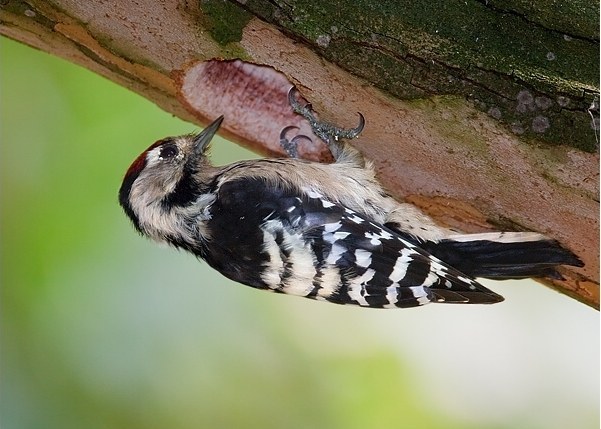
Key Field Marks
- Size & shape: Tiny woodpecker, only about 5.5-6.3 inches long -- roughly sparrow-sized, dramatically smaller than Great Spotted Woodpecker.
- Plumage pattern: Black-and-white barred (ladder-like) back and wings, unlike the solid white shoulder patches of larger pied woodpeckers; underparts are whitish with fine dark streaking on the flanks.
- Head: Male has a red crown patch; female has an all-black-and-white head without red.
- No red vent: Unlike Great Spotted and Middle Spotted Woodpeckers, Lesser Spotted lacks any red on the undertail coverts.
- Bill: Small and relatively short compared to other spotted woodpeckers, fitting its diminutive size.
Separating from Similar Species
- Great Spotted Woodpecker: Much larger, with bold solid white oval shoulder patches (not barring) and a red patch under the tail (vent); males have a red nape patch (not crown).
- Middle Spotted Woodpecker: Larger, with a red crown in both sexes (not just males) and pinkish-washed underparts with more extensive streaking.
- Ladder-barred back combined with tiny, sparrow-like size is the most reliable combination for Lesser Spotted Woodpecker.
Habitat, Range & Season
- Found across much of Europe and temperate Asia, in deciduous and mixed woodland, orchards, parks, and riverside trees, often favoring mature trees with dead or decaying wood.
- Non-migratory resident throughout most of its range, though some northern/eastern populations may make short-distance movements in winter.
- Often forages high in the canopy, making it easy to overlook despite being present year-round.
Behavior
- Forages mostly in the outer canopy and smaller branches (unlike larger woodpeckers, which often work trunks), gleaning and excavating for wood-boring insect larvae, beetles, and other invertebrates.
- Drums less frequently and less loudly than larger woodpeckers, with a faster, weaker, longer drum roll.
- Excavates a small nest hole in dead or decaying wood, often in a slender branch or trunk.
Voice
- Song is a series of shrill, nasal pee-pee-pee-pee notes, somewhat similar to a Wryneck's call but shorter and less strident.
- Drumming is notably faster, thinner, and longer-lasting than that of Great Spotted Woodpecker, though quieter overall.
Frequently asked questions
How do you tell a Lesser Spotted Woodpecker from a Great Spotted Woodpecker?
Lesser Spotted is dramatically smaller (sparrow-sized) with a black-and-white barred back rather than solid white shoulder patches, and it lacks the red undertail patch found on Great Spotted Woodpecker.
How can you distinguish male and female Lesser Spotted Woodpeckers?
Males have a red patch on the crown, while females have an entirely black-and-white head with no red.
Why is the Lesser Spotted Woodpecker hard to see?
Its tiny size, quiet drumming, and habit of foraging high in the canopy on thin outer branches make it easy to overlook compared to larger, more conspicuous woodpeckers.
What does the Lesser Spotted Woodpecker eat?
Mainly wood-boring insect larvae, beetles, and other invertebrates gleaned or excavated from small branches and decaying wood.
Does the Lesser Spotted Woodpecker migrate?
No, it is largely a non-migratory resident across its European and Asian range, though some individuals in the north or east may shift short distances in winter.