
Lesser Scaup Identification Guide
North America's most abundant diving duck, distinguished from the similar Greater Scaup by its peaked head shape and more limited white in the wing.
Read the full Lesser Scaup encyclopedia entry →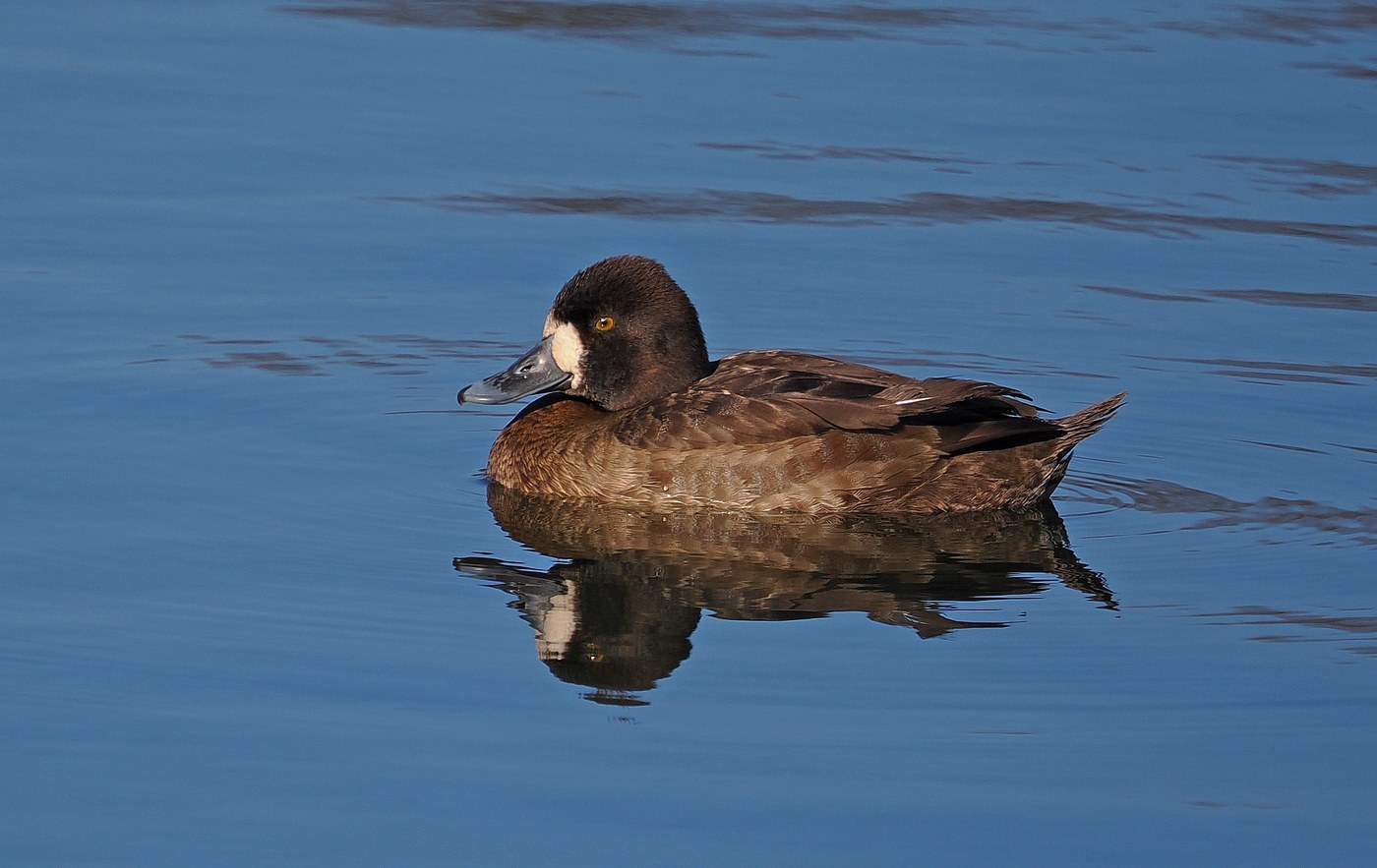
Key Field Marks
- Size & shape: Medium-sized diving duck, smaller and more compact than Greater Scaup, with a distinctive peaked crown that bulges toward the back of the head, giving an angular rather than rounded head profile.
- Adult male: Glossy dark purplish (not greenish) head sheen, black breast, vermiculated gray back, white flanks, and black stern. Bill is blue-gray with a small black nail tip.
- Adult female: Brown overall with a bold white patch at the base of the bill, similar to Greater Scaup females but often with a slightly smaller/less crisp white face patch and a more subtly peaked head shape.
- In flight: White wing stripe is limited to the secondaries, becoming dusky/grayish on the outer primaries -- Greater Scaup shows the white stripe extending further into the primaries.
Separating from Similar Species
- Greater Scaup: Rounder head shape with the highest point over the middle/front of the crown (vs. Lesser's rear-peaked crown), green (not purple) head gloss in males, and more extensive white wing stripe reaching into the primaries in flight.
- Ring-necked Duck: Shows a peaked head too, but has a bold white ring near the bill tip, a gray (not white) flank patch bordered by a black vertical bar in front, and no white wing stripe.
- Head shape and gloss color are the most reliable marks on the water; wing-stripe extent is the best flight-view separator from Greater Scaup.
Habitat, Range & Season
- Breeds across the boreal forest and prairie pothole regions of Alaska and Canada, in freshwater marshes, ponds, and lakes.
- Winters widely across the US in coastal bays, large lakes, reservoirs, and rivers, from both coasts through the interior and into Mexico and Central America.
- Common migrant across the continent; large rafts often gather on big lakes and coastal waters during migration and winter (roughly October-April in most of the US).
Behavior
- Gregarious diving duck, often forming large rafts, sometimes numbering in the thousands, especially on wintering grounds.
- Dives underwater to feed on aquatic invertebrates (mollusks, insect larvae) and some plant material.
- Often associates with Greater Scaup, Ring-necked Ducks, and other diving ducks in mixed flocks, requiring careful comparison for identification.
Voice
- Generally quiet; males give soft whistling notes during courtship, while females give a harsh, growling errr or scaup-like call, from which the species group gets its name.
Frequently asked questions
What is the best way to separate Lesser Scaup from Greater Scaup?
Check head shape (Lesser has a peak toward the back of the crown vs. Greater's rounder, front-peaked head), head gloss color (purple in Lesser vs. green in Greater), and in flight, the extent of the white wing stripe (limited to secondaries in Lesser, extending into the primaries in Greater).
How do you tell a female Lesser Scaup from a Ring-necked Duck?
Female Lesser Scaup has a bold, crisp white patch at the base of the bill, while female Ring-necked Duck has a more diffuse pale face and a white eye-ring, without the same sharply defined bill-base patch.
Where can you see large flocks of Lesser Scaup in winter?
Coastal bays, large lakes, and reservoirs across much of the US, where they often form dense rafts numbering in the hundreds or thousands.
What do Lesser Scaup eat?
Primarily aquatic invertebrates such as mollusks and insect larvae obtained by diving, supplemented with some aquatic vegetation.
Is the Lesser Scaup the same as the bluebill hunters refer to?
The nickname bluebill is commonly used for scaup in general due to their blue-gray bill color, referring to both Lesser and Greater Scaup, which are closely related diving ducks.