
Lesser Rhea Identification Guide
A large flightless bird of South American grasslands and Patagonian steppe, smaller and grayer-brown than the Greater Rhea, with a feathered lower leg.
Read the full Lesser Rhea encyclopedia entry →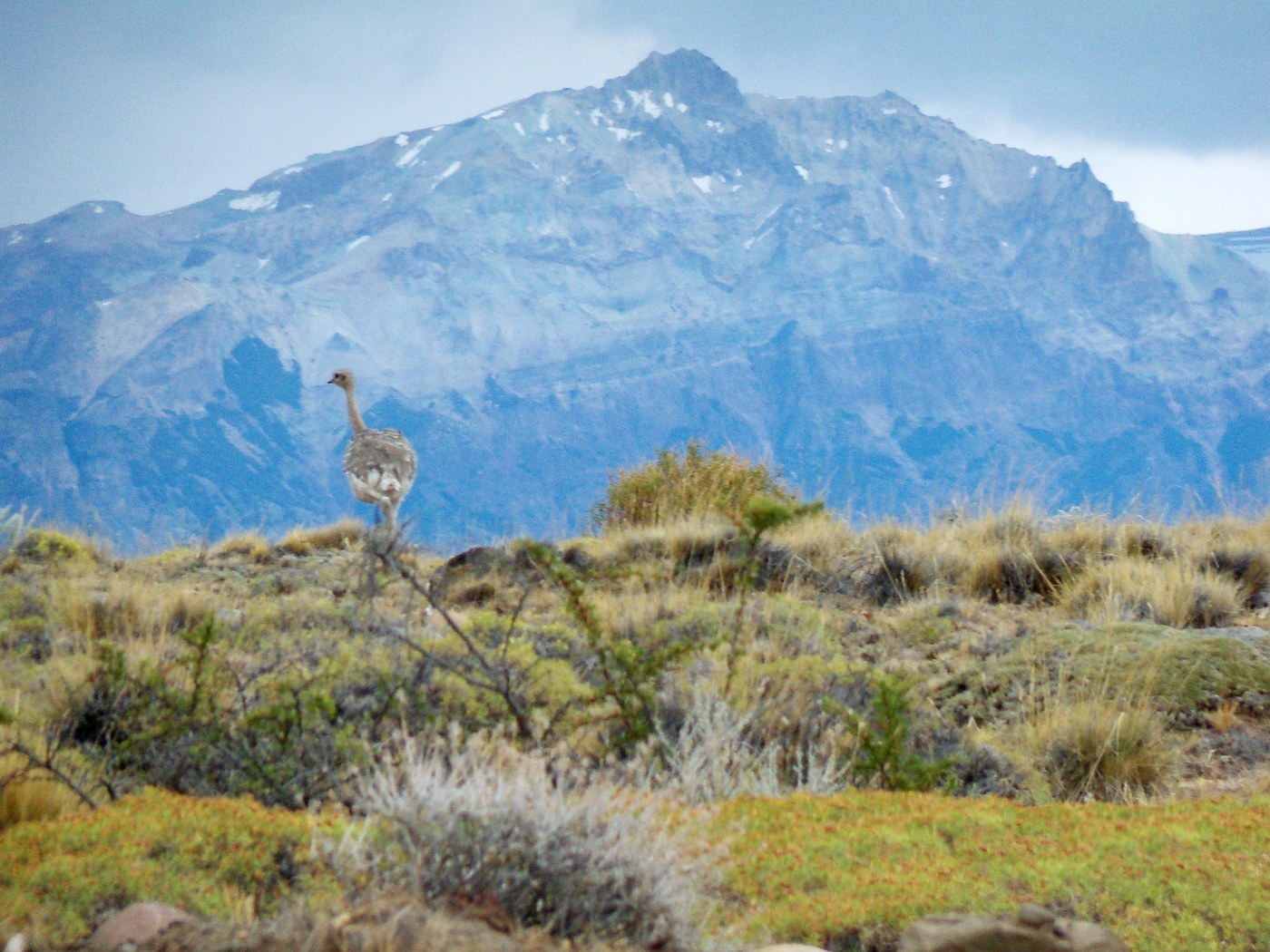
Key Field Marks
- Size & shape: Large flightless bird, standing about 3-3.3 feet tall (smaller than Greater Rhea, which can reach 5 feet), with a long neck, small head, and long powerful legs built for running.
- Plumage: Grayish-brown to sandy-brown overall, with pale spotting/mottling on the back in some populations (especially the Puna subspecies) -- generally paler and grayer than the darker brown Greater Rhea.
- Legs: Feathered partway down the tarsus (lower leg), a key distinguishing feature from Greater Rhea, which has bare, unfeathered legs.
- Toes: Three forward-facing toes on each foot, adapted for fast running rather than perching or flight.
- Head/neck: Small head atop a long neck; overall silhouette resembles a smaller, stockier ostrich-like bird.
Separating from Similar Species
- Greater Rhea: Larger, darker brown, with bare (unfeathered) lower legs and a range that is mostly separate -- Greater Rhea occupies more northerly/eastern grasslands of Argentina, Brazil, Uruguay, and Paraguay, while Lesser Rhea occupies the Patagonian steppe and Andean altiplano further south and west.
- No other native South American bird approaches this species' size and flightless, ostrich-like build, so confusion is mainly with Greater Rhea where ranges might approach each other.
Habitat, Range & Season
- Found in open grasslands, steppe, and semi-arid shrub-steppe of Patagonia (Argentina and Chile) and the high-altitude Puna/altiplano grasslands of the central Andes (Peru, Bolivia, Chile, Argentina).
- Non-migratory resident, present year-round in its range, though some populations may shift locally with seasonal food and water availability.
- Avoids dense forest, favoring open, sparsely vegetated terrain where it can run to escape predators.
Behavior
- Highly social outside the breeding season, forming flocks that forage together on plant material, seeds, and insects.
- Males are polygynous and take on all incubation and chick-rearing duties, tending a communal nest that may contain eggs from multiple females.
- Extremely fast runner, able to reach high speeds to evade predators such as pumas and foxes, using rapid zigzag movements.
Voice
- Generally quiet outside the breeding season; males give deep, booming or roaring calls during courtship and territorial displays.
- Alarm and contact calls include low guttural notes and hisses.
Frequently asked questions
How do you tell a Lesser Rhea from a Greater Rhea?
Lesser Rhea is smaller and paler grayish-brown with feathers partway down its lower legs, while Greater Rhea is larger, darker brown, and has bare, unfeathered legs.
Where does the Lesser Rhea live?
It inhabits the open grasslands and steppe of Patagonia in Argentina and Chile, as well as high-altitude Puna grasslands of the central Andes.
Can the Lesser Rhea fly?
No, like all rheas it is flightless; it relies on its long, powerful legs to run at high speed to escape predators.
Who takes care of the eggs and chicks in Lesser Rhea groups?
The male incubates the eggs -- often a communal clutch from several females -- and raises the chicks alone after hatching.
What does the Lesser Rhea eat?
A mix of plant material, seeds, and insects, foraged while walking through open grassland and steppe habitat.