
Lesser Goldfinch Identification Guide
A tiny, sprightly finch of the western US and Mexico, males showing black or greenish upperparts, bright yellow underparts, and a white wing patch.
Read the full Lesser Goldfinch encyclopedia entry →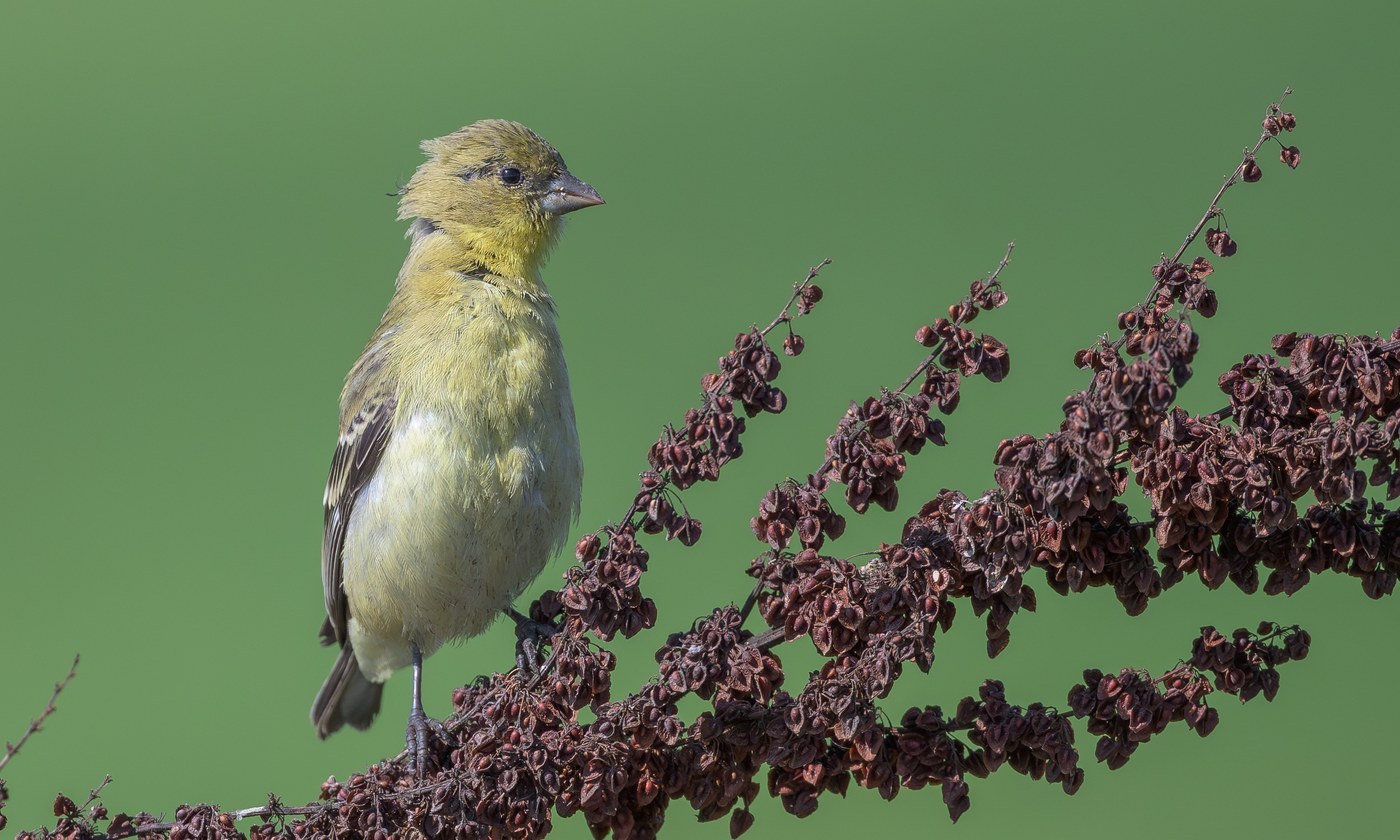
Key Field Marks
- Size & shape: Very small finch, about 3.5-4.3 inches, smaller than American Goldfinch, with a short conical bill and short notched tail.
- Adult male (two forms): Black-backed form (mostly in the east of range, e.g., Texas) has a glossy black cap and back contrasting with bright yellow underparts; green-backed form (mostly West Coast) has an olive-green back with a black cap. Both show white patches at the base of the primaries, forming a bold white wing patch visible in flight and at rest.
- Adult female: Dull olive-green above, pale yellow below, with subtler wing bars and no black cap.
- Bill: Small, pale pinkish-gray, conical.
- Tail: Black with white patches at the base, flashing in flight.
Separating from Similar Species
- American Goldfinch: Larger; breeding males are entirely bright yellow with a black forehead (not full black cap) and lack the extensive white wing patch of male Lesser Goldfinch; females and winter birds are grayer overall.
- Pine Siskin: Heavily streaked brown body, thin pointed bill, and yellow only in wing/tail flashes -- very different from the clean yellow underparts of Lesser Goldfinch.
- Female/immature Lesser vs. American Goldfinch: Lesser Goldfinch shows more contrast between greenish back and yellow underparts, plus white in the tail base, distinguishing it from the plainer, buffier winter American Goldfinch.
Habitat, Range & Season
- Resident (non-migratory in most of range) across the southwestern US from California east to Texas, south through Mexico and Central America into northern South America.
- Found in open woodlands, brushy hillsides, gardens, parks, riparian corridors, and weedy fields -- highly adaptable to suburban and urban settings with feeders and flowering/seeding plants.
- Present year-round across most of its US range; some northern/high-elevation populations shift altitudinally or short-distance in winter.
Behavior
- Highly social, often in small flocks, sometimes mixing with American Goldfinches or Pine Siskins at feeders (especially nyjer/thistle socks) and seeding plants like sunflowers and thistles.
- Acrobatic feeder at seed heads, often hanging upside-down.
- Builds a compact cup nest in shrubs or trees, and readily nests in suburban yards.
Voice
- Song is a long, varied, cheerful jumble of notes, often incorporating mimicked phrases from other birds.
- Common call is a plaintive, rising tee-yee or dee-dee, quite distinct from the flight call of American Goldfinch (per-chick-o-ree).
Frequently asked questions
What's the easiest way to tell Lesser Goldfinch from American Goldfinch?
Lesser Goldfinch is smaller with a solid black or dark cap that wraps further down the head (not just the forehead) and shows a bold white patch at the base of the primaries; American Goldfinch males in breeding plumage are fully bright yellow-bodied without that white wing patch.
Why do male Lesser Goldfinches look different in different regions?
There are two plumage morphs -- a black-backed form found mainly in the south-central US (e.g., Texas) and a green-backed form found mainly along the West Coast -- both are the same species, just geographic variants.
Do Lesser Goldfinches migrate?
Most populations are largely resident year-round, though some birds at higher elevations or the northern edge of the range make short seasonal movements.
What food attracts Lesser Goldfinches to a yard?
Nyjer (thistle) seed feeders, sunflowers, and native flowering/seeding plants like coreopsis and asters are highly attractive to this species.
What does a Lesser Goldfinch sound like?
Its song is a cheerful, varied warble that often mimics other birds, and its common call is a plaintive rising tee-yee, different from American Goldfinch's per-chick-o-ree flight call.