
Lesser Flamingo Identification Guide
The smallest and most numerous flamingo species, known for its deep pink plumage and distinctive dark red, almost all-black bill.
Read the full Lesser Flamingo encyclopedia entry →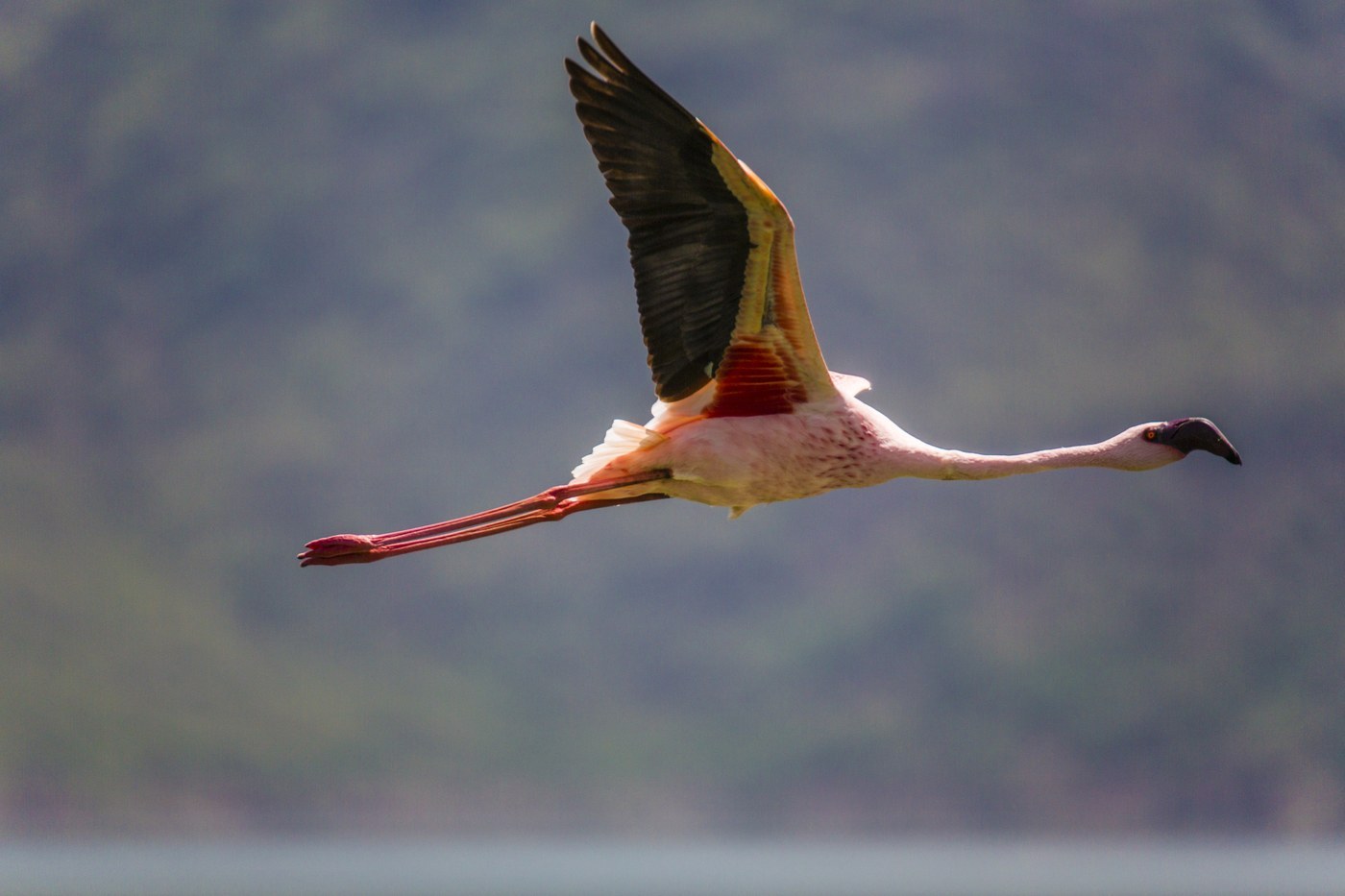
Key Field Marks
- Size: Smallest flamingo species, standing about 31-35 inches tall, noticeably more compact than Greater Flamingo.
- Plumage: Deep pink to carmine-pink body plumage, often appearing more saturated in color than Greater Flamingo, especially in breeding condition.
- Bill: Dark maroon to blackish bill with only a small area of pale color at the base -- appears almost entirely dark at a distance, in sharp contrast to the pink-and-black bill of the Greater Flamingo.
- Legs: Pink, proportionally shorter relative to body size than in Greater Flamingo.
- Eye: Dark red eye with a narrow reddish eye-ring, giving a distinctive facial look up close.
Separating from Similar Species
- Greater Flamingo: Larger and paler pink overall, with a bicolor bill (pale pink base, black tip) rather than the mostly dark bill of Lesser Flamingo.
- Lesser Flamingo flocks often look more uniformly deep pink from a distance than mixed or Greater Flamingo flocks, which appear paler and whiter.
- In flight, both species show black flight feathers contrasting with pink coverts, but Lesser Flamingo's smaller size and darker bill remain the best clues.
Habitat, Range & Season
- Found primarily in eastern and southern Africa, especially the alkaline (soda) lakes of the East African Rift Valley (e.g., Lake Nakuru, Lake Bogoria), plus scattered populations in West Africa and the Indian subcontinent (Gujarat's Rann of Kutch).
- Highly nomadic, moving between lakes in response to water levels and food availability; can form enormous flocks numbering in the hundreds of thousands to over a million birds at prime sites.
- Breeds colonially on mudflats in remote, undisturbed soda lakes; timing varies by region and rainfall rather than a fixed calendar season.
Behavior
- Feeds by filtering blue-green algae (cyanobacteria) and diatoms from alkaline lake water using a specialized, deeply keeled bill held upside-down while sweeping side to side -- a finer filtering apparatus than Greater Flamingo, which eats larger invertebrates.
- Highly gregarious, almost always seen in large, dense flocks.
- Performs synchronized courtship displays, including head-flagging and marching, in large groups before breeding.
Voice
- Nasal, goose-like honking and murmuring calls, generally softer and higher-pitched than Greater Flamingo.
- Large flocks produce a constant low murmuring chorus audible from a distance.
Frequently asked questions
How do you tell a Lesser Flamingo from a Greater Flamingo?
Lesser Flamingo is smaller, deeper pink, and has a mostly dark maroon-to-black bill, while Greater Flamingo is larger, paler, and has a pink bill with a black tip.
Where is the best place to see huge flocks of Lesser Flamingos?
The soda lakes of the East African Rift Valley, such as Lake Nakuru and Lake Bogoria in Kenya, are famous for hosting massive congregations.
What do Lesser Flamingos eat?
They filter-feed on microscopic blue-green algae (cyanobacteria) and diatoms from alkaline lake water using their finely combed bill.
Are Lesser Flamingos found outside Africa?
Yes, smaller populations also occur in parts of the Indian subcontinent, notably the Rann of Kutch in Gujarat, India.
Why do Lesser Flamingos gather in such large numbers?
They congregate at productive alkaline lakes rich in the algae they feed on, and their nomadic movements track fluctuating water levels and food abundance across the region.