
Least Sandpiper Identification Guide
The smallest shorebird in the world, a tiny brownish 'peep' identified by its yellowish-green legs and hunched, low-to-the-ground feeding posture.
Read the full Least Sandpiper encyclopedia entry →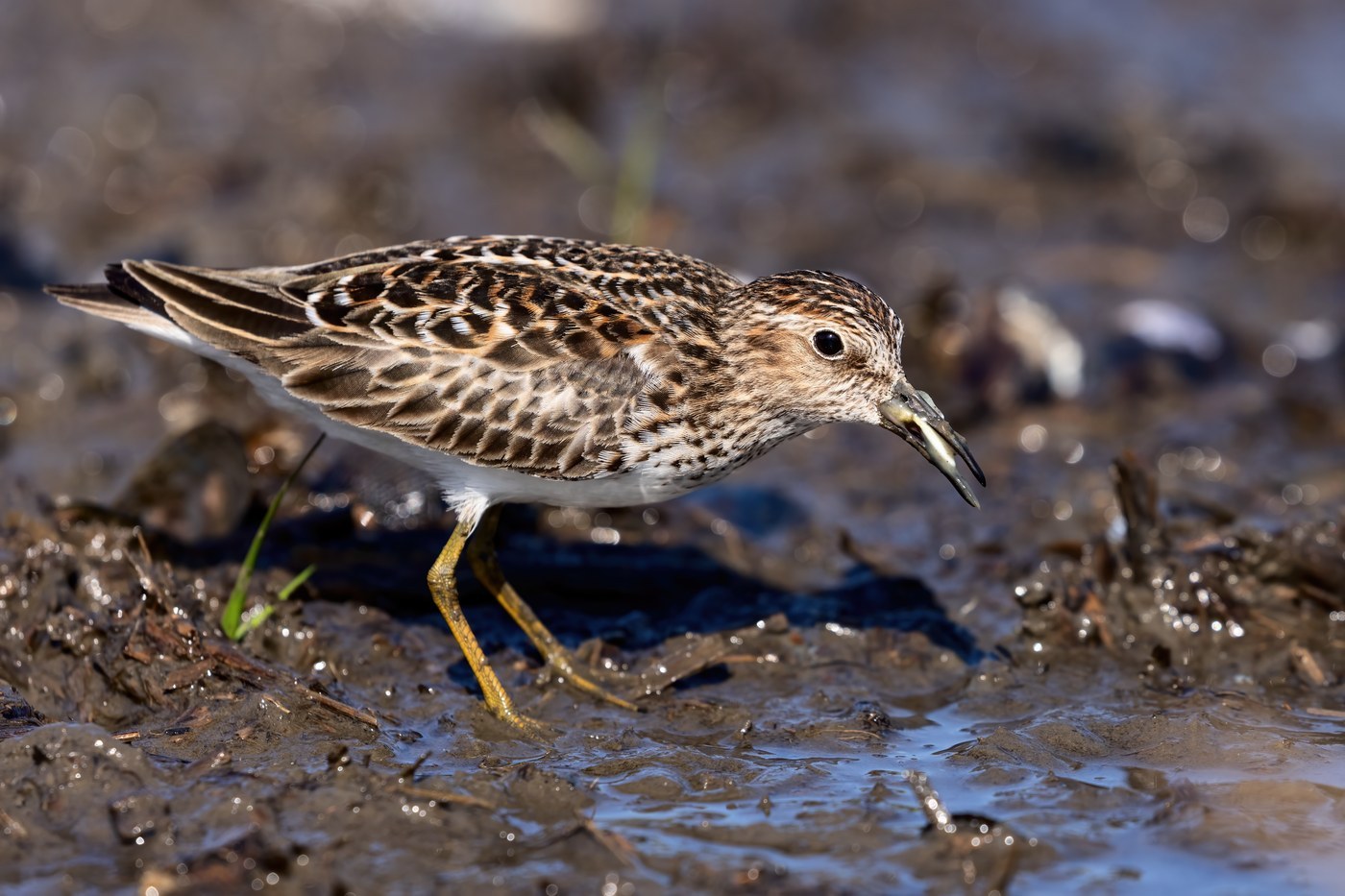
Key Field Marks
- Size & shape: The smallest of all sandpipers, only about 13–15 cm (5–6 in) long, with a small, thin, slightly downcurved bill, a compact rounded body, and a hunched posture, often appearing to crouch close to the substrate while feeding.
- Breeding plumage: Warm brown upperparts with dark feather centers and bright rufous-buff fringes, giving a scaly, richly patterned back; breast washed brownish with fine streaking that ends sharply against a white belly.
- Non-breeding plumage: Plainer grayish-brown above with less rufous tone, and a duller, less streaked breast, similar in tone to other winter peeps but still smaller and more compact.
- Legs: Yellowish to greenish-yellow legs, the single most useful field mark separating it from the very similar Semipalmated Sandpiper and Western Sandpiper, both of which have black legs.
- Behavior: Feeds with a distinctive stooped, hunched posture, picking rapidly at mud and vegetation at the edge of water rather than probing deeply; often forages just above the waterline on muddy or vegetated margins rather than open sandy flats.
Separating It From Similar Species
- Semipalmated Sandpiper: Black legs (not yellowish), a straighter and slightly stouter bill, and a more upright stance; favors more open sand/mudflats than the vegetated edges Least Sandpiper prefers.
- Western Sandpiper: Also black-legged, with a longer, more strongly drooped bill tip (especially in females) and generally paler, grayer overall tone than the warm brown Least Sandpiper.
- Baird's Sandpiper and White-rumped Sandpiper: Both are larger with longer wings extending well past the tail tip at rest, and both have black legs; Least Sandpiper's wings do not project noticeably beyond the tail.
Where & When to See It
- Range: Breeds across northern Canada and Alaska in the tundra and subarctic; winters from the southern United States through Central America and much of South America.
- Habitat: During migration and winter, favors muddy edges, flooded fields, marsh margins, and vegetated shoreline rather than open sandy beaches — often found in slightly more sheltered, muddier spots than other small peeps.
- Season: Passes through most of North America on migration in spring (April–May) and again in fall (July–October); winters commonly along the southern U.S. coast and points south.
Voice & Song Cues
- Flight and contact call is a thin, high, rolling "kreeep" or "preeet," slightly rougher and more trilled than the flatter calls of Semipalmated Sandpiper.
- On breeding grounds, males give a buzzy, trilled display song during aerial courtship flights, though this is rarely heard by birders outside the Arctic breeding range.
Frequently asked questions
What is the single best field mark for identifying a Least Sandpiper?
Its yellowish to greenish-yellow legs are the most reliable feature, clearly separating it from the black-legged Semipalmated and Western Sandpipers it is most often confused with.
How can I tell Least Sandpiper apart from Semipalmated Sandpiper besides leg color?
Least Sandpiper is browner and warmer-toned overall, feeds with a distinctive hunched, crouching posture, and tends to favor muddy, vegetated edges rather than the open sand and mudflats Semipalmated Sandpiper prefers.
Is Least Sandpiper really the smallest shorebird in the world?
Yes, at roughly 13-15 cm long it is the smallest of all sandpiper species and one of the smallest shorebirds globally.
Where should I look for Least Sandpipers during migration?
Check muddy pond edges, flooded fields, and marsh margins with some vegetation, since Least Sandpipers favor these sheltered muddy spots more than open sandy beaches favored by some other peeps.
What does a Least Sandpiper sound like in flight?
It gives a thin, high, rolling 'kreeep' or 'preeet' call that is slightly rougher and more trilled than the flatter calls given by Semipalmated Sandpiper.