
Leach's Storm-Petrel Identification Guide
A small, dark, fork-tailed seabird of the open ocean that nests in burrows on remote islands and is best identified at sea by its erratic, bounding flight and pale rump.
Read the full Leach's Storm-Petrel encyclopedia entry →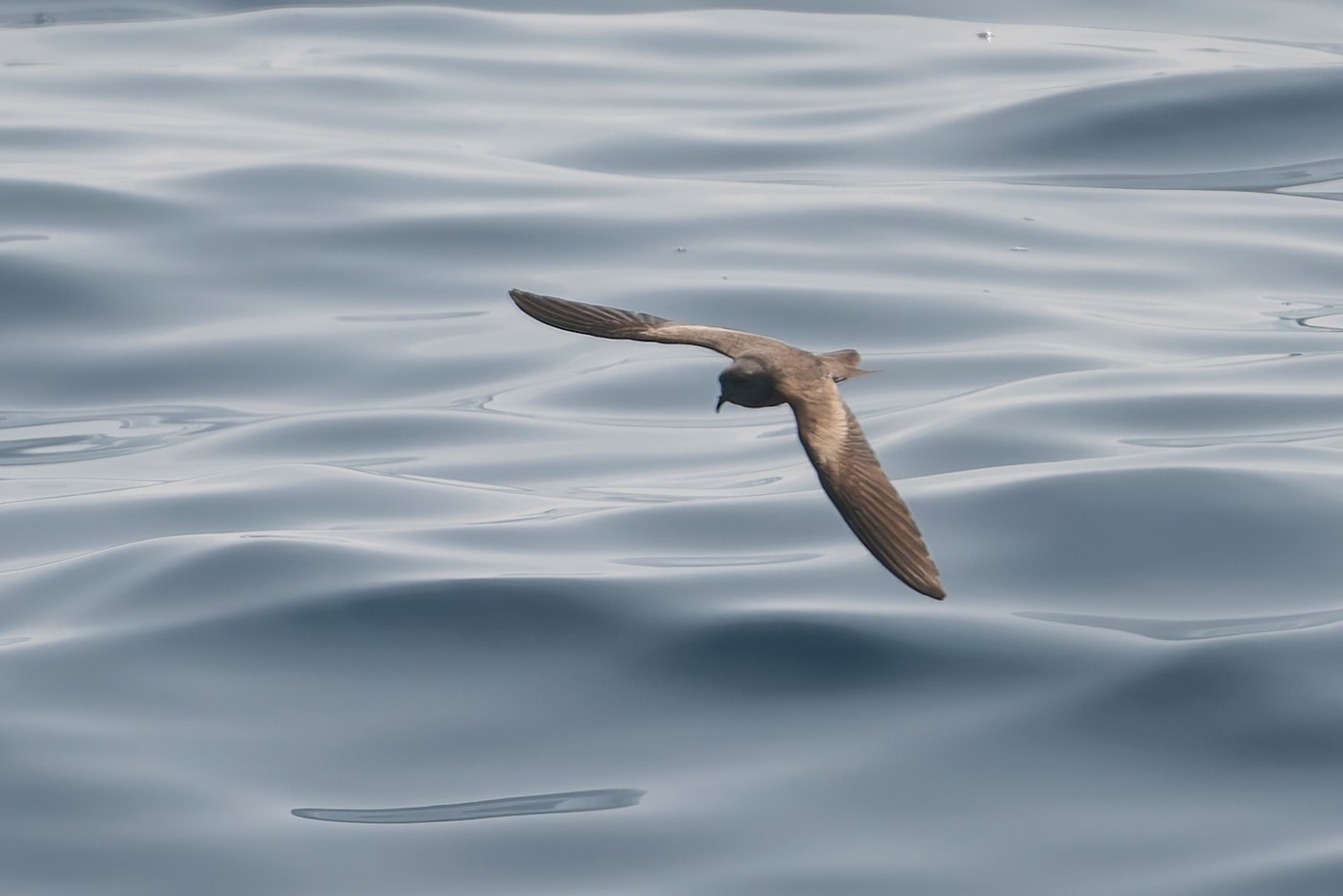
Key Field Marks
- Size & shape: A small storm-petrel about 19–22 cm (7.5–8.7 in) long with a wingspan around 45–48 cm (18–19 in); long, angled wings, a forked tail, and a moth-like, buoyant flight.
- Plumage: Overall sooty-brown to blackish body with a paler brownish-gray diagonal bar across the upperwing coverts; the rump is white but often divided by a faint dark central line (variable, sometimes appearing all-dark in some populations/morphs), unlike the solid white rump of many other storm-petrels.
- Tail: Distinctly forked tail, visible in good views and a key difference from the square-tailed Wilson's Storm-Petrel.
- Flight: Erratic, bounding, and buoyant flight with deep, floppy wingbeats and frequent changes of direction and speed, often veering and zigzagging low over the water — quite different from the fluttering, direct flight of Wilson's Storm-Petrel.
- Behavior: Almost entirely pelagic outside the breeding season, feeding on small fish, squid, and plankton picked from the surface; nests colonially in burrows on offshore islands, visiting colonies only at night.
Separating It From Similar Species
- Wilson's Storm-Petrel: Has a square (not forked) tail, direct fluttering flight with feet often visible trailing beyond the tail and sometimes pattering on the water, and a solidly white rump wrapping around onto the undertail.
- Band-rumped Storm-Petrel: Similar dark plumage and forked tail but flight is more direct and less erratic than Leach's, with a broader, more solidly white rump band and different wingbeat pattern.
- Ashy Storm-Petrel and other dark-rumped storm-petrels: Lack any white rump patch at all, appearing uniformly dark, unlike Leach's variable but usually at least partly white rump.
Where & When to See It
- Range: Breeds on remote islands in the North Atlantic and North Pacific, including islands off Newfoundland, Maine, Alaska, and British Columbia; winters widely at sea in tropical and subtropical waters of the Atlantic and Pacific.
- Habitat: Entirely pelagic away from breeding sites, favoring deep offshore waters; nests in burrows dug into soil on grassy or forested offshore islands free of mammalian predators.
- Season: Present at breeding colonies from spring through early fall, visiting nesting burrows only after dark to avoid predators; otherwise ranges far offshore, best seen on dedicated pelagic boat trips.
Voice & Song Cues
- Silent at sea; at nesting colonies at night gives an eerie, chattering, purring call often described as a series of chuckling notes ending in a sharp "chi-ka" or "tuk-a-tuk," typically heard from within or near the burrow.
Frequently asked questions
How do I tell Leach's Storm-Petrel from Wilson's Storm-Petrel at sea?
Leach's has a forked tail and erratic, bounding flight with deep wingbeats, while Wilson's has a square tail, more direct fluttering flight, and often trails its feet beyond the tail or patters them on the water surface.
Does Leach's Storm-Petrel always have a white rump?
Most individuals show a white rump, though it is often divided by a thin dark central line, and some populations or individuals can show reduced or nearly all-dark rumps, so rump pattern alone should be combined with tail shape and flight style.
Where can I see a Leach's Storm-Petrel?
Since it is almost entirely pelagic away from its nesting islands, the best way to see one is on an organized boat trip well offshore; at breeding colonies it only visits its burrow after dark, making onshore observation very difficult.
What does Leach's Storm-Petrel sound like at its colony?
At night near nesting burrows it gives an eerie, chattering, purring call that often ends in a sharper 'chi-ka' note, audible from within the burrow or as birds fly in after dark.
Why is Leach's Storm-Petrel's flight described as erratic?
It flies with deep, floppy wingbeats and frequent, unpredictable changes in direction and speed, giving a bounding, moth-like flight pattern that differs noticeably from the steadier flight of many other storm-petrels.