
Le Conte's Sparrow Identification Guide
A tiny, secretive grassland sparrow with a strikingly bright orange face and finely streaked nape, more often detected by its insect-like song than seen.
Read the full Le Conte's Sparrow encyclopedia entry →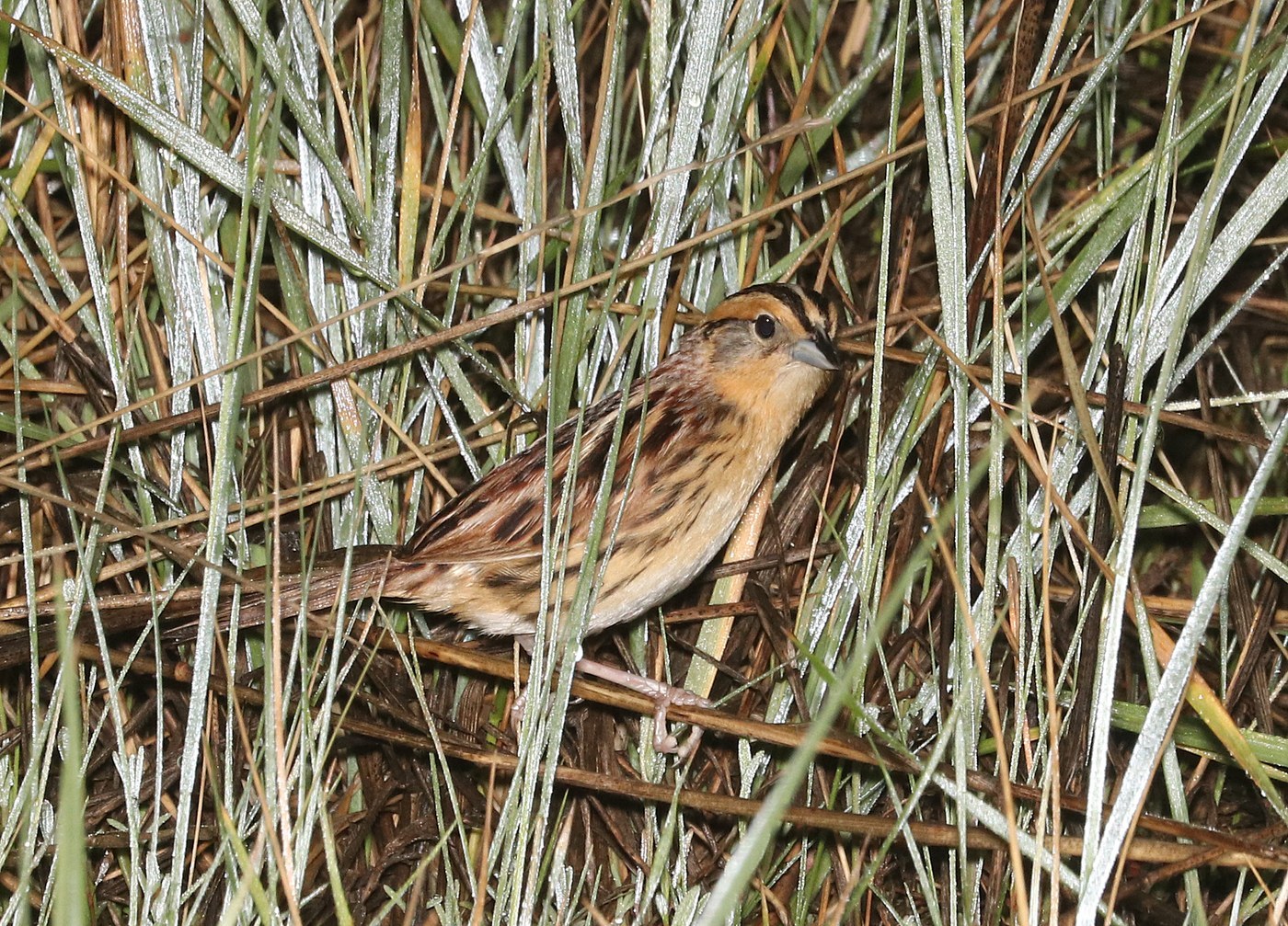
Key Field Marks
- Size & shape: One of the smallest North American sparrows, about 11–13 cm (4.3–5 in), with a flat head, short tail, and a somewhat large-billed, delicate appearance.
- Plumage: Bright orange-buff face and breast frame a gray central crown stripe and grayish ear patch outlined in a thin dark line; the nape shows fine lavender-gray and chestnut streaking (sometimes called "scaly" nape); back is boldly streaked black, chestnut, and buff (a striped, "tiger-backed" look); underparts are cleanly orange-buff on the breast fading to white on the belly, with fine streaking confined to the flanks.
- Bill & legs: Small, pale pinkish bill; pale pinkish legs.
- Behavior: Extremely skulking, favoring dense grass and sedge where it runs on the ground like a mouse rather than flying; when flushed, flies low and drops back into cover quickly, making prolonged views difficult.
Separating It From Similar Species
- Nelson's Sparrow: Also orange-faced, but Nelson's has a much more diffusely blurred (not sharply gray-and-chestnut) nape pattern, less contrasting back streaking, and a grayer, less "tiger-striped" overall look; the two can hybridize where ranges overlap near the Great Lakes.
- Grasshopper Sparrow: Has a plain, unstreaked buffy breast and a flatter, more uniformly buffy face without the sharp gray-orange facial contrast of Le Conte's.
- Savannah Sparrow: Larger, with a streaked breast, a notched tail, and yellowish supercilium rather than the extensive rich orange face of Le Conte's.
Where & When to See It
- Range: Breeds across the northern Great Plains and prairie provinces of Canada into the western Great Lakes region; winters in the southeastern and south-central United States.
- Habitat: Dense, damp grasslands, wet meadows, sedge marshes, and old fields with a thick grass mat — prefers moister, denser grass than many other grassland sparrows.
- Season: Present on breeding grounds from May through August; migrates to wintering grounds by October, returning north in April–May.
Voice & Song Cues
- Song is a very brief, thin, insect-like buzz — often rendered as "tika-zzzzzz-tik," so high, faint, and short that it is easily mistaken for a grasshopper or other insect and overlooked entirely.
- Rarely calls conspicuously outside of song; best located by patient listening in appropriate grassy habitat at dawn.
Frequently asked questions
What is the best field mark for identifying a Le Conte's Sparrow?
Look for a tiny sparrow with a bright orange-buff face, a gray central crown stripe, and a nape finely streaked with gray and chestnut, combined with a boldly striped back.
How do I distinguish Le Conte's Sparrow from Nelson's Sparrow?
Le Conte's shows a sharply contrasting gray-and-chestnut streaked nape and a more crisply patterned, tiger-striped back, while Nelson's Sparrow has a more diffuse, blurry nape pattern and softer overall markings.
Why is Le Conte's Sparrow so hard to see?
It is extremely secretive, preferring to run through dense grass like a mouse rather than fly, and when flushed it typically flies only a short distance low to the ground before dropping back into cover.
What habitat should I search to find Le Conte's Sparrow?
Search damp, dense grasslands, wet meadows, and sedge marshes with a thick grass mat, since it favors moister and denser vegetation than many other grassland sparrows.
What does Le Conte's Sparrow sound like?
Its song is a very short, thin, buzzy insect-like trill, often overlooked because it closely resembles the sound of a grasshopper rather than a typical bird song.