
Lawrence's Goldfinch Identification Guide
A small, gray-and-yellow finch of dry California and Baja California habitats, the least common and most nomadic of the three North American goldfinches.
Read the full Lawrence's Goldfinch encyclopedia entry →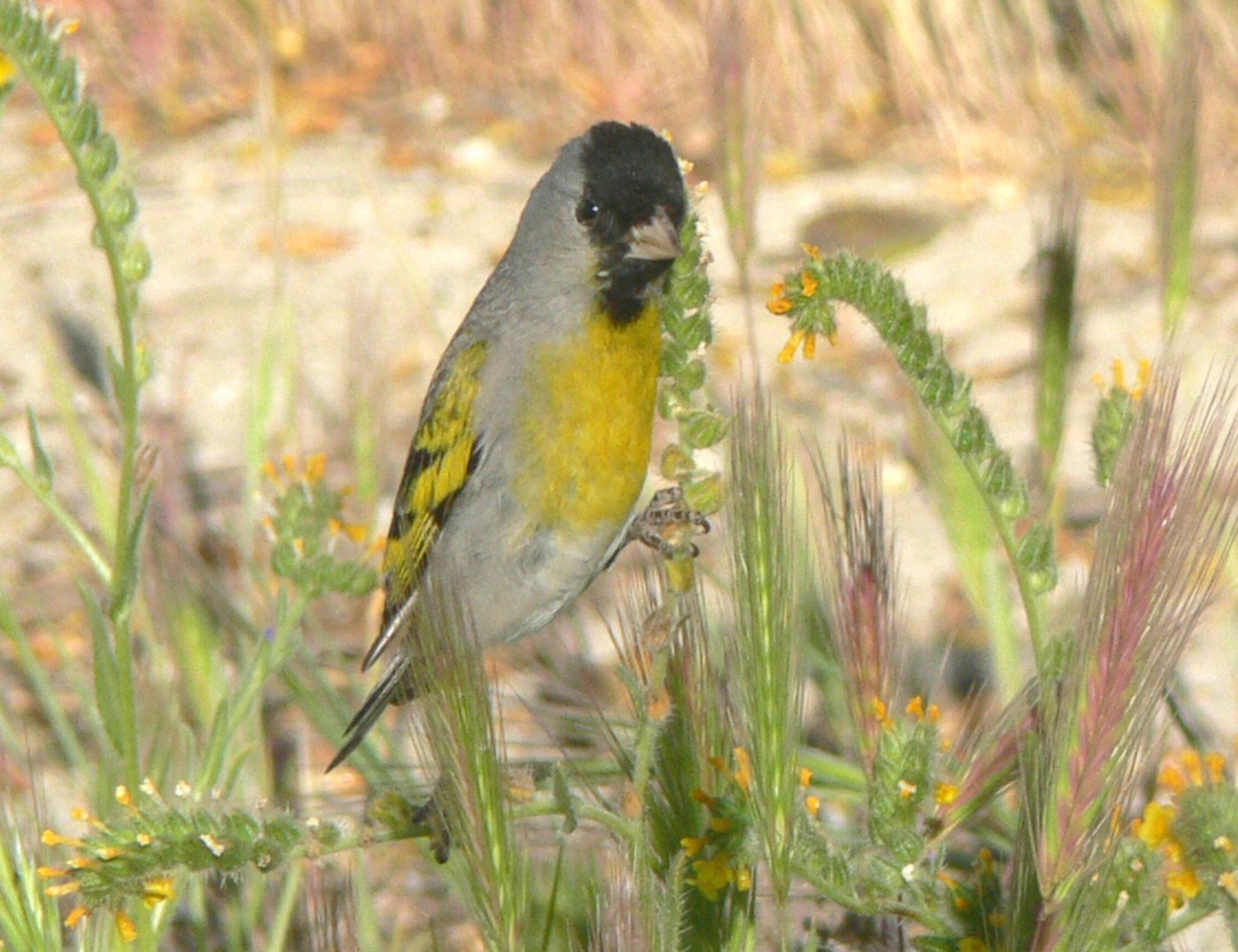
Key Field Marks
- Size & shape: A small finch, about 11–12 cm (4.5 in), with the typical compact goldfinch body, short conical bill, and notched tail.
- Male: Soft gray head, back, and flanks with a bold black face and forecrown patch; bright yellow patches on the breast, wing bar, and rump area; black wings show two pale wing bars and yellow edging on the flight feathers.
- Female: Duller and grayer overall, lacking the black face, but retains yellow tinges on the breast and wing edges along with the same gray body tone.
- Bill: Pale, pinkish-gray, distinctly stubby conical bill typical of goldfinches, adapted for extracting small seeds.
- Behavior: Highly nomadic and erratic in occurrence, often in small flocks; forages on the ground and in low shrubs for seeds, especially fiddleneck and other native annuals; frequently visits water sources in arid habitat.
Separating It From Similar Species
- American Goldfinch: Breeding male American Goldfinch is bright yellow overall with a black cap (not full black face) and lacks the gray body tone; female American Goldfinch is duller yellow-olive, not gray.
- Lesser Goldfinch: Smaller-billed with a greenish or blackish back (depending on subspecies) and much more extensive yellow underparts; lacks the pale gray body and restricted yellow patches of Lawrence's.
- Pine Siskin: Heavily streaked brown bird with a thinner, sharper bill and yellow only in the wings and tail, quite different from the clean gray-and-yellow pattern of Lawrence's Goldfinch.
Where & When to See It
- Range: Breeds primarily in California and northern Baja California, with a range that shifts noticeably from year to year based on rainfall and seed crops.
- Habitat: Arid and semi-arid scrub, oak woodland edges, chaparral, and weedy fields near water, typically in foothill and valley habitats below about 1,200 m (4,000 ft).
- Season: Present as a breeder from spring into summer; largely withdraws from breeding areas in winter, when it becomes even more erratic and unpredictable, sometimes appearing well outside its usual range, including into Arizona and northern Mexico.
Voice & Song Cues
- Song is a bright, varied, bubbly jumble of twittering notes, often incorporating mimicked snippets of other birds' calls, delivered from a perch or in flight.
- Flight call is a distinctive bell-like, tinkling "tink-el" or "tee-yer" note, softer and more musical than the calls of American or Lesser Goldfinch, often the best clue to a bird flying overhead.
Frequently asked questions
What is the easiest way to identify a male Lawrence's Goldfinch?
Look for a small finch with an overall gray body, a bold black face and forecrown, and restricted yellow patches on the breast and wings, quite different from the mostly yellow plumage of American or Lesser Goldfinch males.
Why is Lawrence's Goldfinch hard to find some years?
It is highly nomadic, with its breeding distribution shifting year to year depending on rainfall and the abundance of preferred seed sources like fiddleneck, so it can be locally common one year and nearly absent the next.
How can I tell Lawrence's Goldfinch from a female Lesser Goldfinch by call?
Lawrence's Goldfinch gives a distinctive bell-like, tinkling flight call, softer and more musical than the sharper calls typical of Lesser Goldfinch.
Where is the best place to see Lawrence's Goldfinch?
California's dry foothill and valley regions, especially areas of chaparral, oak woodland edges, and weedy fields near water, are the most reliable places, particularly in years following good winter rains.
Does Lawrence's Goldfinch migrate?
It shows only partial, irregular migration, largely withdrawing from higher and drier breeding areas in winter and wandering unpredictably, sometimes turning up outside its core California-Baja California range.