Laughing Kookaburra Identification Guide
Australia's largest kingfisher, a heavy-billed, chunky woodland bird famous for its raucous, cackling call that sounds like manic laughter.
Read the full Laughing Kookaburra encyclopedia entry →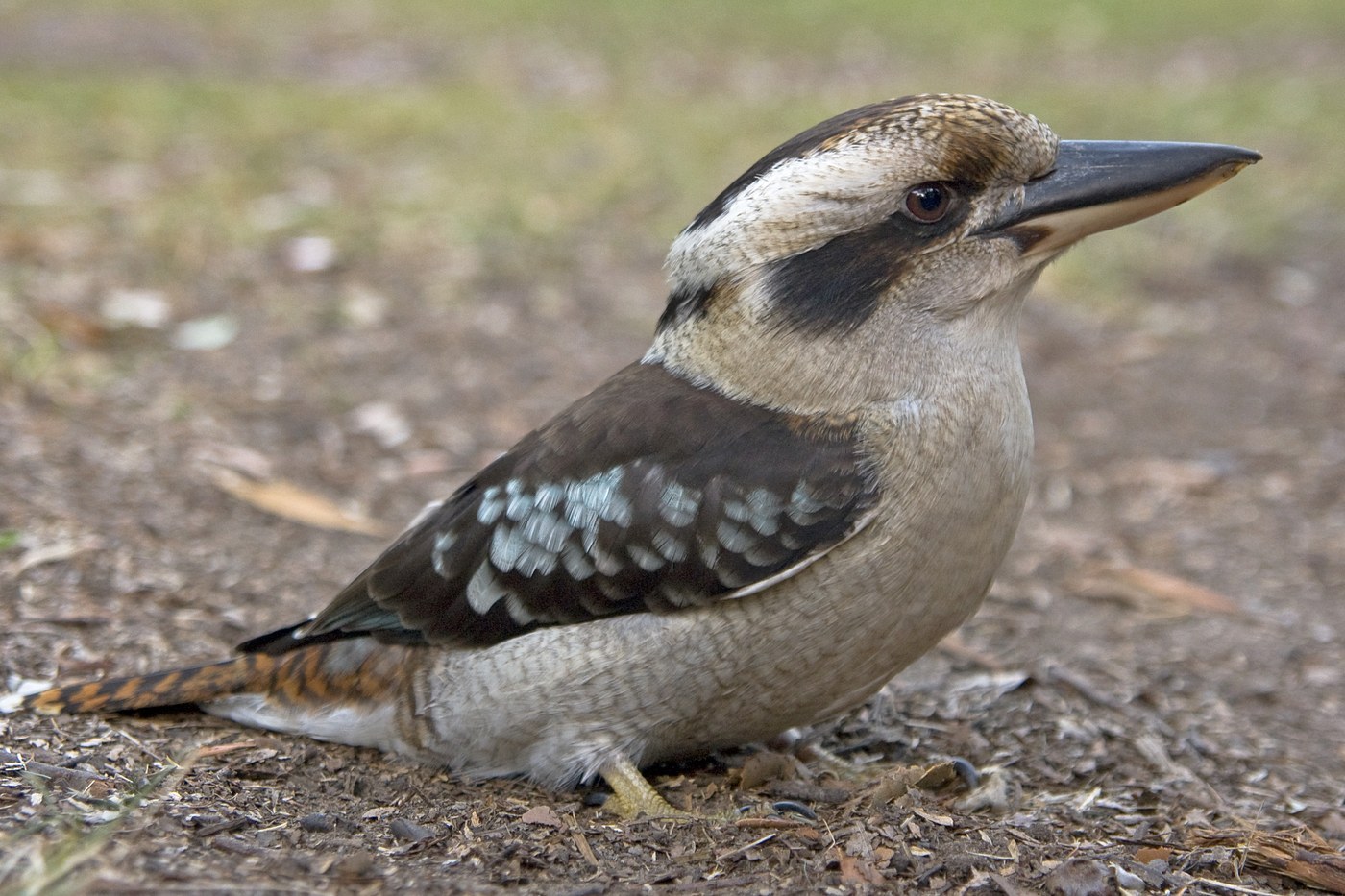
Key Field Marks
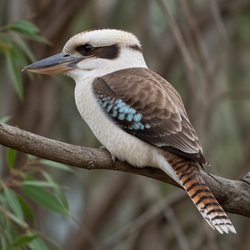
- Size & shape: A large, thickset kingfisher around 40–47 cm (16–18 in) long, with an oversized head, a massive dagger-like bill, a short neck, and a relatively short tail — a stocky, top-heavy silhouette unlike typical small kingfishers.
- Plumage: Off-white to cream head and underparts with a dark brown stripe through the eye; back and wings brown with pale blue-flecked shoulder patches (more visible in males); tail rufous-brown with dark barring.
- Bill & legs: Huge, heavy blackish-brown bill with a pale lower mandible base; short, sturdy grayish legs.
- Behavior: Perches upright and still on branches, wires, or fence posts, watching the ground for prey (large insects, small reptiles, and rodents) before dropping down to snatch it; often seen in small family groups.
Separating It From Similar Species
- Blue-winged Kookaburra: Found in northern Australia and New Guinea, has a more extensively blue tail and blue wing patches, lighter overall streaking on the crown, and a different, more strangled/harsher laughing call.
- Other Australian kingfishers (Sacred Kingfisher, Forest Kingfisher): All are far smaller and more brightly blue-green above, lacking the Laughing Kookaburra's huge bill and dull brown plumage.
- No other bird in its range approaches its bulk and massive bill combined with brown-and-cream plumage, making confusion unlikely once size is judged.
Where & When to See It
- Range: Native to eastern Australia; introduced and now established in southwestern Australia, Tasmania, and New Zealand.
- Habitat: Open eucalypt woodland, forest edges, parks, golf courses, and suburban gardens with mature trees — highly adaptable to human-modified landscapes.
- Season: Resident and non-migratory year-round; pairs and family groups (kookaburras often help raise young cooperatively) defend permanent territories.
Voice & Song Cues
- Its call is one of the most recognizable bird sounds in the world: a loud, echoing, cackling laugh that starts with low chuckling notes and builds into a wild, maniacal crescendo, often performed as a chorus by several family members at dawn and dusk to proclaim territory.
Frequently asked questions
Is the Laughing Kookaburra really a kingfisher?
Yes, it is the largest member of the kingfisher family, though unlike most kingfishers it rarely eats fish, instead hunting large insects, reptiles, and small mammals from a perch.
How do you tell a Laughing Kookaburra from a Blue-winged Kookaburra?
The Blue-winged Kookaburra, found in northern Australia and New Guinea, shows much more blue in the tail and wing coverts and gives a harsher, more strangled call, whereas the Laughing Kookaburra has a mostly rufous-brown tail and the classic rollicking laugh.
Why does the Laughing Kookaburra call so much at dawn and dusk?
The loud group laughing calls serve as territorial announcements, with family members often chorusing together to advertise ownership of their patch of woodland to neighboring groups.
Where can I see Laughing Kookaburras outside Australia?
They were introduced and are now established in New Zealand and on parts of the Australian mainland outside their native eastern range, such as southwestern Australia and Tasmania.
What habitat is best for finding Laughing Kookaburras?
Open eucalypt woodland and forest edges are prime habitat, but they are also very common in parks, gardens, and suburban areas with tall trees, often approaching people for food.
Laughing Kookaburra identified by the community
Recent Laughing Kookaburra sightings identified with Bird Identifier.