
Laughing Falcon Identification Guide
A large, big-headed raptor of Central and South American woodlands, best known for its loud, laughing yelps and its habit of perching motionless for long periods before dropping on snakes.
Read the full Laughing Falcon encyclopedia entry →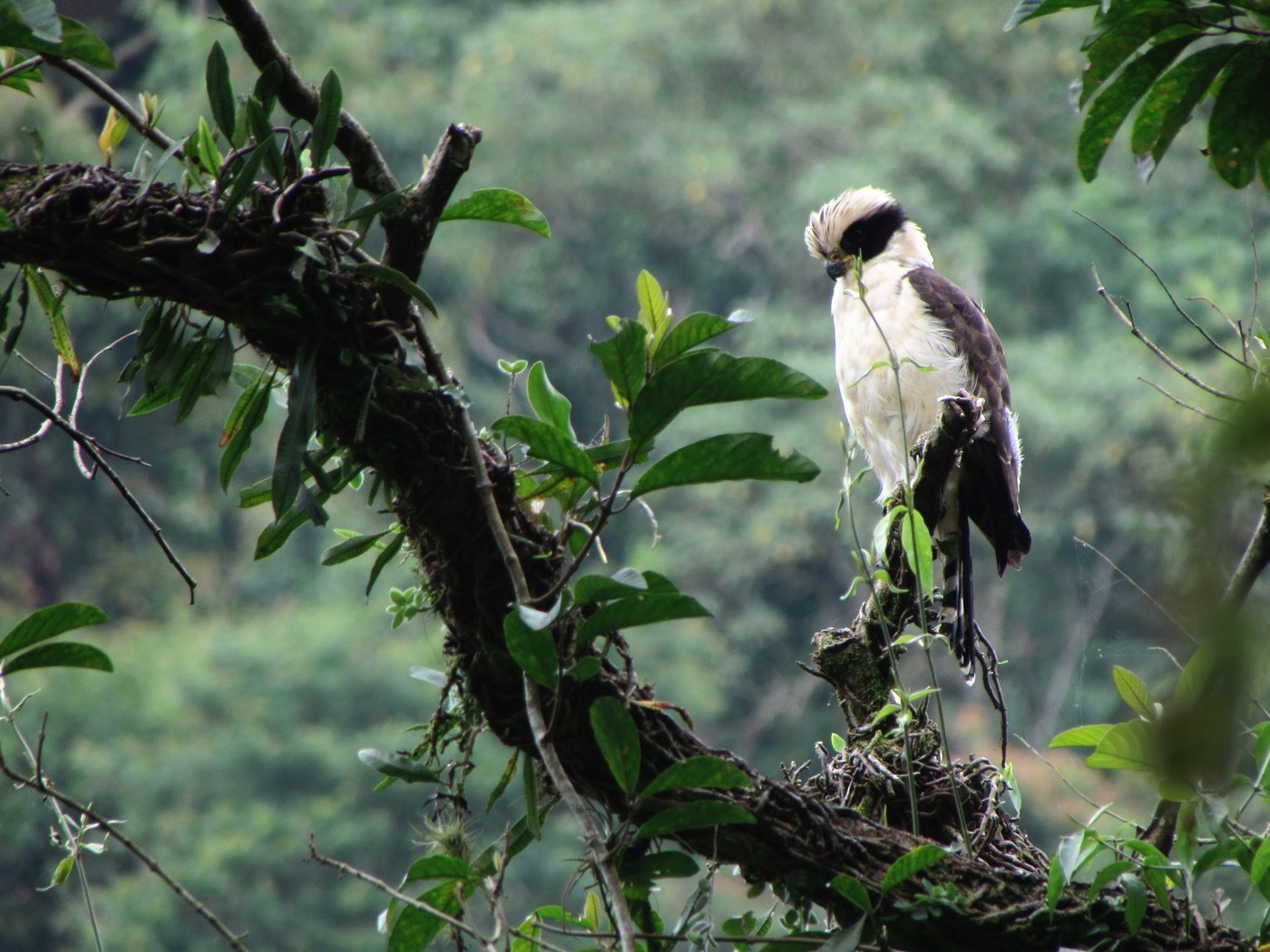
Key Field Marks
- Size & shape: A stocky, big-headed falcon roughly 45–56 cm (18–22 in) long, with a large owl-like head, short broad wings, and a long, strongly barred tail — proportions unlike any other New World falcon.
- Plumage: Creamy buff to whitish head, neck, and underparts contrast with a bold black "bandit mask" running through the eye around the back of the head. The upperparts are dark brown to blackish, and the tail shows crisp black-and-white (or black-and-buff) bands.
- Bill & legs: Heavy, hook-tipped grayish bill; short, thick legs adapted for gripping and killing snakes, its primary prey.
- Behavior: Sits upright and still on an exposed snag or wire for long stretches, scanning the ground — very unfalcon-like, more like a large hawk or even a raptor crossed with a shrike in posture. Often solitary or in pairs.
Separating It From Similar Species
- Bat Falcon and Aplomado Falcon: Both are far slimmer, longer-tailed, and streamlined with typical falcon proportions; the Laughing Falcon's oversized head and black facial mask are distinctive at a glance.
- Barred Forest-Falcon: Slimmer, long-tailed, forest-interior species with fine barring below, lacking the pale head and black mask.
- Roadside Hawk or other buteos: Buteos have rounded wings and different flight silhouette; Laughing Falcons show a heavier head-to-body ratio and the diagnostic mask.
Where & When to See It
- Range: Resident from Mexico south through Central America into much of South America, including the Amazon basin, ranging as far as northern Argentina.
- Habitat: Forest edges, gallery woodland, savanna with scattered trees, and second growth — prefers semi-open country over dense unbroken forest.
- Season: Non-migratory and present year-round throughout its range; pairs hold permanent territories.
Voice & Song Cues
- Named for its far-carrying call: a loud, rhythmic series of "wah-co, wah-co" or "gwa-gwa-gwa" notes that can build into a cackling, laughing duet between paired birds, often given at dawn or dusk and audible over great distances — frequently the first clue to its presence before it is seen.
Frequently asked questions
Why is it called the Laughing Falcon?
It gets its name from its loud, far-carrying call, a rhythmic series of yelping notes that can build into a cackling, laugh-like duet, especially at dawn and dusk.
What makes the Laughing Falcon's shape unusual for a falcon?
Unlike sleek, pointed-winged typical falcons, it has an oversized, owl-like head, short broad wings, and a long banded tail, giving it a heavier, hawk-like silhouette.
What does a Laughing Falcon eat, and how does that affect identification?
It specializes in snakes, which is why it is so often seen perched motionless and upright on an exposed snag scanning the ground, a behavior that helps distinguish it from more active falcons.
How can I tell a Laughing Falcon from a forest-falcon?
Forest-falcons are slimmer with fine barring below and lack the pale buffy head and bold black facial mask that wrap around the back of the Laughing Falcon's head.
Is the Laughing Falcon migratory?
No, it is a non-migratory resident throughout its Central and South American range, with pairs typically holding the same territory year-round.