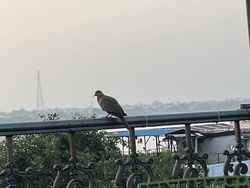
Laughing Dove Identification Guide
A small, slender dove common across Africa, the Middle East, and southern Asia, the Laughing Dove is identified by its warm pinkish-brown breast with a distinctive black-speckled necklace patch and soft, chuckling call.
Read the full Laughing Dove encyclopedia entry →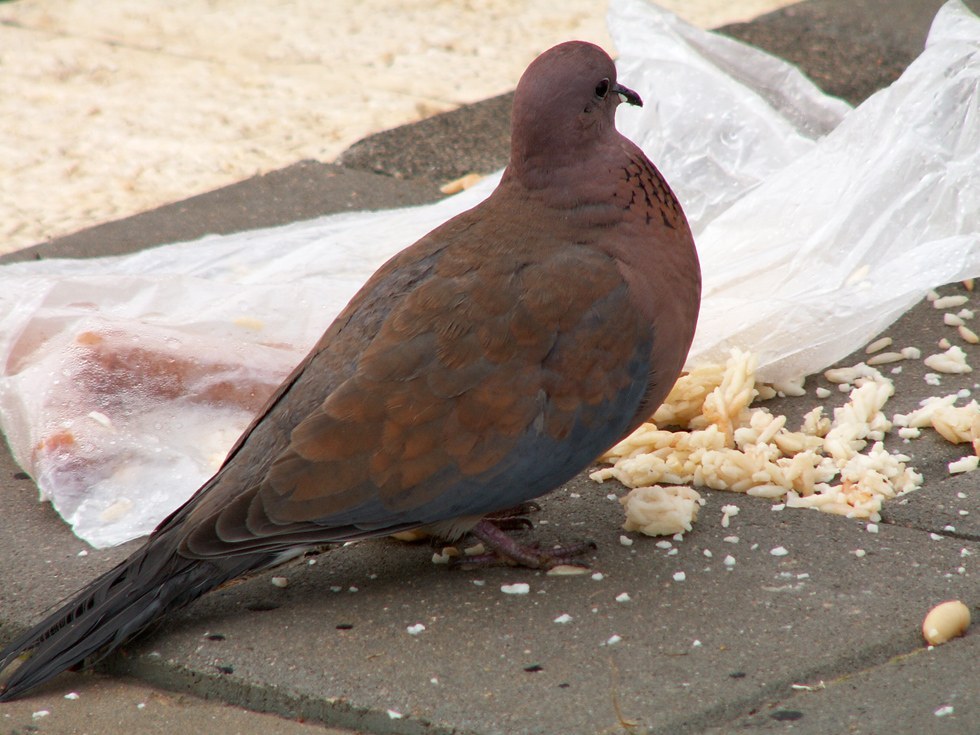
Key Field Marks
- Size & shape: A small, slim dove, about 25–27 cm long, with a fairly long, graduated tail and a small, rounded head, giving a slender, elegant silhouette compared to bulkier doves.
- Plumage: Warm pinkish-cinnamon head, throat, and breast grading to a pale grey-blue on the crown and pale buffy-white belly; back and wings are grey-brown with the wing coverts showing a subtle bluish-grey panel.
- Diagnostic mark: A distinctive black-and-rufous speckled patch (like a broken necklace) across the upper breast/lower throat, formed by small black spots on a rufous background — a key identification feature not shared by most similar doves.
- Tail: Long, graduated dark tail with white-tipped outer feathers visible in flight or when fanned.
- Behavior: Often seen foraging on the ground in pairs or small groups, walking with a bobbing head motion typical of doves; frequently found around human habitation.
Separating Laughing Dove from Similar Species
- Collared Dove (Eurasian Collared-Dove): Larger, paler grey-buff overall with a solid black half-collar around the back of the neck (not a speckled breast patch), and lacks the pinkish breast tone of Laughing Dove.
- Red-eyed Dove / Cape Turtle Dove (in Africa): Both are larger and bulkier with different collar patterns (a solid black half-collar on the nape) rather than the speckled necklace pattern on the breast shown by Laughing Dove.
- Namaqua Dove: Much smaller with a long pointed tail and a black face/throat patch in males, quite different in shape and pattern from the pink-breasted, speckle-necklaced Laughing Dove.
- The speckled black necklace-like patch on a pinkish breast, combined with small overall size and slender build, reliably separates Laughing Dove from other similarly ranged doves.
Where & When to See
- Habitat: Highly adaptable, found in savanna, farmland, semi-desert scrub, parks, gardens, and urban areas; thrives around human settlements and cultivation.
- Range: Widespread across sub-Saharan Africa, North Africa, the Middle East, and the Indian subcontinent, with introduced populations established in Australia and elsewhere.
- Season: Resident and non-migratory across virtually all of its range; visible year-round.
- Best viewing: Look on the ground in gardens, parks, farmland, and dry open country; often approachable and common around towns and villages, making it one of the easier doves to observe closely.
Voice & Sound Cues
- A soft, bubbling, chuckling series of coos, often rendered as "doo-doo-doo, du-du-du," that gives the species its common name for its laughing quality.
- The call is mellower and more musical than the harsher, more monotone cooing of Collared Dove.
- Frequently heard calling from perches in gardens or trees throughout the day, making voice a useful and often first clue to its presence.
Frequently asked questions
What is the key mark that separates Laughing Dove from other small doves?
The speckled black-and-rufous patch resembling a broken necklace across the upper breast, combined with an overall warm pinkish-cinnamon tone, is distinctive and not shown by similar doves like Collared Dove.
Why is it called the Laughing Dove?
Its soft, bubbling, chuckling cooing call has a laughing quality, which gave rise to the common name.
Is the Laughing Dove found in cities?
Yes, it is highly adaptable and commonly found in gardens, parks, farmland, and urban areas throughout its range, often quite tame around people.
How does Laughing Dove differ from Eurasian Collared-Dove?
Collared Dove is larger and paler grey-buff with a solid black half-collar on the nape, while Laughing Dove is smaller, pinker-breasted, and shows a speckled necklace patch rather than a solid collar.
Is the Laughing Dove migratory?
No, it is a non-migratory resident species throughout its range in Africa, the Middle East, and southern Asia, present year-round wherever found.
Laughing Dove identified by the community
Recent Laughing Dove sightings identified with Bird Identifier.