
Lark Sparrow Identification Guide
A boldly patterned open-country sparrow, the Lark Sparrow is identified by its striking chestnut-and-white harlequin head pattern, dark central breast spot, and rounded white-cornered tail in flight.
Read the full Lark Sparrow encyclopedia entry →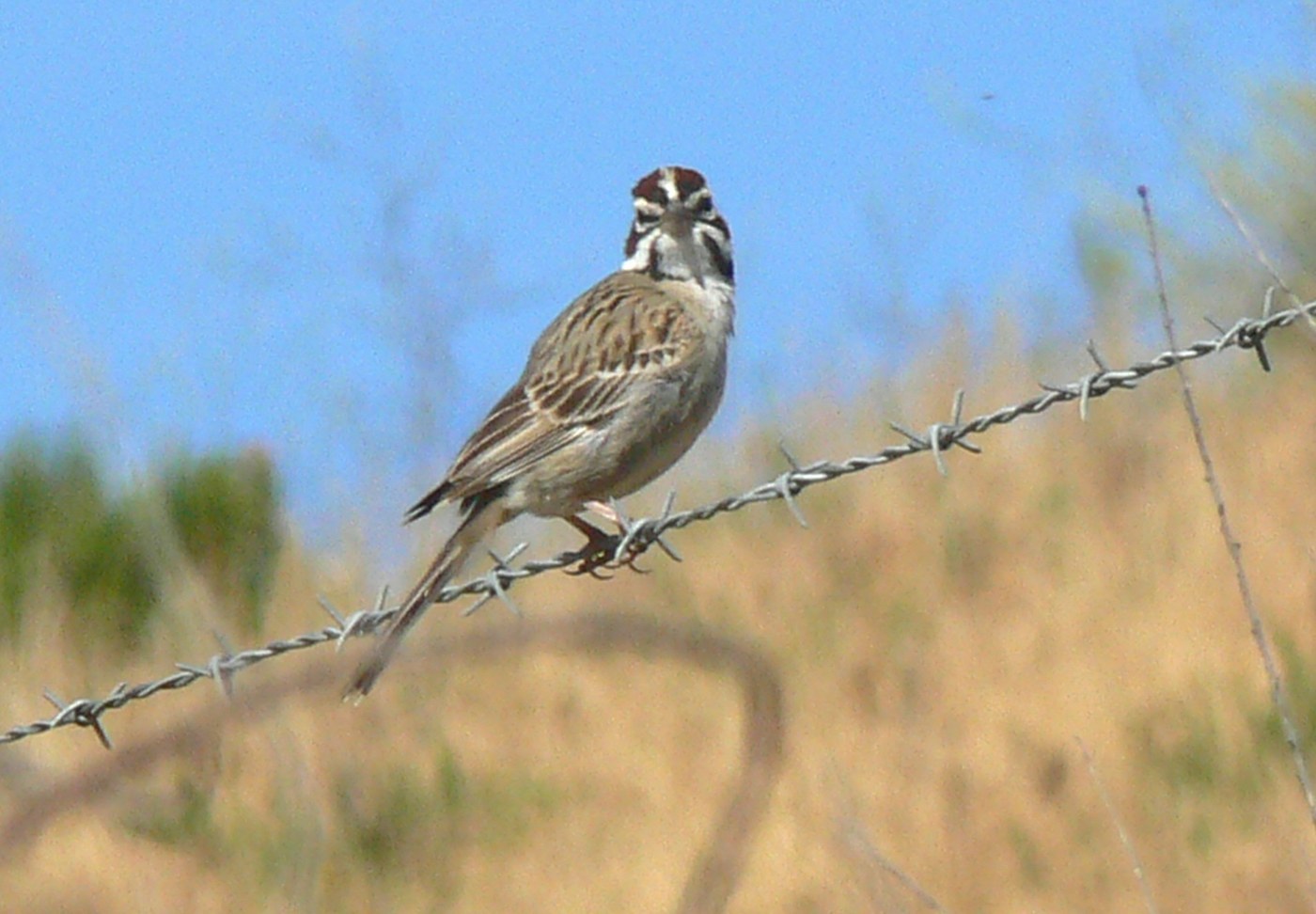
Key Field Marks
- Size & shape: A fairly large, long-tailed sparrow, about 15–17 cm long, with a relatively large head and a somewhat flat-crowned appearance, plus a notably rounded tail.
- Head pattern: Bold and distinctive — chestnut-brown crown stripes and cheek patch set off by white eyebrow and moustachial stripes, creating a striking harlequin-like "clown face" pattern unlike any other North American sparrow.
- Underparts: Clean whitish breast with a single dark central spot, contrasting with the otherwise unstreaked pale underparts (adults) — streaked juveniles can be confusing but retain the head pattern in muted form.
- Tail: Long and rounded, blackish with bold white corners visible especially in flight, giving a fan-like flash useful for identification on the wing.
- Behavior: Forages on the ground in open areas, often walking or hopping; frequently perches on fences, wires, or low shrubs; somewhat gregarious outside breeding season.
Separating Lark Sparrow from Similar Species
- Other sparrows in open habitat (e.g., Vesper Sparrow, Grasshopper Sparrow): None combine the same bold chestnut-and-white facial pattern; Vesper Sparrow has white outer tail feathers but a plainer, streakier face, while Grasshopper Sparrow is much smaller with a flat, buffy, unpatterned face.
- Chipping Sparrow / Field Sparrow (juveniles): Smaller, with plainer face patterns lacking the bold chestnut ear patch and moustachial stripes, and lacking the single central breast spot.
- Overall: The harlequin head pattern plus the single dark breast spot on an otherwise clean white breast is diagnostic and essentially unmistakable among North American sparrows once seen clearly.
Where & When to See
- Habitat: Open, dry grassland with scattered shrubs or trees, savanna, agricultural edges, and sandy or gravelly open ground; often near bare patches used for ground-foraging and dust-bathing.
- Range: Breeds across much of the western and central United States, extending into southern Canada and northern Mexico; winters in the southern United States, Mexico, and Central America.
- Season: Breeds roughly April–August; migrates and winters (roughly September–March) in warmer, more southerly regions, with some populations resident in parts of the southern range.
- Best viewing: Scan open grassy fields with scattered bushes or fence lines; watch for a sparrow perched prominently on a wire or shrub showing an obviously patterned head, or foraging on bare ground nearby.
Voice & Sound Cues
- A rich, complex song combining buzzy trills, clear whistles, and short melodic phrases, often described as more musical and varied than many other sparrow songs.
- Song is frequently delivered from an exposed perch or occasionally in a brief display flight during the breeding season.
- Call notes include a sharp "tsip" or short chip, less distinctive than the song, so song is the more useful auditory cue for confirming identification.
Frequently asked questions
What is the single best field mark for a Lark Sparrow?
The bold chestnut-and-white harlequin facial pattern combined with a single dark spot in the center of an otherwise clean white breast is unique among North American sparrows.
How can I identify a Lark Sparrow in flight?
Look for the long, rounded tail with bold white corners flashing as the bird flies, a useful mark when the head pattern is hard to see at a distance.
Do juvenile Lark Sparrows look different from adults?
Yes, juveniles show more streaking on the breast and a somewhat muted version of the adult head pattern, but the basic facial pattern is usually still discernible.
What habitat is best for finding Lark Sparrows?
Open, dry grassland with scattered shrubs, fence lines, or trees and areas of bare or sandy ground for foraging are the most productive habitats.
Is the Lark Sparrow's song useful for identification?
Yes, its rich, varied song combining trills and clear whistles is distinctive and often delivered from an exposed perch, helping confirm identification even before the bird is seen well.