
Lappet-faced Vulture Identification Guide
Africa's largest vulture is identified by its massive size, bare pink-and-red wrinkled head with fleshy skin folds ("lappets"), and broad dark wings with a bold white leg-band pattern.
Read the full Lappet-faced Vulture encyclopedia entry →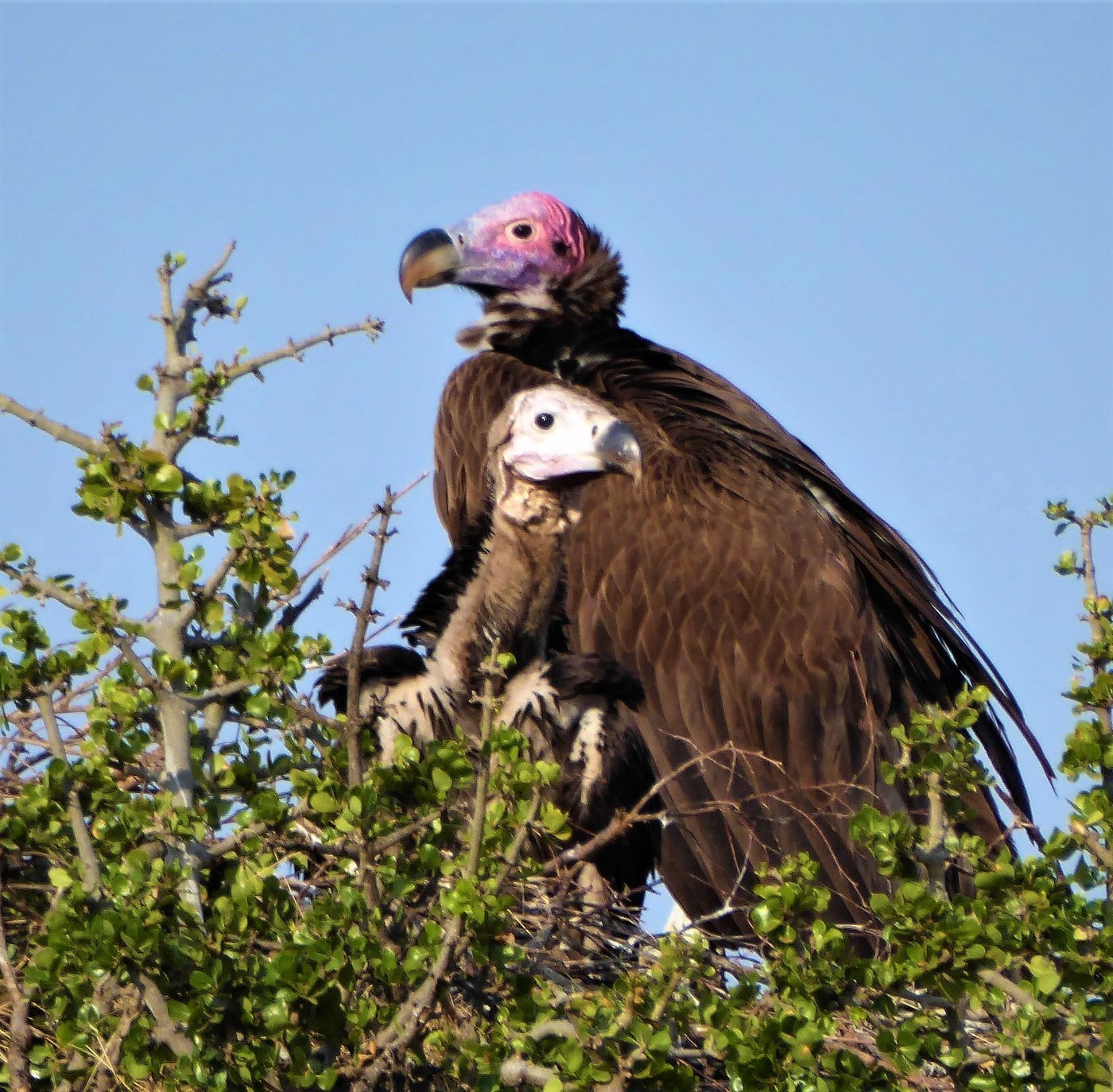
Key Field Marks
- Size & shape: The largest and heaviest African vulture, with a wingspan up to about 2.9 m and a powerful, bulky build; broad wings and a short, wedge-shaped tail give a heavy, commanding silhouette in flight.
- Head: Bare, deeply wrinkled pink-to-red skin covering the head and neck, with pendulous folds of skin ("lappets") along the sides of the neck — the source of the species' name, and a key diagnostic feature at close range or through optics.
- Plumage: Dark blackish-brown upperparts and body with a whitish band of feathers/down across the upper legs ("leggings") visible in flight, contrasting with the otherwise dark underwing.
- Bill: Massive, powerful, pale horn-colored bill, the heaviest bill of any African vulture, capable of tearing tough hide and tendons that other vultures cannot open.
- Behavior: Dominant at carcasses, often displacing other vulture species due to its size and powerful bill; frequently arrives later than smaller vultures but takes over feeding once present.
Separating Lappet-faced Vulture from Similar Species
- White-headed Vulture: Smaller, with a whitish (not pink/red wrinkled) head, pink bill base, and white belly, quite different from the Lappet-faced's larger size and pink wrinkled head.
- Griffon vultures (e.g., African White-backed, Rüppell's): Both are smaller, paler brown overall, with pale downy neck ruffs rather than bare wrinkled pink skin, and lack the heavy bill and white-leg-band pattern of Lappet-faced Vulture.
- Cape Vulture: Paler, more uniformly buffy-brown with a pale eye and less bulky build; also lacks the wrinkled pink head and white leggings.
- The combination of huge size, bare wrinkled pink head with lappets, and pale leg band is unique among African vultures and makes adult Lappet-faced Vulture readily identifiable.
Where & When to See
- Habitat: Open savanna, semi-desert, and arid plains, generally avoiding dense woodland; nests in large stick nests atop flat-topped acacia or similar trees.
- Range: Widely but thinly distributed across sub-Saharan Africa, with a small disjunct population in the Arabian Peninsula (Sinai and parts of the Middle East, now very rare there); most reliably found in large protected reserves due to population declines from poisoning and habitat loss.
- Season: Resident and non-migratory; present year-round wherever found, though individuals may range widely in search of carcasses.
- Best viewing: Scan the sky for large, dark, broad-winged soaring vultures over open plains, or check gatherings at carcasses in major East and Southern African reserves, where the Lappet-faced often stands out and dominates smaller vulture species.
Voice & Sound Cues
- Largely silent away from the nest and carcasses, like most vultures.
- At feeding sites, gives low hisses, grunts, and guttural growling notes when competing with other vultures for access to a carcass.
- Bill-snapping and hissing displays are used to intimidate other scavengers rather than true vocal song, so identification relies primarily on visual features rather than calls.
Frequently asked questions
What is the easiest way to identify a Lappet-faced Vulture?
Its very large size combined with a bare, deeply wrinkled pink-to-red head and neck and a pale band across the upper legs in flight are the most distinctive and reliable field marks.
How does it differ from other African vultures at a carcass?
It is noticeably larger and bulkier with a much heavier bill than griffon-type vultures, and its bare wrinkled pink head lacks the pale downy neck ruff typical of species like African White-backed Vulture.
Why is this species dominant at carcasses despite arriving later?
Its massive size and exceptionally powerful bill allow it to tear tough skin and tendons other vultures cannot access, letting it displace smaller vultures once it arrives.
Where does the Lappet-faced Vulture nest?
It builds large stick nests on top of flat-topped trees such as acacias in open savanna habitat, typically nesting solitarily rather than colonially.
Is the Lappet-faced Vulture common?
No, it is considered endangered with a declining population due to poisoning, habitat loss, and reduced food availability, so sightings are generally scarce even within its range.