
Lanner Falcon Identification Guide
A powerful, mid-sized falcon of Africa and Eurasia, the Lanner is identified by its pale rufous crown, grey-brown back, and swift, direct flight typical of large falcons.
Read the full Lanner Falcon encyclopedia entry →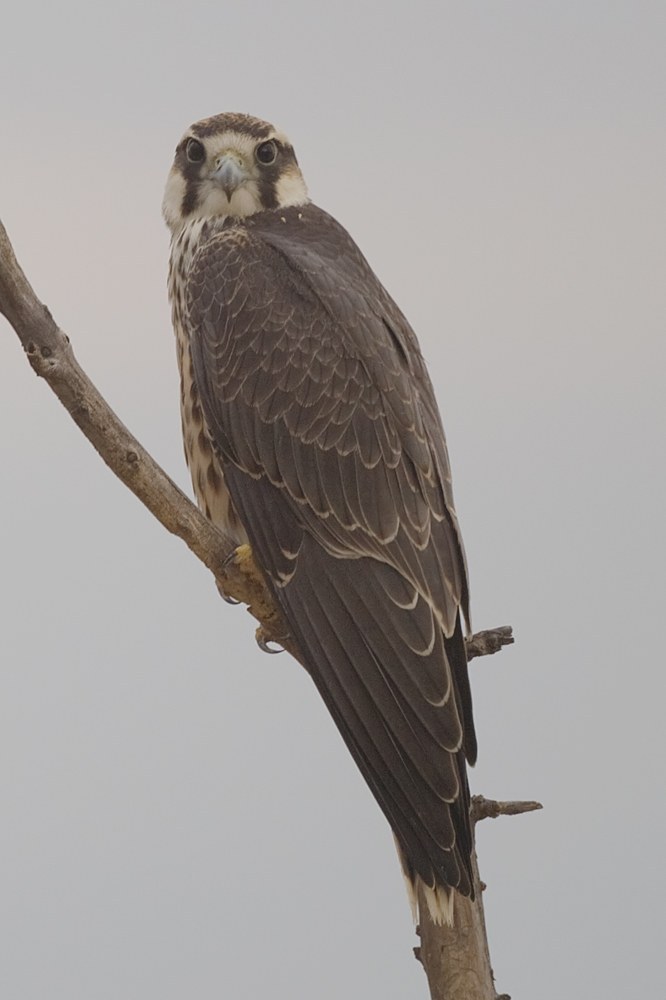
Key Field Marks
- Size & shape: A large falcon, about 43–50 cm long, with a heavier build than Peregrine Falcon but proportionally longer tail and slightly less pointed wings; broad-shouldered and powerful in flight.
- Plumage: Adults show a pale rufous to chestnut crown and nape contrasting with a grey-brown back, and creamy to pale buff underparts with light streaking or spotting, less heavily marked than many other falcons.
- Face: A relatively thin, less extensive black malar (mustache) stripe compared to Peregrine Falcon, and a pale, sometimes whitish forehead and supercilium.
- Juveniles: Browner overall with heavier streaking below and a less defined rufous crown, which develops with maturity.
- Flight: Fast, powerful, and direct with stiff wingbeats; hunts in swift low pursuits or high stoops, often working in pairs to flush and catch prey, including cooperative hunting of birds in flight.
Separating Lanner Falcon from Similar Species
- Peregrine Falcon: Peregrine has a bolder, broader black malar stripe, a dark (not rufous) crown, and more heavily barred underparts; Lanner's pale rufous crown and thinner mustache mark are the key differences.
- Saker Falcon: Larger and paler overall with a less contrasting head pattern and broader-based wings; ranges overlap in parts of the Middle East and Central Asia, where Saker's larger size and paler, more uniform tone help separate it from the smaller, more rufous-capped Lanner.
- Barbary Falcon: Smaller and more compactly built, often considered a subspecies/relative of Peregrine, with a more Peregrine-like face pattern than Lanner's paler, thinner-mustached look.
- Overall, the pale rufous crown against a grey-brown back is the most useful mark distinguishing Lanner from other similarly sized falcons across its range.
Where & When to See
- Habitat: Open country including savanna, semi-desert, farmland, cliffs, and mountainous terrain; frequently nests on cliff ledges or in old stick nests of other raptors on trees or pylons.
- Range: Widespread across most of Africa (outside dense rainforest and deep desert), the Middle East, and parts of southeastern Europe through to Central and South Asia; largely resident but with some local/altitudinal movements.
- Season: Present year-round across most of its range, with breeding typically in the dry season in Africa.
- Best viewing: Scan open plains, escarpments, and cliff faces; look for a falcon perched on a prominent rock, pylon, or dead tree, or hunting low and fast over open ground, sometimes in pairs.
Voice & Sound Cues
- A harsh, repeated "kek-kek-kek" or "wray-wray-wray" cackling alarm call near the nest site, similar in structure to other large falcons but slightly higher-pitched and more strident than Peregrine.
- Generally quiet away from breeding cliffs; vocal activity increases sharply when defending nest sites from intruders.
- Pairs may duet with overlapping calls during courtship and territorial displays in early breeding season.
Frequently asked questions
What's the quickest way to tell Lanner from Peregrine Falcon?
Look at the crown and mustache: Lanner has a pale rufous crown and a thinner, less bold black malar stripe, while Peregrine has a dark crown and a broad, heavy black mustache mark.
Does the Lanner Falcon hunt differently from Peregrine?
Both are fast aerial hunters, but Lanners more frequently hunt cooperatively in pairs, using low, coursing flight to flush prey, in addition to high stoops.
Where does the Lanner Falcon nest?
It typically nests on cliff ledges, but will also use old stick nests built by other raptors or corvids in trees or on pylons in open habitat.
Is the Lanner Falcon migratory?
Most populations are largely resident with only local or altitudinal movements, unlike some other falcon species that undertake long-distance migration.
How do juvenile Lanner Falcons differ from adults?
Juveniles are browner with heavier streaking on the underparts and a less distinct rufous crown, which becomes cleaner and more colorful as the bird matures.