
Lammergeier Identification Guide
Also called the Bearded Vulture, this massive mountain raptor is identified by its diamond-shaped tail, orange-washed underparts, black facial "beard," and long, narrow, falcon-like wings.
Read the full Lammergeier encyclopedia entry →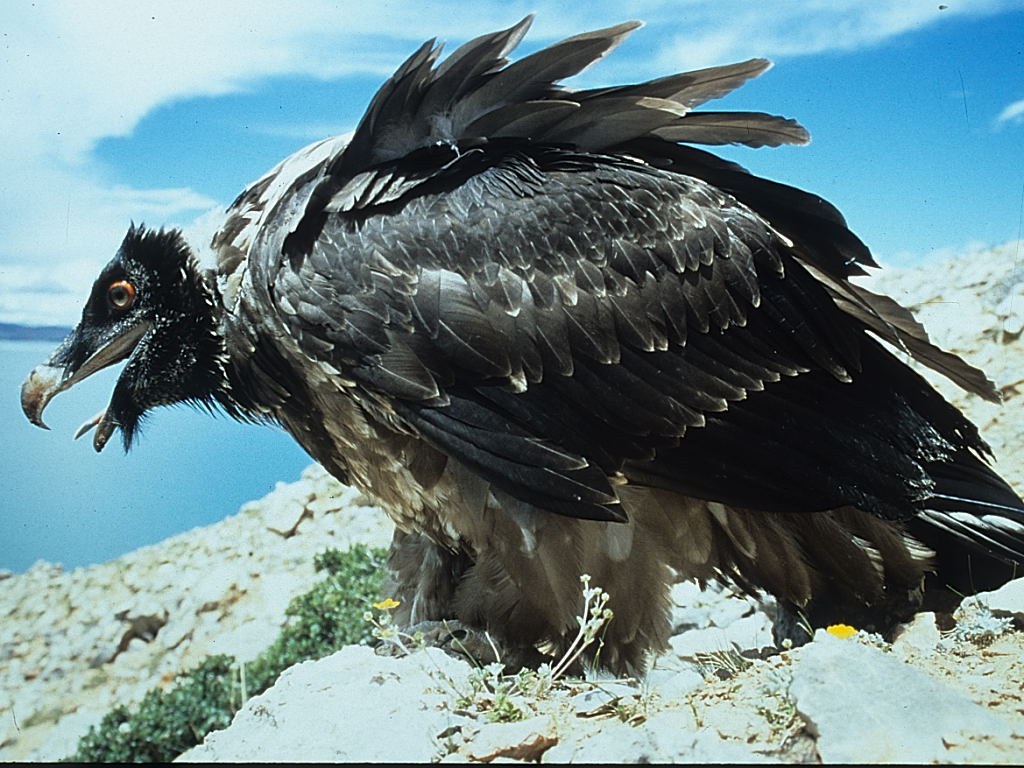
Key Field Marks
- Size & shape: A huge raptor with a wingspan of up to about 2.3–2.8 m; distinctive long, narrow, pointed wings and a long, wedge-shaped (diamond-shaped) tail unlike the rounded or fan-shaped tail of typical vultures.
- Plumage: Adults show a pale creamy to orange-rufous head, neck, and underparts (the orange tone comes from deliberate dust-bathing in iron-rich soil), with dark grey-black upperwings and back; juveniles are much darker, sooty brown overall, taking around 5–7 years to reach full adult plumage.
- Head: Distinctive black bristly feathers forming a "beard" under the bill, plus a black mask through the eye; unlike true vultures, the head is fully feathered, not bald.
- Flight silhouette: Soars on flat or slightly bowed wings, with the long wedge tail and slim wings giving a cross-like, almost falcon- or harrier-like profile at a distance rather than the broad, fingered-wing silhouette of griffon vultures.
- Behavior: Famous for dropping bones from height onto rocks to smash them for the marrow, a major part of its diet; soars for long periods over mountain terrain.
Separating Lammergeier from Similar Species
- Griffon Vulture and other Old World vultures: These have broad, rounded, "fingered" wings, short fan-shaped tails, and bald or downy heads/necks — very different from the Lammergeier's narrow wings, long wedge tail, and fully feathered head.
- Golden Eagle: Similar mountain range and soaring habits, but Golden Eagle has a shorter, rounded (not wedge-shaped) tail and lacks the orange wash and black beard.
- Egyptian Vulture: Much smaller, with a white body and black flight feathers and a bare yellow face, quite distinct from the Lammergeier's larger size and diamond tail.
- The unique wedge-shaped tail combined with huge size and narrow wings makes adult Lammergeiers essentially unmistakable once seen well.
Where & When to See
- Habitat: High mountains and rugged, remote cliffs and gorges, typically foraging over alpine and subalpine terrain, from around 1,000 m up to over 5,000 m elevation.
- Range: Patchily distributed across mountain ranges of southern Europe (Pyrenees, Alps — reintroduced, Balkans, Crete), the Caucasus, Middle East, Central Asia, the Himalayas, and East and southern Africa (including the Ethiopian Highlands and Drakensberg).
- Season: Resident and non-migratory in most areas, though immature birds may wander more widely; visible year-round where present, but populations are small and localized, requiring dedicated searching in known strongholds.
- Best viewing: Scan high mountain skylines and cliff faces from viewpoints in known range areas (e.g., Pyrenees, Drakensberg, Ethiopian Highlands, Himalayan foothills), especially around bone-dropping sites ("ossuaries") on flat rock slabs below cliffs.
Voice & Sound Cues
- Generally a silent species away from the nest; rarely vocalizes in flight.
- Around nesting cliffs, may give thin, high-pitched whistling calls between mates or to fledglings.
- Identification in the field relies almost entirely on visual cues (silhouette and plumage) rather than voice, given how infrequently it calls.
Frequently asked questions
What is the single most reliable field mark for a Lammergeier?
The long, wedge-shaped (diamond) tail combined with narrow, pointed wings gives a unique silhouette unlike any other vulture, which have rounded fan-shaped tails and broad fingered wings.
Why do adult Lammergeiers look orange?
Adults deliberately bathe in iron oxide-rich mud or dust, staining their naturally pale cream feathers a rusty orange color; the underlying feathers are actually whitish.
How do juveniles differ from adults?
Juveniles are almost entirely dark sooty brown all over and lack the pale head and orange wash, gradually acquiring adult plumage over five to seven years.
Is it true this species eats bones?
Yes, bone marrow makes up a large part of its diet; it carries bones aloft and drops them onto rocky slabs to shatter them, then swallows the fragments and extracts marrow with its tongue.
Where is the best place to see a Lammergeier?
Reliable areas include the Pyrenees and Alps in Europe, the Ethiopian Highlands, the Drakensberg in southern Africa, and parts of the Himalayas, where dedicated viewpoints near cliffs offer good sighting chances.