
Kori Bustard Identification Guide
One of the heaviest flying birds alive, the Kori Bustard is identified by its huge size, grey-and-black crested head, finely vermiculated grey back, and slow, stately walk across African grasslands.
Read the full Kori Bustard encyclopedia entry →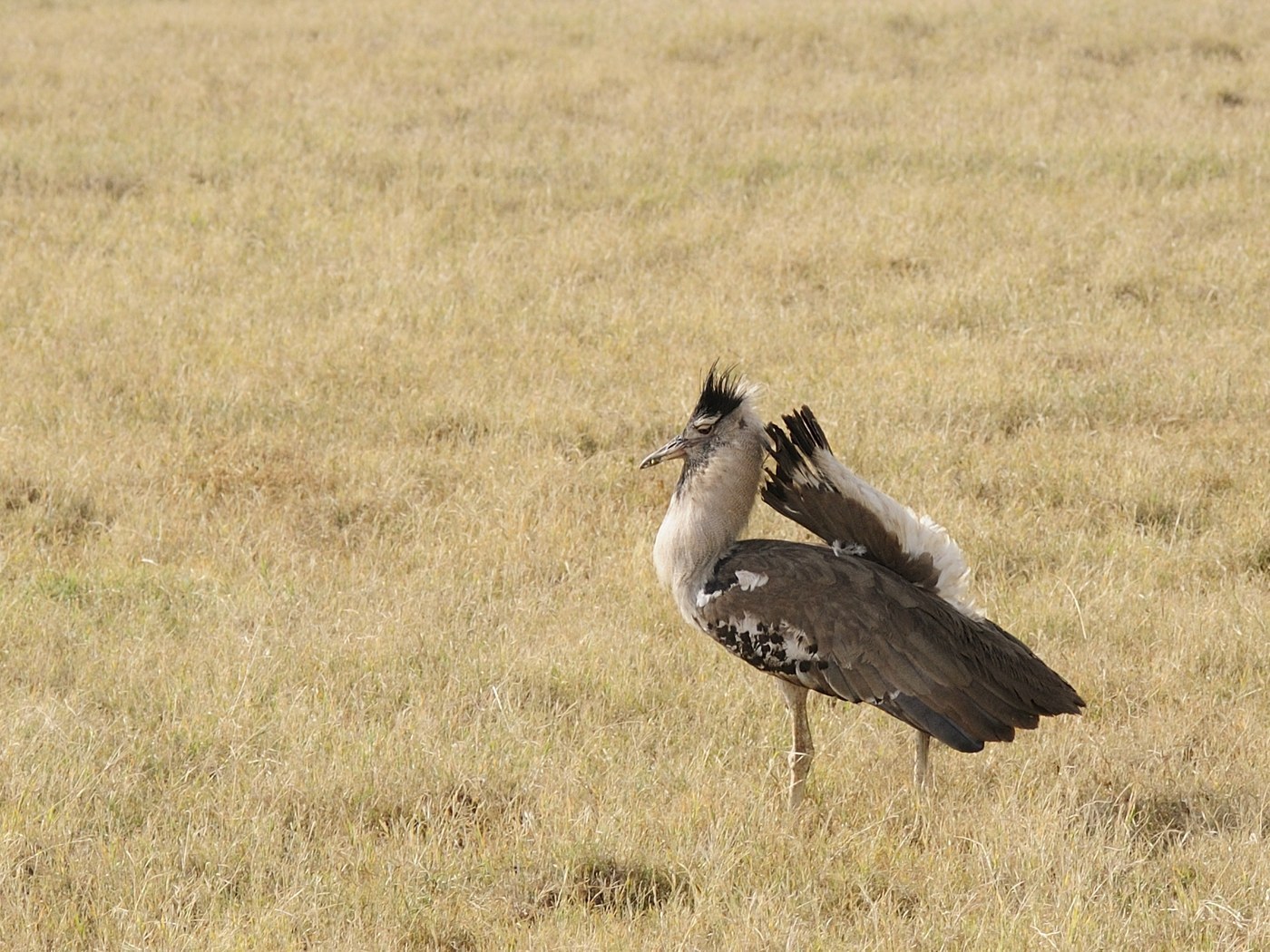
Key Field Marks
- Size & shape: Enormous and heavy-bodied — among the heaviest flying birds in the world, standing up to about 1.2–1.4 m tall with males noticeably larger and heavier than females; long neck, long sturdy legs, and a horizontal, ground-hugging posture.
- Plumage: Finely vermiculated grey upperparts giving a subtly barred appearance at close range, white underparts, and a black-and-white patterned neck and crown.
- Head: Pale grey with a shaggy blackish crest that can be raised, and a black line through/around the eye.
- Bill & legs: Stout, straight, pale bill; long, thick, yellowish-grey legs built for extensive walking rather than perching.
- Behavior: Walks slowly and deliberately across open ground foraging for insects, small reptiles, and seeds; reluctant to fly, preferring to walk away from disturbance, and taking off only with a heavy, labored run-up when necessary.
Separating Kori Bustard from Similar Species
- Other African bustards (e.g., Denham's/Stanley's Bustard, White-bellied Bustard): All are noticeably smaller and slimmer than Kori Bustard; Kori is by far the bulkiest bustard across most of its range, with a distinctly grey (not warm brown) vermiculated back.
- Secretarybird: Superficially also a large, long-legged ground bird of similar habitat, but Secretarybird is slimmer, has long black leg "pants," a raptor-like hooked bill, and dramatic head plumes quite different from the Kori's shaggy crest.
- Ground hornbills: All-black or black-and-white plumage with a heavy curved casqued bill readily separates ground hornbills from the grey, straight-billed Kori Bustard.
- The combination of massive size, grey vermiculated back, and slow walking gait is generally diagnostic within its range.
Where & When to See
- Habitat: Open, dry grassland, savanna, and semi-arid scrub with scattered trees; avoids dense woodland and tall grass.
- Range: Widespread across sub-Saharan Africa, from East Africa (Kenya, Tanzania) south through Zambia, Botswana, Namibia, and South Africa, plus parts of West and Southern Africa; generally in protected savanna reserves due to habitat loss and hunting pressure elsewhere.
- Season: Resident, though some populations show local movements tied to rainfall and food availability; present year-round in most protected areas.
- Best viewing: Scan open grassland plains during game drives in East and Southern African reserves; look for a large, pale grey shape standing well above the grass, often near recent burns or short-grass areas.
Voice & Sound Cues
- Generally silent for most of the year; the most notable vocalization is the male's deep, resonant booming call given during display.
- Displaying males inflate the throat, raise and fan the tail over the back, droop the wings, and give low booming notes to attract females — an impressive and diagnostic breeding display.
- Alarm and contact calls are otherwise infrequent, so visual identification (size, posture, plumage) is usually more useful than voice.
Frequently asked questions
Is the Kori Bustard really one of the heaviest flying birds?
Yes, large males can weigh up to around 18–19 kg, making the species one of the heaviest birds capable of sustained flight, though they fly infrequently and prefer walking.
How do I tell a Kori Bustard from a Secretarybird at a distance?
Secretarybird is slimmer with long black 'trouser' feathers and a raptor-like face, while Kori Bustard is bulkier overall with an evenly grey, finely vermiculated body and a shaggy crest rather than head plumes.
Why does the Kori Bustard rarely fly?
Its large body mass makes flight energetically costly, so it prefers walking to forage and only flies when necessary, taking off with a long, heavy run-up.
What does the male's display look like?
Displaying males inflate their throat pouch, fan their tail up over the back, droop the wings to the ground, and give deep booming calls to attract mates.
What habitat should I search for Kori Bustard?
Open grassland and savanna with short grass and scattered trees, typically in East and Southern African game reserves, offer the best chances of finding this species.